
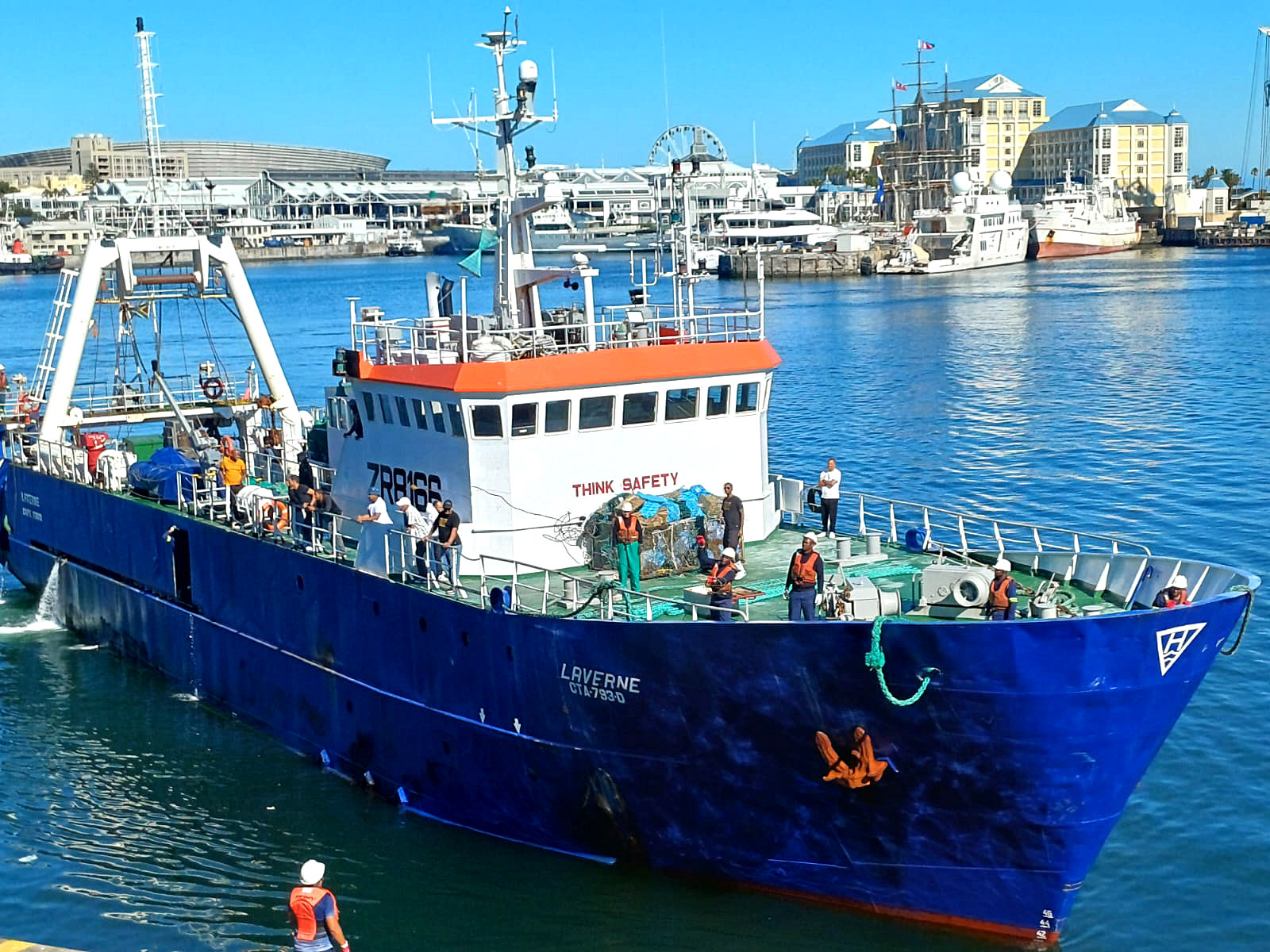
 The Laverne trawler owned by Viking Fishing. (Photo: Tim Reddell)
 /file/attachments/2985/TroubledWaters_405609.jpg)
Tim Reddell has spent more than four decades in South Africa’s fishing industry, rising from industrial engineer to managing director of Viking Fishing, a division now part of Sea Harvest. Viking operates trawlers, processing facilities, and aquaculture ventures, and has built its success on both hard-won quota acquisitions and the difficult realities of South African fisheries governance. Reddell has also chaired the South African Deep-Sea Trawling Industry Association (Sadstia) multiple times, giving him a front-row view of the struggles and politics that shape the sector.
In conversation, he blends pragmatism with frustration. He is proud of South Africa’s world-class fisheries science, but critical of how government systems have decayed since the 1980s. He believes the quota system, while imperfect, is the only thing stopping the tragedy of the commons. He is sceptical of how Marine Protected Areas (MPAs) are imposed, and he has clear ideas on what he would ask the new Minister of Forestry, Fisheries and the Environment, Willie Aucamp. Above all, he insists that the future of fishing here will be defined less by expansion than by survival and value-adding.
Tim, let’s start with your background. How did you come into this industry?
I trained as an industrial engineer at Stellenbosch. My first job was with I&J as an engineer, and over time I worked my way up to chief operating officer. After disagreements with shareholders, I left and started my own company – really a bundle of smaller operations: Hangberg Trawling Fishing, Quayside Fish Suppliers, Sentinel Seafoods and others. Eventually I partnered with Nico Bacon, and together we consolidated those quotas into Viking Fishing. Every quota Viking has, we bought – never granted. That’s important, because it shows the scale of investment and risk involved.
/file/attachments/2985/TimReddell_947304_9a30c3b3582338aa0228de2b439ad7ef.jpg "Tim Reddell.")
You’ve been in fishing for over 40 years. How has the industry changed?
Scientifically, it’s stronger now. We have people like Professor Doug Butterworth, who I think is one of the best fisheries mathematicians in the world. Our models and data are second to none. But, paradoxically, the reporting systems and government administration were better in the 1980s and 1990s. South Africa has simply declined in many state functions: roads, utilities, fisheries systems – it’s the same pattern. Other countries like Poland have moved ahead while we’ve gone backwards.
And the stocks themselves? Are we overfishing?
No. If you look at hake, for example, the Total Allowable Catch (TAC) fluctuates. Every time it creeps above 150,000 tonnes, you know within a few years it will come down again. Then it stabilises and climbs back up. That cycle has been consistent throughout my career. We’re not running out of fish – the science and the system keep us in check. The same with horse mackerel: we thought it had collapsed, but it turned out to be an availability issue, and the stock recovered.
So the quota system works?
It has to. Everyone – from the biggest companies to the smallest entrants – wants more fish. But the resource is finite. If you allow open access, you’ll collapse the stocks. So yes, quotas are imperfect, but they’re the only thing preventing a tragedy of the commons.
The real problem is in implementation. The government handed out 15-year rights, with the idea that after three years there would be audits – checking whether the rights-holders had invested in boats, factories and jobs as they promised. That hasn’t happened. Instead, you get “paper quota holders” who sit on rights without deploying them, while genuine operators shoulder the costs.
Many smaller operators feel the system disadvantages them.
I sympathise, but reality is reality. The little guys were granted quotas without having to pay for them. Many haven’t built the infrastructure to use them. If you want to enter this industry today, you either need to buy an existing quota or form a joint venture. That’s what Viking has done for decades. You can’t just conjure new fish from the sea.
What about the endless litigation around quotas?
It’s a mess. If someone feels they didn’t get enough quota, they litigate. The government, fearful of court action, tries to broker compromises – usually by taking fish away from someone else. That leads to constant appeals and uncertainty. What we need is a robust process with no mistakes, and a government with the courage to defend its decisions. Otherwise ,we’re in perpetual limbo.
You’ve argued for converting quotas into property rights. How would that work?
Think about a house. You buy it, you get a title deed, you can sell it or use it as security for a loan. In South Africa, quotas are 15-year rights, not property. That means you can’t use them as collateral. If I go to a bank wanting to buy a trawler worth R100-million, they ask: What happens if your rights aren’t renewed? They won’t lend.
In places like Australia, quotas are property rights – percentages of the Total Allowable Catch that can be bought, sold or mortgaged. That creates real security and liquidity. I would have converted our quotas at the last allocation: 50% granted outright, 25% via application, and 25% sold by government. Then you’d have a functioning market instead of political horse trading.
Would you push that reform if you had Willie Aucamp’s ear?
Yes. I’d tell him bluntly: turn quotas into tradable property rights. That would unlock investment, reduce litigation and give banks confidence to fund vessels and factories. Without it, we’re stuck in cycles of contestation.
/file/attachments/2985/IJfishingboatUmlobiFreepik_751904_619f7da890fc3a8e3f9676e93bf08443.jpg "The I&J fishing boat Umlobi. (Photo: Freepik)")
Let’s talk Marine Protected Areas. How do you see them?
They’re new here – only in the last few years. The problem is how they’ve been imposed. On paper, MPAs cover less than 2% of our Exclusive Economic Zone. But that’s misleading, because we don’t fish the whole zone. For smaller operators like Viking, nearly 40% of our traditional grounds are now closed off.
I’m not saying MPAs are all bad. Mistakes happen – like when one was poorly geotagged on a seamount where vessels accidentally strayed over the line. That’s been corrected now. But the bigger issue is evidence: there’s no solid proof that MPAs here have boosted fish stocks.
We’ve even done controlled trials, leaving grounds dormant and testing them years later, with little difference. Scientists will argue otherwise, of course. It depends who you ask.
What about the role of poaching and organised crime?
There’s a lot of noise around that. My view is that the real crisis is nearshore: abalone, rock lobster, shellfish. There, poaching is rampant and enforcement is weak. Offshore, in 300 metres of water, I don’t think illegal trawling is a big issue. All our vessels carry tracking systems; fisheries knows exactly where we are. If foreign boats showed up in our grounds, we’d notice.
Do you see scope for growth in the industry?
Not in catching more fish. The resource is capped. Growth comes from value-adding: processing fish into loins, fingers, crumbed products – turning commodity into retail. That’s where jobs and margins are.
Would you advise a young entrepreneur to enter the industry now?
Honestly, no. If you want a job working for an established company, fine. But if you dream of starting a new Viking today, it’s impossible. Everything is locked up. The only way in is to buy someone out, which requires huge capital and the right empowerment credentials.
And the future — what will the South African fishing look like in 20 years?
The status quo. I don’t see dramatic changes up or down. The hake resource will stay in the same band, managed scientifically. The big opportunities lie in fixing nearshore fisheries like lobster and abalone, where proper enforcement could restore resources. But overall, this is not an industry of expansion any more – it’s about defending what we have and adding value.
Closing thoughts
Tim Reddell represents the pragmatic heart of South African commercial fishing: deeply experienced, fiercely protective of science and sustainability, but weary of government inefficiency and political games. His call to turn quotas into property rights is radical in the local context, but rooted in international practice. Whether anyone in the government will listen is another matter.
If his forecast is right, the next two decades will be less about catching more fish than about doing more with what South Africa already has. DM
Tomorrow
Deon van Zyl: “We’re crippled by government inefficiency.”
Previously
Setting up the series: Untangling South Africa’s fishing industry