



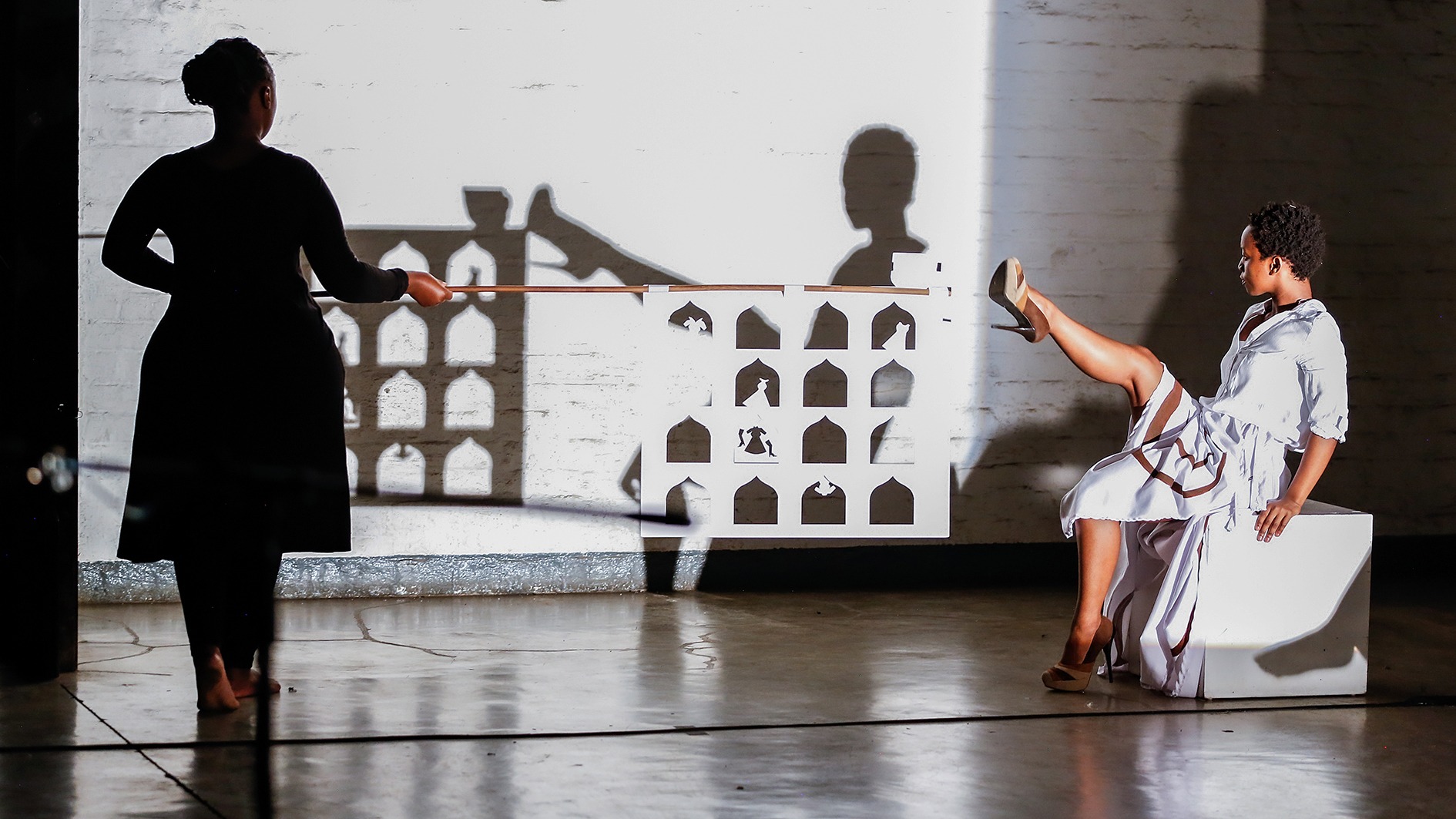
 Meet Me Between Tehran and Mbabane, 2023. (Photo: Zivanai Matangi)
Movement necessitates change. The act of travelling to different places with new contexts shifts our ways of seeing and engaging with the world, and influences our understanding of the places we’ve journeyed from. This is true of artists, too. In addition to training, collaboration and exploration, an artist’s practice is deeply affected by the places in which they live and work.
The artist Nava Derakhshani has, over the years, worked across ceramics, performance, photography, video and installation, moving from architectural studies to artistic practice.
Born in southern Africa to Iranian parents, Derakhshani has lived, studied and worked in cities including Cape Town, Mbabane, Gaborone, Johannesburg and New York, where she has recently completed her MFA at Hunter College.
***
David Mann: You’ve moved across architecture, photography, collage, performance and now ceramics and sculpture. What has remained constant for you across all these shifts, what is the conceptual thread that runs through your work?
Nava Derakhshani: For me, the impulse has been around art making through material exploration, and the seeking of joy through the specific medium. Clay, for example, is a grounding material that requires patience and attentiveness from the maker.
I wanted to become a master thrower, and that requires dedicated, meditative attention. I cannot throw well on days when I have had an argument, for example. The act of repetition for mastery is very attractive to me and is part of the artistic process and growth of an artist.
I had the privilege of making a number of iterations of my performance piece with new collaborators, and this contributed to the work’s evolution with the input of my collaborators’ expertise. I see materials as tools to accomplish the art that I am seeking; the more tools I have in my box, the more freedom I have to make new work.
At the same time, there are thematic throughlines in all of my work.
Studying architecture at the University of Cape Town gave me a spatial understanding of the remnants of apartheid’s segregation in Cape Town and the deep injustices perpetuated on the city scale.
My investigation into my family’s migration stories highlighted the traumas my parents and their peers endured. Their exile was bequeathed to me, placing me in a constant state of yearning for the unattainable. Critical engagement with my inherited Orientalisms, the mediation of second-hand access to a forbidden homeland, and the inevitable romanticising and distortion that comes through this mitigated translation of culture. I think this is a common experience in the Global Diaspora and is something I grapple with in my art: a longing for belonging that just can’t be.
Themes along lines of gender are always present with me, from playfully poking fun at global patriarchies or exploring themes of beauty and self-expression. The South African discourse on feminism, and through a diasporic Persian and Iranian lens, is a part of me.
/file/attachments/orphans/DetailfromtheGoldenSamovarinstallation_NavaDerakhshani_532799.jpg "Detail from the Golden Samovar installation. (Photo: Courtesy of Nava Derakhshani)")
DM: You often speak about a sense of yearning in your work, especially around place and identity. What does distance, from South Africa, from home, give your practice? And do you think your work would look different if you were based somewhere like Tehran or Eswatini?
ND: Being in New York, I identify as a double immigrant, responding to the language they use here as a “first” or “second-generation” migrant. It’s interesting being here because the discourse is centred on New York, the USA, and there is hardly room for thinking of Africa or Southwest Asia and North Africa as a centre, or the centre, or even of local cultures as central. It asked me for a lot of adaptation to translate my positionality in this context.
I feel critical of the Global North’s pervasive role in geopolitics, while still choosing to situate myself here. It seems to be a leap to decentre global whiteness. I think of The Curio Shop, presented by the Asian American artists collective Godzilla in 1993. The show was a direct response to stereotypes of Chinese/Asian tropes, through an uncomfortable leaning into and exaggerating of stereotypes associated with Asians by using the motif of a Chinatown souvenir store.
For me, this is still centred on a dominant North American POV, rather than focusing on peripheral cultures as central. On the other hand, the discourse I come from in South Africa is a rejection of a peripheral status and a focus on our perspective as not only important, but central. My use of the Farsi language, therefore, is inherently subversive. My South African style of collaboration is less individualistic and was about the input of the artists that I was working with, to make something amazing together.
I was at the Guggenheim recently to see Rashid Johnson’s show. He leans deeply on what he refers to as black identity markers, such as shea butter, black wax and soap, and African tropes such as masks and zebra skins, the wilderness, and the occasional guest feature of Persian carpets in his “black yoga” pieces. I think it’s interesting how tropes of identity are uncomfortably exaggerated or simplified in the diaspora, and how our positionality lends itself to a removed sensibility and a longing for something that is simply unattainable, in an effort for place-making in the places we exist.
I can’t imagine the kind of work I would make in Tehran because it simply is not an option for me. When I look at artists in the country, their political response is one of subversion and deceit as they negotiate a deeply censored and monitored art space, using the gallery to make statements that unfold over time to reveal hidden meanings, because they have to submit government proposals for their shows.
We can look at similar examples of art made by artists in Africa, where the use of materials and gestures is embedded in a framework of understanding within the culture and place. El Anatsui’s use of bottle tops, or his cargo canvases, for example.
They make so much sense to me, while they also translate into the Western gaze, where there is an emphasis on materiality. Marshall McLuhan’s The Medium is the Message still holds strongly in a contemporary art space. And I think if I were making art in Eswatini, it would be material-heavy, responding to the geography and climate of my birthplace.
/file/attachments/orphans/DetailsfromGoldenSamovarinstallation_NavaDerakhshani_899875.jpg "Details from Golden Samovar installation. (Photo: Photo courtesy of Nava Derakhshani)")
DM: The way you use light often turns viewing into a kind of performance – the audience has to move around the work to engage with it. I’m thinking of the Golden Samovar from your time at Hunter. Could you talk about that piece, and how your practice shifted while you were there?
ND: It’s interesting to use these two works as a comparison: one is, as you say, devotional and memorial in nature, the other is satirical, cynical and humorous. They both speak to gender, but in drastically different tones and media.
The light sculpture emerged from my performance piece involving light and shadow. I was still deeply moved by a feminist uprising in Iran and the diaspora following the state murder of Jina Mahsa Amini, combined with the discovery of Hunter’s laser cutter.
I started making cutouts with the machine from photos documenting graffiti in Iran at the time. City walls became sites for revolutionary messages, which were routinely cleaned or marked out by the authorities, only to be rewritten, censored again and then rewritten again. This became a public dialogue of repression and defiance, written and rewritten over and over again by an unruly public, and witnessed on the internet. I used the graffiti wall texts, with their dripping, spray-painted, handwritten lines, to make luminous objects. This was an act that refused their censorship in Iran, by effusing their words on the other side of the planet.
This was the power of diaspora in that unusually unified moment. For a while, almost all Iranians were united and in a deep solidarity with one another. While those in Iran were being suppressed, the diaspora was amplifying their stories and creating massive momentum internationally, with huge protest marches, where one in Berlin amounted to approximately 100,000 people who travelled in bus-fulls from around the region.
My Baha’i upbringing fed me stories of a feminist figure, Tahirih, who boldly unveiled herself in a public gathering in 19th-century Persia. Named “The Pure One”, her act was deeply unsettling to her pious peers, and her message was clear: the time for women’s equality is now.
To me, the young women burning their headscarves in Tehran, in circles reminiscent of witch fables, girls holding hands, one covered and another with her long, thick hair on her back, reminded me of Tahirih and the power of her act that led to her execution, a similar fate met by many protestors in Iran.
/file/attachments/orphans/MeetMeBetweenTehranandMbabane2023_NavaDerakhshani_346369.jpg "Meet Me Between Tehran and Mbabane, 2023. (Photo: Courtesy of Nava Derakhshani)")
DM: You developed Meet Me Between Tehran and Mbabane in Johannesburg in 2022 and restaged it in New York the following year. What changed in the work – and in your way of collaborating – when you made it in New York?
ND: I was quite out of my comfort zone making such a detailed, performative and choreographed piece accompanied by skilled musicians. I had ideas and gestures in my mind, stories and histories stirring within me, and the agitation of the historical moment we were witnessing.
While the piece was based on the women’s movements in Iran, it was made in South Africa, a country that has a ridiculous rate of femicide and gender-based violence. The two-wall projection at The Centre echoed the parallels women are grappling with globally.
Bongile Lecoge-Zulu gifted me with deep and sympathetic listening as she helped me direct the piece at The Centre, and I feel indebted to my cast of dancers, puppeteer, musician, and the curators that I was working with on Season 9. I felt supported and cared for in a tumultuous time, as I sat at night to cut out my paper figures for the shadow work, or painted my Farsi calligraphy on the skirts that Nthabiseng Malaka designed for my show.
Recreating the work in New York required me to start from scratch in terms of finding collaborators, sourcing costumes, figuring out the lighting and promoting the work. It was a tough transition, but the nesting that The Centre provided me with was a solid foundation to build from and grow the work with.
I used the opportunity that NYC afforded me in terms of the diverse immigrant presence and a dedication to the arts to find collaborators who resonated with the work and who participated in remaking the piece from a place of passion and dedication.
I initially referred to the whirling Sufi dervish in the piece. I was thinking about the contested form of Vernacular Islam, which integrated traditional spirituality into mysticism, and the persecution of the Baha’i religious minority in Iran.
I was inspired by the daily acts of protest in the form of dance by women on streets and subways, an act that is illegal in Iran, and in opposition to a culture that loves to celebrate. As we developed the piece for a second time in NYC, we were confronted with the news from Gaza, and again, I was inspired by dance as remonstration. DM
This interview has been edited for clarity and length. Find out more about Derakhshani’s multidisciplinary practice here.