




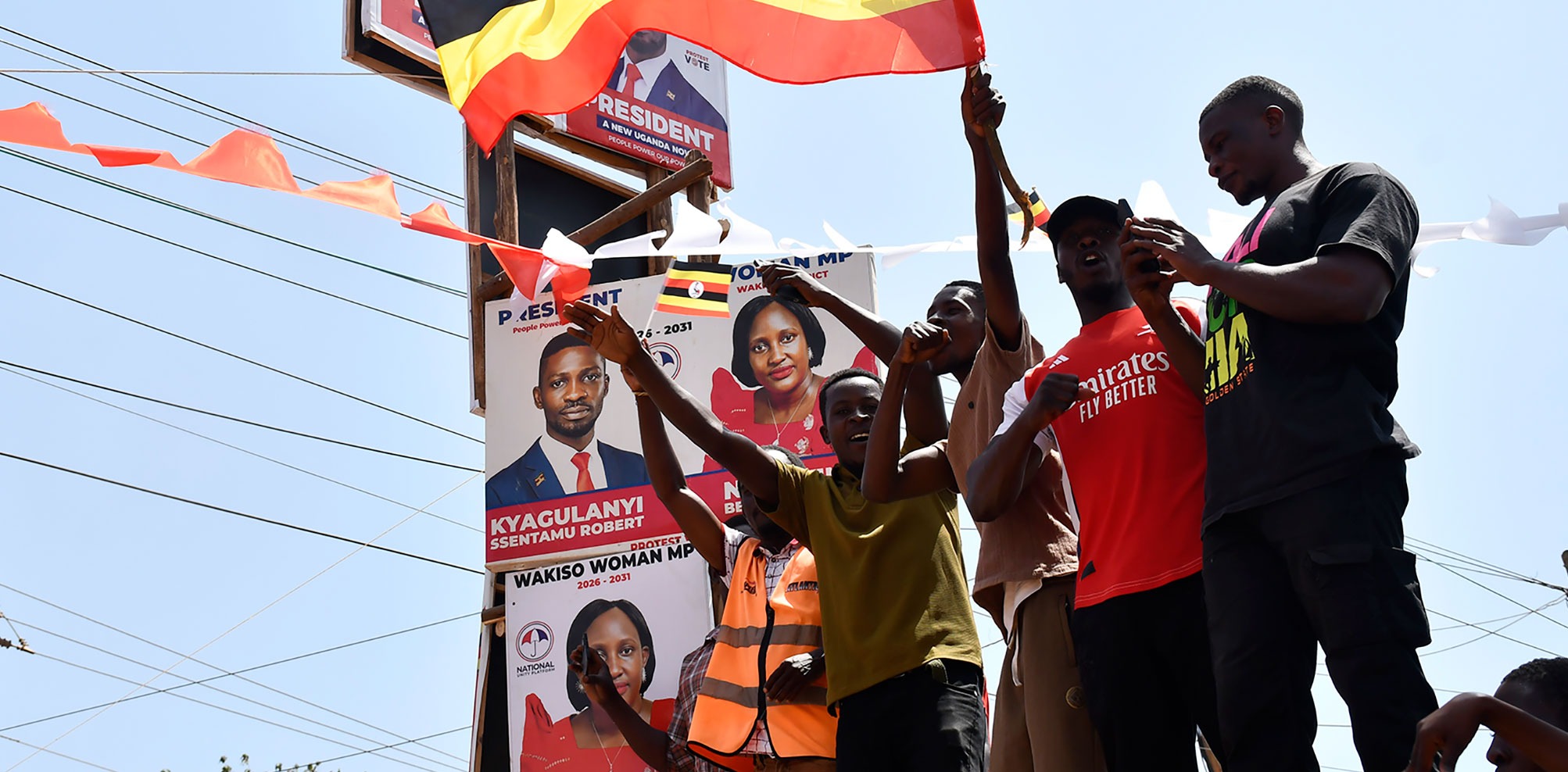
 Supporters of Uganda's opposition National Unity Platform leader, Bobi Wine, make their way to Wine's rally in Katogo, Uganda, on 1 December. (Photo: Isaac Kasamani / EPA)
 /file/dailymaverick/wp-content/uploads/2025/10/label-Op-Ed.jpg)
As Uganda approaches its elections on 15 January, the campaign trail has revealed as much about how political actors seek power as why they seek it. Beyond competing manifestos and personalities, this campaign cycle has showcased a wide range of campaign strategies — traditional, modern, and unconventional — each aimed at capturing voter attention in an increasingly crowded political space. The effectiveness of these methods will ultimately be judged by the results, but their deployment already offers important insights into the state of political campaigning in the Pearl of Africa.
It is important to acknowledge that Uganda’s electoral landscape is not an even playing field. The country’s political environment has long been characterised by restrictions on opposition activity, uneven access to resources, and limitations on where, how, and when different candidates can campaign. As a result, not all political actors can deploy the same range of campaign techniques described here.
Some strategies are enabled by incumbency and state reach, while others are constrained by regulation, security enforcement or administrative barriers. This article does not seek to equate opportunity or fairness among candidates. Rather, it focuses specifically on the political campaign techniques and strategies visible during this election campaign cycle in Uganda, examining how power is communicated and contested within existing political realities.
At the heart of Uganda’s campaign culture is the political rally. Rallies continue to serve as the most visible expression of political strength, allowing candidates to project popularity, energise supporters, and dominate news cycles. Music, slogans, party colours, and carefully choreographed performances transform these gatherings into spectacles of political identity.
For example, Robert Kyagulanyi (Bobi Wine) has drawn large crowds in urban centres such as Kira Municipality, where supporters lined major roads to greet him on his campaign tour. The National Resistance Movement (NRM) under President Yoweri Museveni has also relied on large rallies to demonstrate organisational capacity. Yet rallies are resource-intensive and often preach to the converted, raising questions about their ability to persuade undecided voters rather than merely mobilise existing bases.
/file/attachments/2986/13633268_337585.jpg "Bobi Wine addresses his supporters during a campaign meeting in Nantabulirwa village on 9 January. (Photo: Isaac Kasamani / EPA)")
Whistle stops
Another notable tactic is whistle stops. Both of Uganda’s two leading contenders, Museveni and Wine, have been pictured addressing citizens directly in public spaces, sometimes stopping convoys or speaking from the middle of roads, and making brief appearances across multiple locations in a single day. This technique blends symbolism with accessibility, projecting an image of humility, control and connection with “ordinary people.” Unlike rallies, these stops are designed to appear unscripted and intimate, even when heavily secured, with their power lying more in visual storytelling than in policy detail.
In contrast, door-to-door campaigning represents a more intimate and targeted strategy. Forum for Democratic Change (FDC) campaign officials have highlighted the importance of personalised voter contact, including door-to-door outreach, as part of their broader engagement strategies, aiming to connect with local concerns such as livelihoods, service delivery, and cost of living. Door-to-door campaigning has been acknowledged by FDC officials as cost-effective and a way to deepen candidate-voter relationships.
The campaign landscape has also been transformed by digital media. Social platforms have become central arenas for political messaging, especially among young and urban voters.
Both Museveni and Wine’s campaign teams leverage TikTok, Instagram and X to rapidly share videos, highlight campaign events, and counter opponents. This approach allows candidates to reach audiences directly, bypassing traditional media gatekeepers, and to amplify their messages far beyond physical campaign events. On the other hand, podcasts and long-form conversations allow candidates to engage more deeply. A notable example is the Unstoppable GenZ Museveni podcast, which features Museveni discussing issues like employment and innovation with Gen Z hosts.
A distinctive feature of campaigns is the use of T-shirts, branded merchandise, and campaign posters. Both NRM and NUP (Wine’s party) distribute campaign items to extend visibility and signal political identity, with supporters and commentators posting about campaign gear across social platforms, as highlighted by CNN International reporter Larry Madowo in a widely shared post on X.
Campaign posters have become ubiquitous, appearing in neighbourhoods, on vehicles and in public spaces to reinforce candidates’ presence. The sitting president has gone as far as placing posters even at high-traffic locations such as airports, demonstrating how parties are maximising both physical and digital visibility to remain constantly in voters’ sight.
/file/dailymaverick/wp-content/uploads/MC-Uganda-Museveni_6.jpg "A giant election poster for incumbent Ugandan president Yoweri Museveni on a building in the capital, Kampala. (Photo: Stringer / EPA-EFE)")
Unconventional tactics
This campaign cycle has also seen unconventional visibility tactics, including life-sized statues resembling Museveni and innovative digital events such as the NRM “Longest Online Rally”. These strategies act as symbolic and digital extensions of a candidate’s presence, turning physical and virtual spaces into sites of political conversation.
The statues grab attention in public spaces, while online rallies engage viewers far beyond the immediate audience, creating content that can be shared and amplified across social media. Together, these tactics reinforce name recognition, spark discussion, and generate viral visibility, extending the campaign’s reach well beyond traditional rallies and posters. Whether seen as creative branding, political theatre, or digital engagement innovation, they illustrate how campaigns are experimenting with physical and online symbolism to capture voter attention and generate buzz.
What is striking is not the use of any single strategy, but the integration of multiple tactics. Rallies become social media content, whistle stops turn into viral clips, podcast segments circulate online, and T-shirts and symbolic displays sustain visibility on the streets. This layered approach reflects an understanding that voters encounter political messages repeatedly across different platforms.
Ultimately, the effectiveness of these strategies will be measured at the ballot box. Yet beyond electoral outcomes, Uganda’s campaign season offers broader lessons about political communication, voter engagement and competition. It highlights a shift toward hybrid campaigning where traditional methods coexist with digital innovation and symbolic experimentation.
The results of the 15 January elections will reveal not only who has won political power, but which campaign strategies resonated most with the electorate. For political practitioners, analysts, and citizens alike, this moment provides an opportunity to reflect on how campaigns shape democratic participation and how the art of campaigning in Uganda continues to evolve. DM
Gcotyelwa Jimlongo is a political campaigns specialist at the Political Campaign Resource Hub, a subsidiary of the International Centre for Political Campaigns based in Johannesburg.