




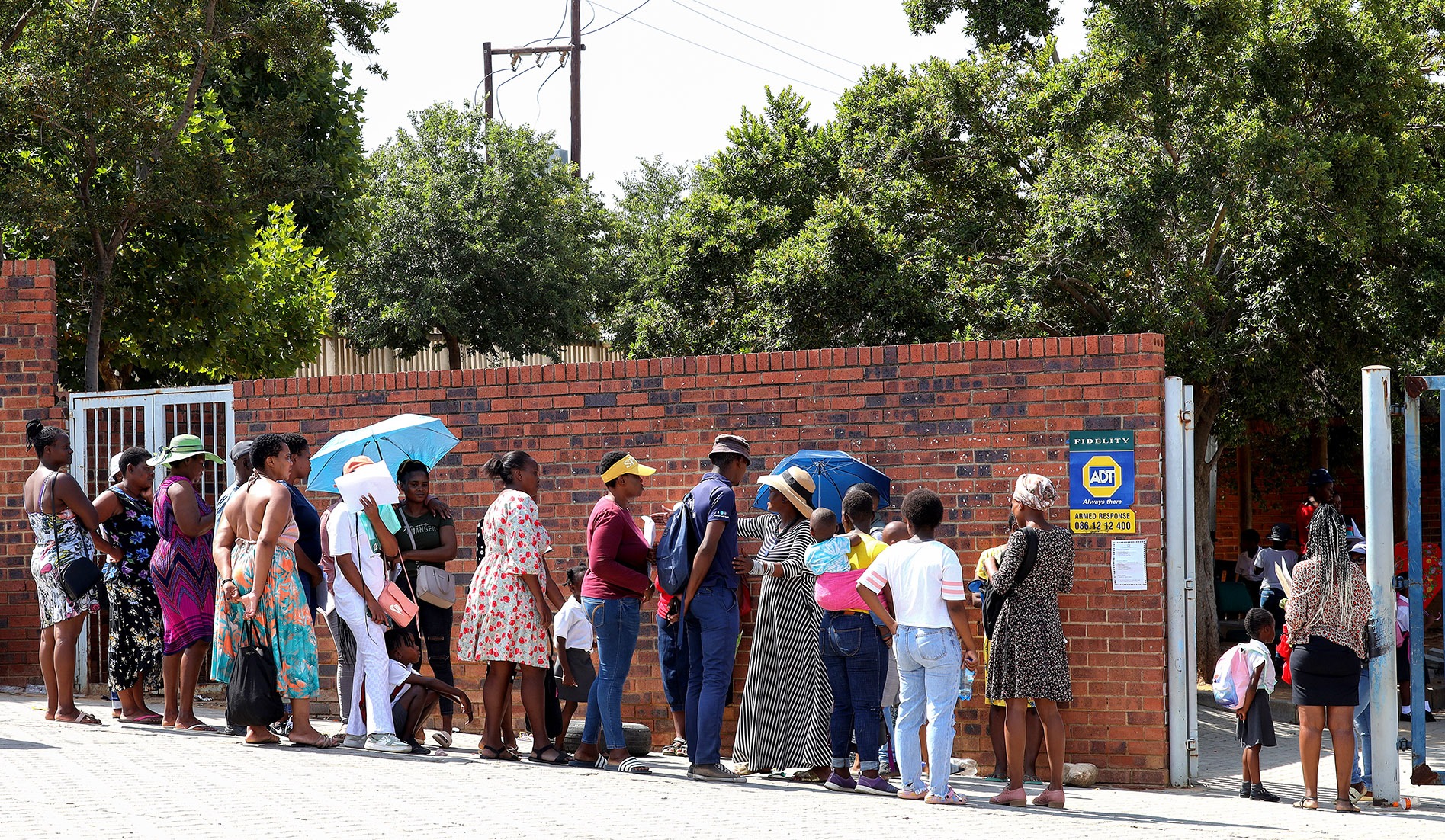
 Symptomatic of an annual crisis, parents of unplaced learners queue outside the Tirisano-Mmogo Primary School in Randburg, Gauteng, on 16 January 2023. (Photo: Luba Lesolle / Gallo Images)
 With schools across South Africa set to reopen on Wednesday, 14 January, the Gauteng Department of Education (GDE) is under severe pressure to place learners. A staggering 4,858 Grade 1 and Grade 8 pupils remain unplaced — 1,381 in Grade 1 and 3,477 in Grade 8.
The GDE said it “continues to release placement and transfer offers daily, supported by targeted interventions in high-pressure districts, to ensure that all remaining learners are placed as efficiently and fairly as possible, in line with regulated admissions criteria and available school capacity”.
The late application window, which runs from 17 December to 30 January, has already received 11,183 submissions. Of these, 5,701 were for Grade 1 and 5,482 for Grade 8. All processed late applications will result in final placements at the parent- or guardian-selected school, provided space is available. The GDE urged parents to visit their chosen school, starting on 14 January, to submit the required documents.
The department said that most of the remaining unplaced learners were in Gauteng’s urban and metropolitan districts, which face ongoing strain from rapid population growth and limited school infrastructure.
Ekurhuleni is the highest-pressure district, with 3,169 unplaced learners in the following areas:
- Ekurhuleni North: 1,741 (Grade 1: 381; Grade 8: 1,360);
- Ekurhuleni South: 1,181 (Grade 1: 569; Grade 8: 612); and
- Gauteng East: 247 (Grade 1: 85; Grade 8: 162).
The breakdown in Johannesburg is:
- Johannesburg North: 3 (Grade 8);
- Johannesburg East: 1,173 (Grade 1: 95; Grade 8: 1,078); and
- Johannesburg South: 352 (Grade 1: 250; Grade 8: 102).
In Tshwane, there are only 14 unplaced learners, all in Tshwane North (Grade 1: 1; Grade 8: 13). There are 70 unplaced learners in Sedibeng East.
The department said it had prioritised Ekurhuleni and Johannesburg, implementing district-based placement, the continued release of placement and transfer offers, and utilising available capacity in neighbouring schools.
/file/attachments/orphans/ED_542359_855786.jpg "The Gauteng Department of Education reports that thousands of learners remain unplaced, but daily placement and transfer offers continue as the department works to accommodate every learner. (Photo: Sharon Seretlo / Gallo Images)")
Constant anxiety
Yet behind the department’s assurances, there are still hundreds of desperate parents looking to have their children placed.
One parent, who wished to remain anonymous, detailed a monthslong ordeal to secure a Grade 1 spot for his child, a process that has spiralled into constant anxiety as the new academic year looms.
“We were applying for Grade 1, on the first day the applications came out in July [2025]. We applied for three schools, which are within the area that we know and where the kid was at crèche last year,” he said.
The parent, who lives in Pretoria North, said he had been waiting for the school placement, which finally came towards the end of November. However, his child was placed at a school that was not included in the application.
“We don’t know the school. We tried to find information, and the comments were not pleasing. It is also logistically impossible because it is out of our way; in terms of where I work, and my wife, the schools that we applied to [are] on the way,” he said.
The parent declined the placement offer and submitted an appeal through the system, which has been stuck in limbo with its status frozen as “submitted” or “being processed” for months. Two visits to the district office provided no help.
“They said the appeals are only handled by the MEC of education. He’s the one who formally replies on the system as well to say if the submission was successful or not, so we’ve been waiting for that. On the internet, on the Department of Education page, there’s a place that says ‘speak to the MEC’, so it gives you an email or something. I also sent an email, and the response was just that they’re going to finalise, but nothing has come out of it,” he said.
Now, with schools reopening on Wednesday, 14 January, the parents’ anxiety is crushing.
“It’s all we think about every day. I log into this system almost three to five times a day. We’ve had to make applications at a private school, just in case, because if the child doesn’t start with others, that is going to be an issue, where they fall,” he said.
“It’s top of the list at the moment. It’s something you discuss on a daily basis, hoping that it will change. If you go to the district, you’ll just be turned back and they say, ‘Wait for the system, wait for the system.’ If you call the numbers of the district, they don’t work. They [the GDE] are releasing countdowns now on their socials, but for parents that are not being placed, you just look at them and say, ‘But my kid has not been placed.’”
The parent also expressed frustration with the GDE online admissions application system. The platform is bedevilled by technical glitches, such as the website crashing under peak traffic, login timeouts, failed document uploads and poor communication, including undelivered SMS notifications and vague status updates, resulting in anxious parents who still do not know where and when their children will go to school.
“Firstly, I don’t think the system is working to people’s benefit. Back in the day, when we were applying for school, walk-ins were literally what we did, and there were never issues where kids were not placed or didn’t have school at this time of the year,” he said.
“Why that was changed to this online system, I don’t understand, and even if we adopt the system, there needs to be a quicker response if there’s issues like this, because you can’t be waiting two or three months to get a response, where now we are literally on the 23rd hour. It’s not working at all.”
Centralised system blamed for placement chaos
AfriForum argues that Gauteng’s centralised online school placement system is the root cause of thousands of Grade 1 and Grade 8 learners facing uncertainty just days before the 2026 academic year begins. The organisation warns that without reform, this annual crisis will persist, violating children’s right to quality education.
“This situation shows exactly why a centralised system cannot work in a complex education environment like Gauteng. The Department of Education has taken control of school placements but has not accepted responsibility for the fallout and has therefore shifted the consequences of the failed system onto schools and parents,” said Carien Bloem, the head of AfriForum’s education projects.
/file/attachments/orphans/WhatsApp-Image-2023-11-17-at-105449_410708.jpeg "Carien Bloem, the head of AfriForum’s education projects. (Photo: AfriForum / Wikipedia)")
Bloem added that schools, which were best equipped to assess their own capacity, infrastructure and learning needs, were sidelined from the process. They receive untimely notifications about applications or placements, leaving parents in the dark. Despite the department mandating communications from 16 October 2025, placement offers trickled out sporadically from November, with most arriving in December, fuelling family stress.
“The consequences of this failed centralisation are far-reaching. Parents are now being forced to show up at schools this week without confirmed placements, while schools are now forced to try to solve a problem they did not create,” said Bloem.
The DA’s shadow MEC for education, Sergio Isa Dos Santos, said despite Education MEC Matome Chiloane’s assurances of “efficient and fair” placements, he had received verified reports of parents being offered schools between 60km and 95km away from their homes.
/file/attachments/orphans/ED_581807_458451.jpg "Gauteng Education MEC Matome Chiloane. (Photo: Sharon Seretlo / Gallo Images)")
“This is completely unacceptable. The GDE shifts the cost of the department’s failures on to families, placing an unfair financial burden on them,” he said.
In Tshwane, petitions from aggrieved parents underscore persistent issues: local learners displaced from nearby schools, ongoing Grade 8 placement bottlenecks, and appeals rejected without explanation or left unresolved for protracted periods. Requests for sibling placements, safety considerations and special circumstances are routinely disregarded.
“While the GDE points to percentages and system progress, these statistics mask the lived reality. A placement on paper does not equate to real access to education when children are sent far from home or left in limbo days before schools reopen,” said Dos Santos.
He said the crisis was the result of admissions processes starting too late, weak capacity planning in high-growth areas and limited transparency around placement decisions.
/file/attachments/orphans/ED_544063_761728.jpg "The DA’s shadow education MEC, Sergio Isa Dos Santos. (Photo: Deaan Vivier / Gallo Images / Beeld)")
National placement strains echo Gauteng woes
The situation in Gauteng reflects countrywide ongoing challenges in school placements for the 2026 academic year.
A News24 article published on Friday revealed that almost 23,000 pupils in Gauteng, Mpumalanga, Limpopo and the Western Cape were still awaiting school placements.
Limpopo Department of Education spokesperson Mike Maringa said the department was hoping to finalise the placement of 997 pupils before schools reopen. Mpumalanga Department of Education spokesperson Jasper Zwane said the number of outstanding placements was being reduced daily by admission committees working with principals.
The spokesperson for the Western Cape Education Department (WCED), Bronagh Hammond, said that despite placing 96% of applicants, a wave of late submissions had challenged placement efforts.
As of 7 January, the WCED had successfully placed 180,960 learners for whom applications were received for grades R, 1 and 8. Placement was still in progress for 7,540 learners in these grades.
However, late applications continue to hinder placement progress. Since 1 November 2025, the WCED has received 10,666 late applications — 5,873 in November, 4,035 in December and 758 in January.
“Despite extensive public communication and advocacy encouraging parents to apply on time, thousands of applications are still being submitted well after the official deadlines,” said Hammond.
“Late applications create considerable challenges for the WCED. They disrupt planning for learner placement, resource allocation and staffing, and place additional strain on the department to place learners immediately during a period when schools are closed for the holidays. This means that discussions around placement can only resume once schools reopen, delaying the process further.”
Hammond said the department was actively working to secure placement opportunities for learners who were still awaiting placement.
“With schools reopening for staff on Monday, we will engage more extensively with principals and management teams to identify additional spaces. Further movement within the system is expected as schools finalise promotion, progression and enrolment lists, which often create additional capacity,” she said.
Additionally, the department will conduct its 10-day snap survey once schools have been open for 10 days.
“This survey provides accurate data on learner numbers in each grade, allowing the system to settle before reporting. The information gathered is critical for determining where additional resources, such as furniture and equipment, are needed and where further placement opportunities may exist,” said Hammond. DM