
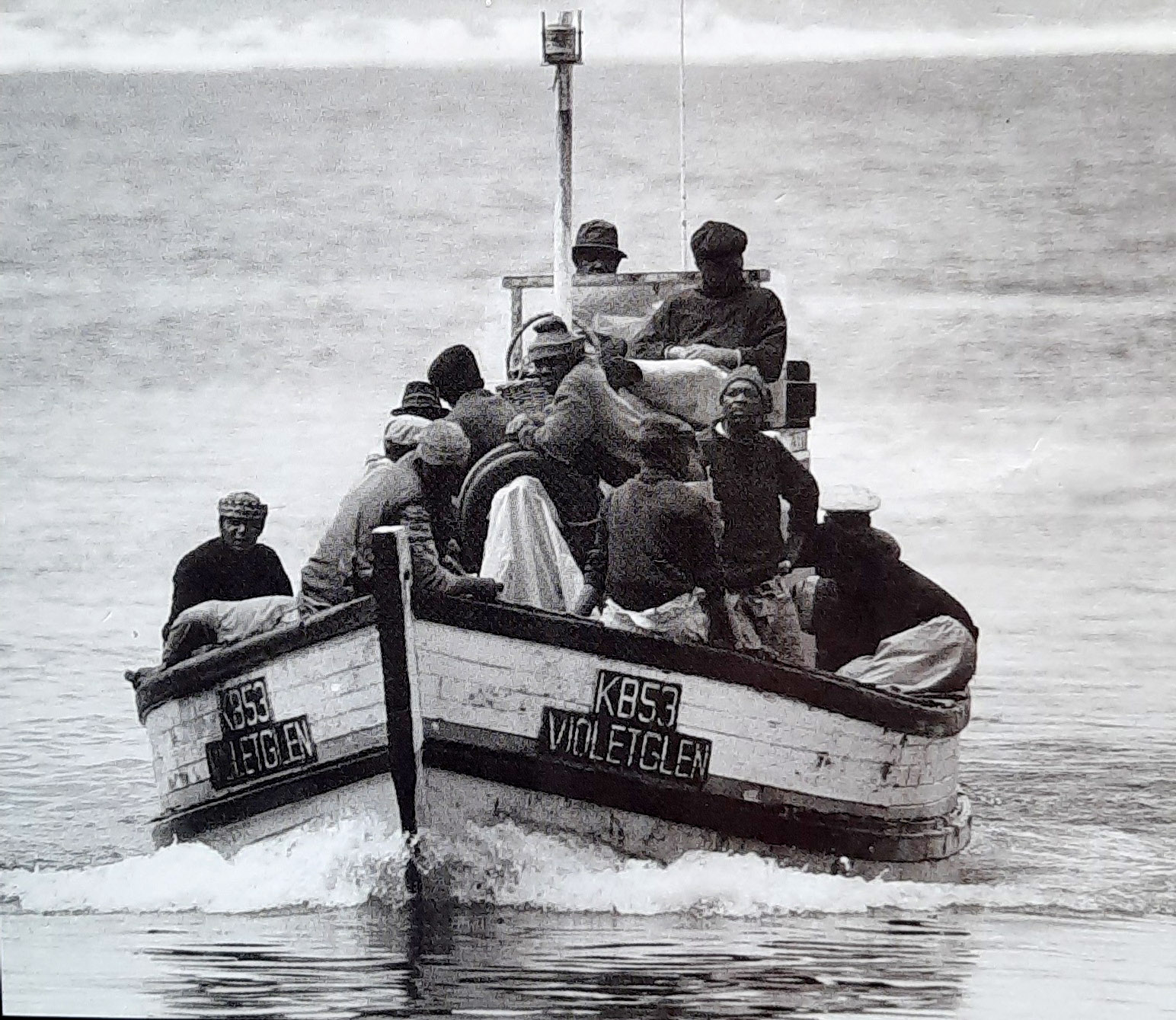
 Returning with the day’s catch. (Photo: Tony Trimmel)
 /file/attachments/2985/TroubledWaters_405609.jpg)
As global fish stocks plummet and great marine shoals thin into scattered traces, the value of what remains is rising sharply. It’s a textbook example of scarcity economics: the fewer fish there are, the more lucrative the hunt becomes. But this isn’t just a matter of money, it’s a race against collapse of a vital food source.
From coastal villages to industrial factory ships, the scramble to extract what’s left has become frenzied, often heedless of legality or long-term sustainability. And South Africa’s fisheries, once among the world’s richest, are being stripped – by greed, neglect, an invasion of silent foreign boats and the erosion of political and scientific oversight.
Mark Wiley is one of the few remaining South Africans with deep institutional memory of the country’s fishing sector – its policy history, its systemic failures and the political intricacies that have led to the present crisis.
A former politician with the DA, Wiley’s interest in fishing is not simply bureaucratic, it’s personal. His father, a long-serving parliamentarian and former minister of environmental affairs, was a fierce advocate for sustainable fishing, helping to establish marine reserves and ban destructive netting practices in False Bay.
From growing up immersed in the fishing communities of the South Peninsula to serving on maritime and environmental committees after South Africa’s transition to democracy, Wiley has lived through and helped shape the evolution of fisheries policy. Though retired from public office since 2019, he has kept detailed archives and a keen eye on the slow-motion decline unfolding in South African waters.
His insights are both a warning and a call to action. The history is clear. The science is available. The collapse is avoidable – but only if we treat the sea not as an infinite gift, but as a fragile inheritance. If we fail, we will not only run out of fish. We will run out of the time window for their recovery.
***
Can you give us a sense of how South African fishing developed historically?
It goes back thousands of years. Coastal foragers built tidal traps with stone berms – basic but clever systems where fish would be swept in at high tide and trapped when the tide receded. You’ll still find these along the Western Cape coast.
The presence of these early humans can still be seen in shellfish middens – heaps of discarded mollusc shells that show just how central marine food was to early diets.
When colonisation began, the Dutch and later the British recognised the commercial potential of South African waters. Fishing villages formed – Kalk Bay being one of the first – with many residents of Filipino and Khoi descent.
These communities became the backbone of local fishing, particularly line-fishing and trap-netting.
The early nets had large mesh, which was critical: they allowed fingerlings to escape and breed. Today’s nets are a different story.
/file/attachments/2985/MarkWileyDonPinnock_157139_05550fde8fe13202e5e32cb850b85d2a.jpg "Mark Wiley. (Photo: Don Pinnock)")
Larger-mesh nets is a way to protect juveniles and spawning biomass?
Absolutely – bigger mesh would let the young through. But that assumes honour among thieves. Fine nets increase the by-catch significantly. That’s the species you weren’t intending to or are not allowed to catch. The pressure inside these nets will kill most species so this by-catch is simply dumped or kept for processing and not recorded. Many fishing trawlers and some nations simply ignore regulations, turn off their transponders, enter sovereign waters illegally and strip resources.
China is a major culprit. You can see their fleets off our coast by day, waiting outside the 200-mile Maritime Zone limit. Then at night they turn off their transponders and suddenly whole fleets appear within a stone’s throw from the shore, harvesting species like chokka or any species that they can get. By daylight they’re gone. Without enforcement, larger-mesh rules or reserves don’t matter.
South Africa had a history of world-class fisheries research
We did. The first fisheries research station and a very popular aquarium was at St James in the early 1900s, run by a resident marine scientist, Dr John Gilchrist. When it was closed in 1937, its contents and research data were transferred to a new facility in Sea Point and were the foundation of the Fisheries Research Institute.
Decisions were taken grounded in empirical data, derived from a whole network of floating state-run laboratories, university departments and shore-based research stations. That is the only way to take decisions to ensure sustainability of the resource. But much of that capacity has been lost.
Research is now often outsourced to consultants and underfunded. Tertiary institutions no longer produce enough marine scientists, and many of our best went abroad. Without reliable science, quota decisions, catch effort and policing become political or emotional – a recipe for collapse. Without doubt, political patronage may have influenced some of the quota allocations in the past but it was always underpinned by science and strictly enforced.
South Africa registered two factory ships in the 1960s and 70s. What was the effect?
Massive. The Suiderkruis and the Willem Barends were allowed to operate, mostly off the then South West African coast as the migrating shoals of sardines, pilchards and anchovies moved south. They stripped the ocean. These weren’t regular trawlers – they were floating factories. Fish were dragged on board in massively long nets, processed on board, packed and stored in cold rooms without having to return to harbour. That means they could stay at sea for weeks or months, working nonstop.
The catch effort of one factory ship equalled that of about 15 traditional boats. It was a staggering intensification and stocks plummeted.
The statistics at the time were staggering and shocking. The total catch of sardines in 1968 was 1.38 million tons. Within three years this had dropped to about 300,000 tons. There was a brief rally in the period 1972-74 to just under 600,000 tons before another radical drop to under 50,000 tons in 1978. It has never recovered.
You mentioned the Canadian cod crash earlier. Can you explain what happened?
The Grand Banks of Newfoundland used to host some of the richest cod fisheries on Earth. Many fishing communities were established in the 1700 and 1800s totally dependent on cod fishing. There were tales of shoals so thick that you couldn’t row a boat through them. But with the rise of factory trawlers in the mid-20th century, everything changed.
In 1968, Canada harvested 810,000 tons of cod – three times the historical average. By the early 1990s the stock collapsed, fell off a cliff. Ninety-nine percent of the northern cod population vanished in just 18 months. Other subspecies saw equally disastrous declines.
The Canadian government took the hard decision: in 1992 they instituted a total ban which they even enforced with the navy. Trawlers were hauled out of the water. About 30,000 jobs were affected. But they did something smart – they created aid packages, retrained fishers and redirected some into new sustainable fisheries like crab.
Only in 2024 – 32 years later – did they cautiously reopen cod fishing. That’s how long it takes for a species to recover.
South Africa must learn from that: science-based management and political will are non-negotiable.
/file/attachments/2985/TheonedthatdidntgetawayTravisDaniels_246183_7663b5aa4a139e4793d65eaa4f3548df.jpg "The one that didn’t get away. (Photo: Travis Daniels)")
What about South Africa’s policing of its exclusive economic zone (EEZ)?
In 1994, we passed the Maritime Zones Act which extended our sovereignty over the 200 nautical miles from our coast – airspace, surface area, the sea contents and the sea floor. Additionally the South African territories of Marion and Prince Edward Islands were included.
Back then, we had capacity: Navy ships, Air Force planes, fisheries patrols and scientific vessels. Now, almost nothing. Satellites can see trawlers entering our waters, but without patrol vessels or aircraft to intervene, it’s meaningless. Foreigners, and maybe some locals, trespass daily, stealing resources. If you can’t enforce your EEZ responsibilities, you risk losing sovereignty over that territory.
The navy’s ships are mostly in port. The air force lost its maritime patrol capacity years ago and the Department of Fisheries doesn’t have the boats or the crew. Their sea time is minimal.
So how would you assess the state of South African fisheries today?
I’m not close to the current department, but from what I read, see and hear the situation is not good. Research capacity has dwindled. Inspectors are undertrained and largely absent. Quota allocations have been politicised, lacking in transparency and logic and often given to people with no fishing background or interest in the resource. They then sell quotas to real operators.
Small-scale fishers are squeezed out. Quotas are often short-term and single-species, discouraging investment in vessels and equipment. This leads to poverty, corruption, poaching and, above all, unseaworthy vessels and equipment in an already hazardous occupation.
Speaking of poaching, how serious is it?
Very serious. Abalone, crayfish and other species are highly prized in East Asia. Gangs exchange poached marine resources for drugs. Divers in camouflage and backed up with armed guards on ultra-fast craft strip reefs under the cover of night. Many officials, including Parks Board staff, look the other way – sometimes out of fear, sometimes complicity. Meanwhile, authorities are more likely to rigorously enforce permit conditions against ordinary citizens catching a few crayfish or other rod-caught species legally than confront organised poachers. That’s upside-down enforcement. This is not winning hearts and minds.
What about traditional fishing communities and their knowledge?
Local knowledge is valuable, but it must work hand-in-hand with science. Traditional community fishers know when and where fish come in, but many species are now extinct or endangered. No amount of tradition changes that reality. Hard decisions are needed –including closing a fishery for a period, as Canada and other nations have done. But then the government must provide aid packages and retraining. Fishermen could also be paid to patrol portions of the EEZ or act as on-board monitors instead of being given quotas, helping to police our waters while maintaining livelihoods.
/file/attachments/2985/seabed-trawling_926526_77c1dda0da7006d54d4edaa8091b44e2.jpg "A trawler at work. (Photo: Wikimedia Commons)")
What solutions would you prioritise?
First, political will. It costs nothing to make science-based, transparent, national-interest decisions instead of party-political ones. The department must publish clear data on quotas and role-players, as was once the norm. Rather opt for a smaller fishing industry catching multi-species on longer-term quotas to ensure year-round employment, investment in boats and equipment.
A smaller catch industry would be easier to sustain and monitor. Make any by-catch part of the quota. With today’s technology, non-specific targeting of species is simply unacceptable.
Second, rebuild scientific capacity – invest in tertiary training with bursaries, adequately fund research ships and facilities and bring young scientists into careers – not pay consultants.
Third, fulfil your sovereign obligation by policing the EEZ properly: use the navy and other border-control entities to enforce the law and to hold trespassers to account. Just recently the Australian Border Force intercepted two foreign trawlers, apprehended the crew and scuttled the boats. They are not alone in taking drastic action of this sort.
In the short term, engage outside aircraft with some state officials on board and patrol our EEZ . These aircraft don’t need to be equipped with sophisticated apparatus. But it’s vital that the country establish an active presence out there.
Fourth, retrain displaced workers, offering alternative livelihoods and interim support packages.
Finally, develop an integrated, legally enforceable and monitored maritime policy involving defence, transport and environment. This is about food security, trade and trade routes – and sovereignty. Whatever is now in place simply does not cut it.
And if we don’t act?
Then we will see more species collapse, job losses, more foreign exploitation, more crime and ultimately the loss of control over our own sovereignty. We can’t afford to deny science or delay action. The sea may look limitless, but it’s not. Without urgent reform, South Africa risks repeating the mistakes of others – only this time, the damage will be permanent. DM
Tomorrow:
Tim Reddell: Steering Viking Fishing through South Africa’s troubled waters.