




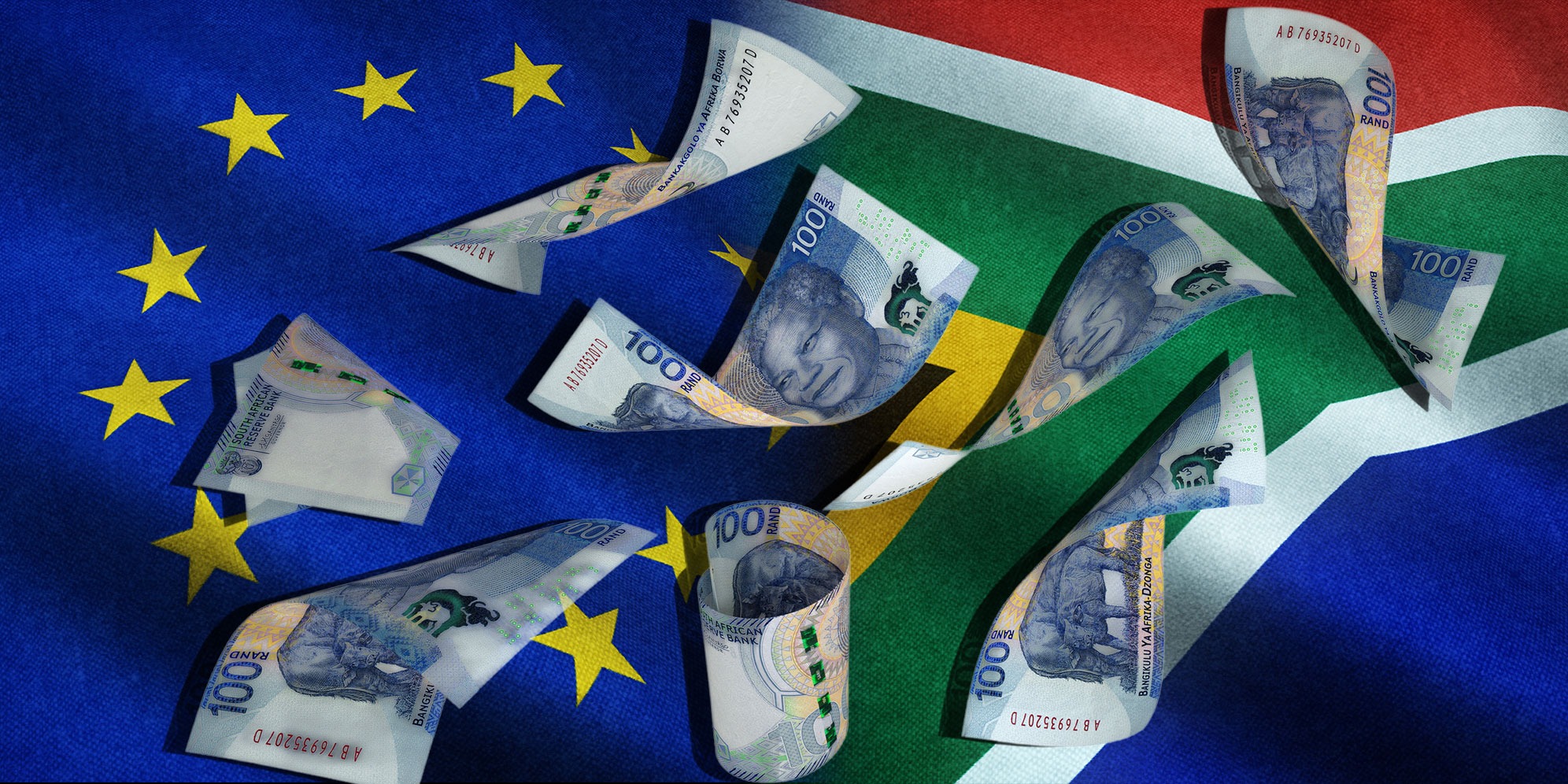
 Illustrative image: European Flag | South African Flag. (Image: Freepik) | Money. (Image: Istock) | (By Daniella Lee Ming Yesca)
 The European Union (EU) has removed South Africa from its list of “High-Risk Third Country Jurisdictions”, the latest vote of confidence in the Treasury’s efforts to combat money laundering and clean up the country’s finance risk profile.
The Treasury said on Tuesday, 13 January 2026, that South Africa was added to the high-risk list in 2023 as “an automatic consequence of its greylisting by the Financial Action Task Force (FATF)”.
South Africa was scrubbed off the Financial Action Task Force Grey List in October last year, paving the way for its removal from the list of countries classified by the EU as risky jurisdictions for financial transactions.
Read more: South Africa scrubs off FATF greylisting and reclaims financial compliance mojo
What this means
The removal from the high-risk list means financial transactions between South Africa and the EU will not be subjected to such high levels of regulatory scrutiny, which in turn should provide a boost to trade and investment flows. And if South Africa loses its African Growth and Opportunity Act status, it could seek to further strengthen its trade ties to Europe to compensate for the expected fall in exports to the US market.
Five other African countries – Burkina Faso, Mali, Mozambique, Nigeria and Tanzania – were also taken off the high-risk list in the wake of their removal from the grey list.
“The decision to remove South Africa (and other African countries) from the European Union list was published on Friday, 9 January 2026, and will take effect on 29 January 2026,” the Treasury said.
“EU law requires that financial institutions in the EU must apply a higher level of scrutiny to transactions involving parties in countries deemed to be high risk (‘enhanced due diligence’), resulting in more rigorous and intrusive checks, increased documentation requirements, continuous monitoring and senior management approval for transactions.”
Such regulations can curb financial flows and are a disincentive to investment and trade.
The EU said that South Africa and the other five African states delisted had “... strengthened the effectiveness of their AML/CFT regimes and addressed technical deficiencies”.
Pointedly, the Treasury said its work was not yet done and that “deficiencies in the prevention, identification, investigation and prosecution of money laundering and terrorism financing” still needed to be addressed.
South Africans weary of crime and corruption will be well aware of that. But at least progress has clearly been made.
South Africa may yet get removed from another list that it wants to remain on – the African Growth and Opportunity Act (Agoa), which gives eligible African countries duty-free access to the US market for most of their exports.
Read more: US Congress moves to revive Agoa but SA’s continued participation is in doubt
Read more: Absa PMI falls in December to lowest level since pandemic
That could prove to be a more serious blow to South Africa’s slow-growth economy at a time when the manufacturing sector is losing steam with confidence levels at their lowest since the pandemic. DM
Comments
Scroll down to load comments...