




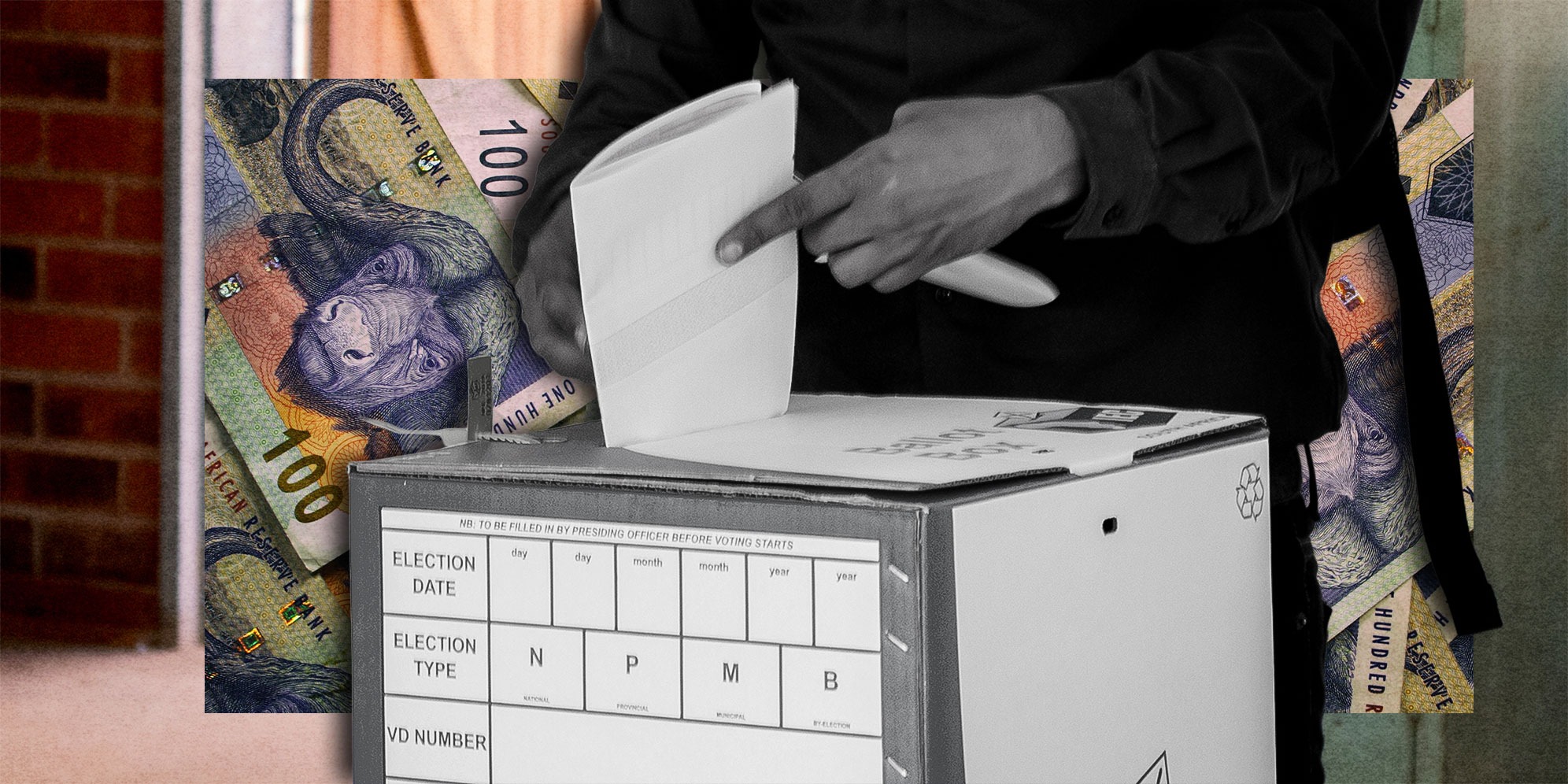
 Illustrative Image: Voters at the Duff's Road voting station in KwaMashu, KwaZulu-Natal, on 8 May 2019. (Photo: Aisha Abdool Karim) | Money. (Image: Istock) | (By Daniella Lee Ming Yesca)
 /file/dailymaverick/wp-content/uploads/2025/10/label-Op-Ed.jpg)
Elections are fundamental to democracy, but their financial implications are escalating. Between now and 2027, many African countries, including Nigeria, Kenya, and Republic of the Congo, will hold elections. This is at a time when the rising cost of politics and campaign spending is rapidly changing the electoral landscape across the continent, with implications for democracy’s health.
Campaigns, technological advancements, security, and other logistics contribute to these costs and make money an essential, if not central, part of politics. Money is a very necessary component of political competition. While money does not automatically guarantee electoral success, victory comes rarely to those with insufficient financial resources. Many people, especially women and younger people, get excluded from politics because they are unable to mobilise the funds required.
Political aspirants use diverse sources to raise money
Money gives an advantage to better-financed candidates and gives financiers power over elected officials and citizens. Those who present themselves for election are either wealthy enough to finance their own campaigns or must make personal sacrifices, including incurring debt, to raise the necessary funds.
Many rely on wealthy financiers for backing, expecting some payback in return. Those who fail in their bid incur financial losses and sometimes debt. However, those who succeed try to focus immediately on recouping their expenditures while stockpiling resources for a likely re-election. The primary task of delivering public goods becomes a casualty.
Investing in politics is beyond lucrative — it is the easiest way for those with dubious income to clean up their illicit wealth. By sponsoring politicians, political entrepreneurs gain the opportunity to influence decisions when their candidates are elected to office. Democracy slowly becomes an elite competition for the auctioning of votes to the highest bidder rather than a system of checks through which voters can hold politicians to account.
Regulations exist, but they are often subverted
Legislation regulating campaign financing exists on paper, but it is hardly obeyed by politicians and political parties. Nigeria is an interesting case study where the lack of enforcement by relevant institutions remains a big challenge.
For instance, the expenditure limits by political parties and candidates were stipulated in section 88 of Nigeria’s 2022 Electoral Act. The existence of limits is not new, but is easily circumvented through third parties. This is partly because the ceiling on the Electoral Act is also unrealistic compared to what is required in practice. Moreover, the Independent National Electoral Commission requires political parties to submit audited financial reports that capture relevant outflows after each general election. No such audit report is available in the public domain.
Voters are enablers due to a trust deficit
The electorate is complicit in the rising cost of elections. The complete lack of trust in politicians and public institutions means that voters do not believe whatever promises they make during campaigns.
The history of failed assurances has forced voters in many countries to take their destiny into their own hands. The idea that politicians are dishonest and use their offices to enrich themselves is widely shared among voters worldwide, especially in Africa.
The ostentatious display of wealth by politicians and their families, amid infrastructural decay and poor service delivery, points to the fact that monies budgeted for public goods end up in their private pockets to fund a lavish lifestyle.
Ordinary people feel abandoned, helpless, and frustrated. Therefore, voters will rather exchange their support and votes for instant gratification, including money or other physical goods of value, before or during the elections. Politicians have to strive to meet these needs, including raising money to buy votes during elections. Provision and distribution of these physical goods form part of campaigns and contribute to the high cost of politics.
Cost is only half the story
The conversations around electoral reforms often focus on integrity and institutional capture, but usually omit how electoral cycles distort fiscal policy and entrench unsustainable spending patterns. The greater danger lies in how elections alter the structure of public finance. With elections on the horizon, countries often witness widening budget deficits and unsustainable borrowing due to politically motivated policies.
Economic haemorrhaging from pre-election spending and post-election austerity carries long-term negative consequences for people with low incomes. Political bargains are struck with budgets, and development dividends are skewed towards party loyalty.
As competition intensifies, incumbents convert public resources into political instruments to offer incentives to their cronies. In Nigeria, constituency projects are known conduits which politicians use to divert public resources. Civil society groups have uncovered several cases of inflated or ghost projects while scrutinising expenditures made on behalf of the constituents.
The way forward
Countries like Nigeria and Kenya, which will be holding elections, should watch for these impending fiscal pressures. This political economy trap could trigger increased discontent among the population. The painful hangover from the 2023 elections in Nigeria led to the hasty removal of the fuel subsidy, triggering inflationary pressures across the economy.
Vertical enforcement of campaign finance legislation has failed. This is because those expected to implement these laws are potential beneficiaries of the gaps. Regulatory institutions like electoral commissions are often captured by state agents as part of a grand plan to manipulate election results in favour of the highest bidder. Deliberate efforts are made to blur the separation of powers, permit conflict of interest and render the parliament comatose.
Real reform can only come from below through resilient civic action and demands by a committed electorate, who should insist on urgent improvements. Private donors must be subjected to scrutiny to keep illicit monies out of politics and elections. Compliance with political finance regulations should be incentivised, and courts should be empowered to impose sanctions and punish violations. DM
Dr Uche Igwe is a senior political economy analyst and visiting fellow at the Firoz Lalji Institute for Africa at the London School of Economics and Political Science. He can be reached at u.igwe@lse.ac.uk