




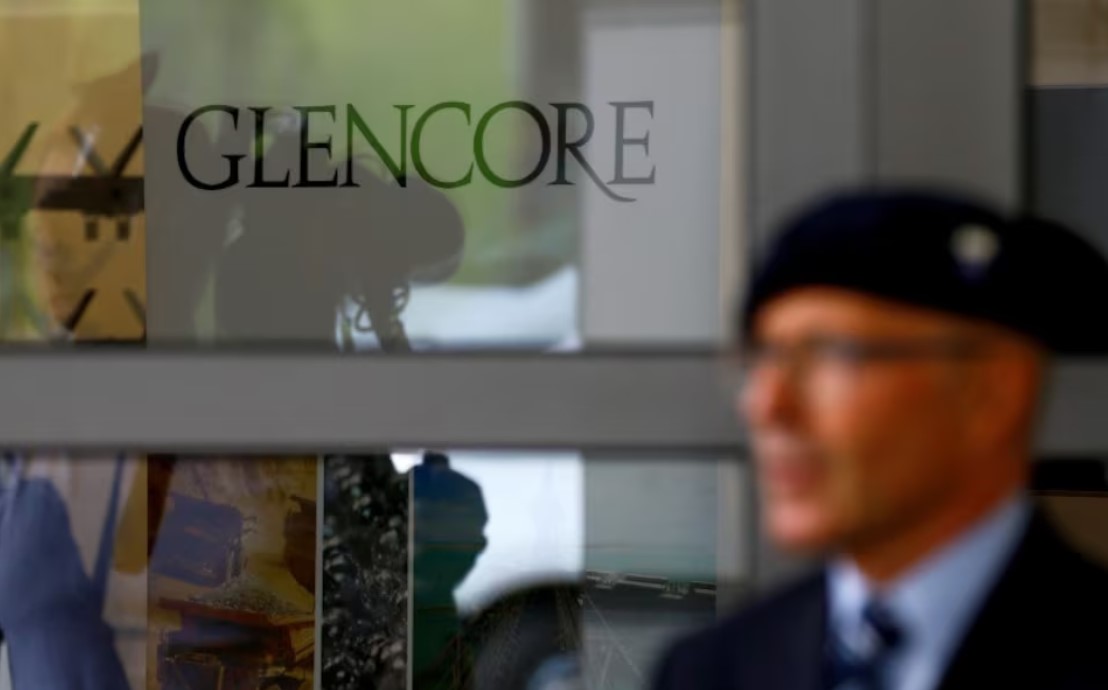
 An employee of a private security company stands in front of the logo of Glencore during the company's annual shareholder meeting in Cham, Switzerland May 24, 2017. REUTERS/Arnd Wiegmann/File Photo
 After a rather tame first week of the year on the JSE from a SENS perspective, it was Glencore that got the market all hot under the collar with a spike of nearly 14% in response to an announcement regarding a potential deal with Rio Tinto. The price eventually settled 10.5% higher on the day.
The world’s biggest mining company?
To be precise, the mining giants are looking at a “possible combination” of “some or all of their businesses” – in other words, they aren’t being very precise at all. This is deliberate, as the public announcements are designed to give as much wriggle room as possible. Flexibility is always your friend in life, especially in dealmaking.
But they do go on to give another important nugget: they expect that any such merger would take the form of Rio Tinto acquiring Glencore via a scheme of arrangement. Based on this comment, it sounds like the deal on the table would be a mega-merger that might carve out some unwanted parts of the group along the way. Again, nothing is certain at this stage and everything is subject to the final negotiations.
Still, we know that Glencore’s market cap is R1.33-trillion and Rio Tinto is worth more than R2.2-trillion. It would make sense for Rio Tinto to be seen as the acquirer here. If the deal goes ahead, it looks like it could create the world’s largest mining company (BHP’s current market cap is roughly R2.6-trillion).
It’s going to be particularly interesting to see what the regulators think about that.
The great divide in mining
Mining consolidation is not a new concept, although we’ve certainly seen a strong recent acceleration in this trend. The most interesting feature of the recent activity is that instead of deals that are creating more diversified groups across commodities, we are typically seeing efforts to create larger groups (with scale benefits) that play in a more focused basket of commodities.
The main driver of these deals is the push into transition metals like copper, leading to a repositioning of the pieces on the mining chess board into groups focused on non-transition commodities and those who are playing in only the transition metals.
This makes sense in theory, since the mining houses with legacy assets (like coal) should trade at structurally different valuations to the houses focused on copper with its applications across electric vehicles and data centres.
Naturally, value investors will be drawn more towards the “dirty” assets that have demonstrable cash flows and don’t require heroic (risky) assumptions about future demand. These dirty assets will typically trade on a fat dividend yield and thus a low earnings multiple. Conversely, the “clean” transition assets will be full of promises about a green future. They will have designer websites with pictures of renewable energy projects and Very Happy Humans Living Their Best Lives. ESG consultants will have bills to send. This will undoubtedly mean a lower dividend yield due to a higher valuation multiple.
As always, there will be ways to make money on both types of assets. There will also be ways to lose money. These are very different types of investments.
Anglo American-Teck Resources is the obvious blueprint
You may recall that BHP made a play for Anglo American in 2024, with the latter’s board fending off the bid by noting the complexities that BHP required for the implementation of the merger.
As history has shown us, this bid lit a fire under the you-know-whats of the Anglo execs. They went on a crusade to sort out the group and unlock the value that was promised to shareholders. The great irony is that most of the steps taken were similar to BHP’s request, including the demerger of Anglo Platinum (now Valterra Platinum) and efforts to sell other parts of the group that don’t make sense in a transition metal environment.
Perhaps the nuance is that Anglo had more time to execute them without the pressure of the BHP deal?
Either way, while the market speculated on whether BHP would come back for Anglo, it became clear that Anglo had a different suitor in mind. Teck Resources emerged as Anglo’s desired dancing partner, with the announcements screaming “merger of equals” at anyone willing to listen – even though it doesn’t take higher-grade maths to work out that it isn’t equal at all.
The Anglo-Teck deal speaks directly to what we are observing in the mining sector: a focus on larger groups that can win in copper. For better or worse, Anglo stepped away from other major exposures and created a cleaner group that was ready for a deal. They still have a number of headaches (like De Beers), but eventually the tricky elements of the group became small enough that a deal is still viable.
This willingness to transact first and iron out the awkward exposures later underpins the Glencore-Rio Tinto negotiations. It’s exactly why they are giving themselves flexibility around the structure.
Don’t ignore Jubilee Metals
At the other end of the spectrum from a size perspective we find Jubilee Metals with its humble market cap of R2.7-billion. The share price is up just 6% over 12 months, having completely missed out on the boom in mining stocks that was the key feature of the markets in 2025.
Jubilee sold off its PGM assets in a deal that was agreed before the sector delivered eyewatering returns towards the end of 2025. The transaction recently closed and Jubilee Metals has received the initial cash tranches. As much as this has frustrated punters who watched a PGM rally happen without them, it leaves Jubilee Metals as a pure-play opportunity in copper.
With so much global focus on this commodity, there are many who see Jubilee Metals as an obvious acquisition target. As a bolt-on deal in the copper space, it makes so much sense.
Perhaps the sector titans first need to fight to see who will emerge as the biggest and most important group for the next era of mining. The egos in this space are almost as big as the balance sheets and Jubilee Metals is a tiny blip on the radar in a world of mining mega-mergers.
But it’s a blip nevertheless, and blips can make money. DM