




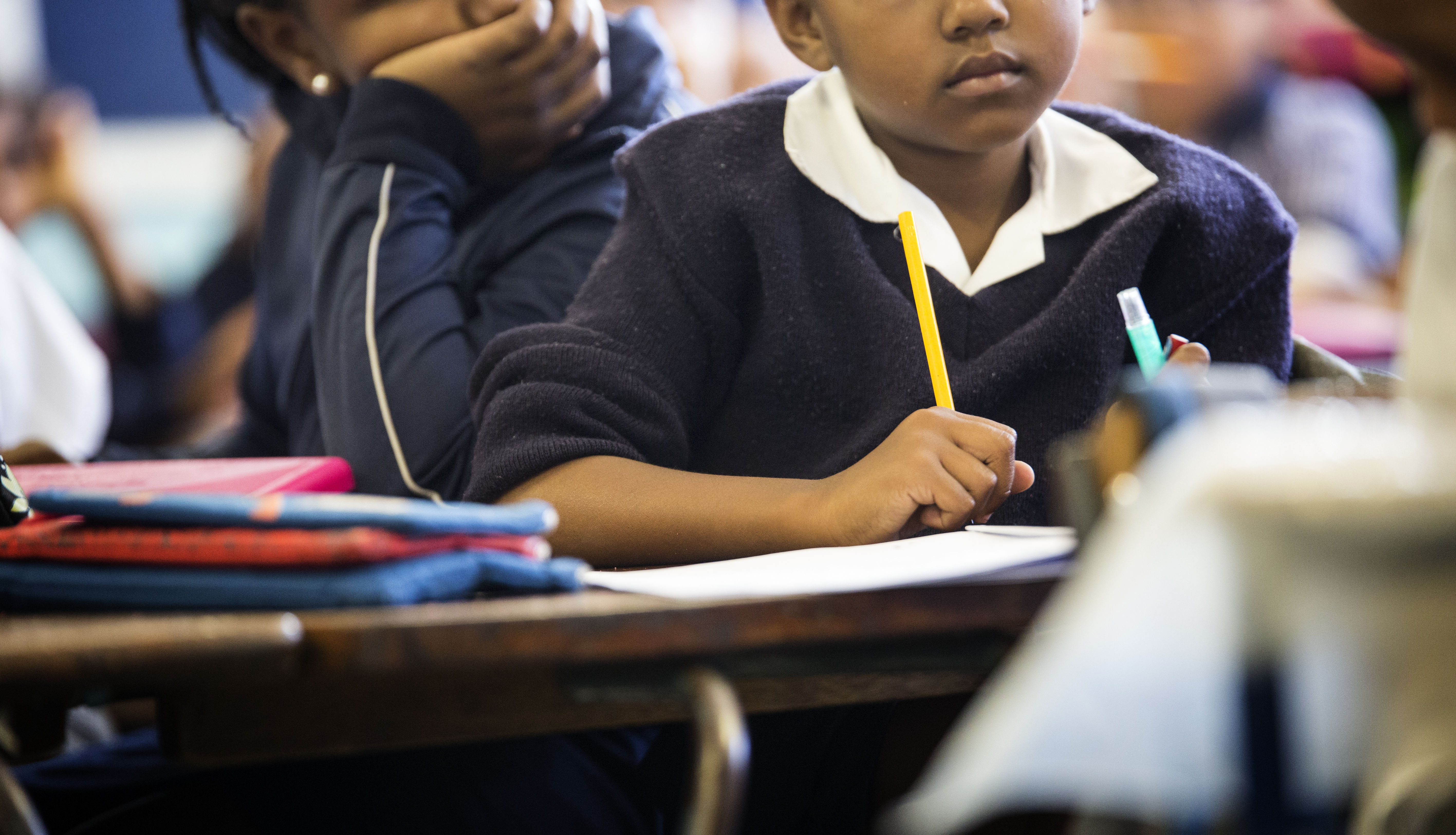
 The Competition Commission says the financial strain families face during the January uniform rush is driven in large part by anticompetitive supply agreements and unfair pricing practices. (Photo: Leila Dougan)
 Growing up, I never grasped why my mother would descend into a state of near-existential panic whenever I misplaced a school jersey after netball practice. After the inevitable lecture on responsibility, I would find myself elbow-deep in the lost-and-found, hunting for green knitwear as if my life depended on it.
Now, looking at the balance sheets, I finally understand that it was never just about the sweater. It was about the fact that school clothes are, quite frankly, bloody expensive.
We have entered that frantic January window where parents navigate the oppressive scent of polyester and mothers strategically buy school shoes two sizes too large, hoping they might survive a growth spurt. But the squeeze at the till is not merely a symptom of inflation.
According to the Competition Commission, this annual burden is compounded by persistent anti-competitive procurement practices that have kept prices artificially high for more than a decade at least. In a media release last Friday, the commission explained that it has been responding to complaints about the escalating prices of these essential items since 2010.
Read more: Competition Commission warns schools of legal action after 220 complaints about uniform purchases
“Parents should not be forced to procure school uniforms or related learning material from exclusive suppliers,” said Mpho Moate, an analyst at the commission. “In fact, schools should adopt and implement competitive procurement practices. The commission has developed guidelines to raise awareness in particular to help the schools, the school governing bodies as well as the parents to understand the benefits of competition in the market, as well as [to] encourage parents to be involved and exercise their right to choose value for money.”
The great uniform divide
Price data reveals substantial differences between retailers and specialised suppliers. Daily Maverick compared the prices of generic school clothing items across four different retailers in-store.
/file/attachments/2986/PHOTO-2026-01-07-18-06-13_444749.jpg)
A two-pack of long-sleeve white shirts costs between R229 and R329 at Woolworths. In contrast, single shirts at PEP range from R59.99 to R79.99. So, two shirts from PEP would cost you between R120 and R160.
Basic items from specialised suppliers are often more expensive than chain retailers like PEP and Jet. At School and Leisure in Claremont, Cape Town, two-packs of white-collared shirts are priced up to R208.50, while grey shorts reach R293.50.
Daily Maverick spoke to a mother from Pretoria who has a child going to Grade 1 in a private school. She said the stationery pack for her child cost R640. The cost for the child’s new school clothes was R1,210 for school shirts, skirts and a jacket, although the school also had second-hand clothes for purchase.
Say your daughter attends Fairmont High in Durbanville and you had no school clothing items for the year. If you were to buy all items from School and Leisure, the cost breakdown would be:
Liana Turner, a mother of three children in grades 1, 4 and 6 based in Cape Town, told Daily Maverick that the prices of school clothes are “ridiculous”. Two school shirts alone cost her R600. “You can hand down [school clothes], but they grow at different rates. She doesn’t necessarily fit into her sister’s clothes,” Turner said, referring to her younger daughter.
Stationery costs vary by thousands
The financial strain extends to the classroom desk. For her three children, Turner estimated that she spent between R3,000 and R4,000 on school stationery this month.
Daily Maverick compared the cost of school stationery supply packs on supplier Waltons’ website, which features required stationery supply lists provided by public and private schools across the country, although it does not cover every South African school or every grade’s list within specific schools.
For an overview of how the cost and requirements vary from school to school and between provinces, Daily Maverick looked at what a stationery pack would cost for a Grade 2 pupil in every province. The schools were picked at random and where lists for Grade 2 supplies were available.
At Edenglen Primary in Gauteng, stationery supply packs for Grade 2 cost R2,716.79. A pack at Gaffie Maree Primary in the Northern Cape costs only R252.16. Similar disparities exist elsewhere. Parents in the Free State might pay R1,900.71 at AJ Jacobs Primary, while those at Gonubie Primary in the Eastern Cape spend only R333.50.
Stationery requirements also vary widely, with some of the more exhaustive lists containing up to 25 items while cheaper packs, such as the Gonubie Primary School list, contain only 11.
The evergreen contract cycle
The Competition Commission said that long-term exclusive supply agreements have historically prevented competition. Some of these deals have lasted between 10 and 50 years, forcing parents to pay higher prices because they had no alternative vendors.
According to the commission, it resolved 465 complaints related to school uniforms and learning materials between 2020 and 2025.
How this affects you
Price differences between retailers and provinces mean that where you shop and which school you choose directly determine whether your back-to-school budget is hundreds or thousands of rands.
While new regulatory guidelines and retail promotions offer potential relief, exclusive supply deals might still limit your ability to find affordable, generic alternatives in your area.
Read more: Parents complain about price of school-branded Covid-19 essentials
In a joint circular from the commission and the Department of Basic Education (DBE) dated 2020, schools were encouraged to limit the number of unique or branded items. They were also urged to follow a competitive bidding process when appointing suppliers.
The commission is collaborating with the DBE to develop a monitoring tool for uniform prices and suppliers. This system is anticipated to be available in all schools before the end of this year.
Seeking relief in retail aisles
Retailers are trying to bridge the gap with targeted promotions. PEP offers a deal in which you can buy a pair of school shoes for just 99 cents provided you spend R300 or more on school clothing and stationery at PEP, pay with FNB debit, credit or Fusion cards, and have a PEP rewards card. However, this promotion is limited to the first 120,000 qualifying customers.
Read more: We don’t have a school stationery problem, we have an annual accountability problem
“We know that the start of the school year can be tough on the family budget, and we recognise the importance of school uniforms in promoting confidence and a sense of belonging,” said Beyers van der Merwe, chief marketing officer at PEP.
Other retailers are following suit with volume-based savings. Stores such as Pick n Pay offer “Take 2, save 20%” deals. Jet provides a R100 discount for every R500 spent on school clothing items online.
Accountability at the gate
“Suppliers should avoid entering into exclusive supply agreements with the schools. The school governing bodies should implement pro-competitive procurement practices and ensure that the schools comply with the guidelines,” Moate said.
“Parents should shop around for school uniforms and related learning materials and everyone is encouraged to report any supplier or any school that flouts the Competition Commission guidelines.”
Read more: How to keep school costs at stress-free levels
In the commission’s newsletter from March 2021, Paul Colditz, CEO of the Federation of Governing Bodies of South African Schools, said school governing bodies have a fiduciary duty to ensure education is accessible and affordable without compromising quality.
If you are a parent or guardian braving the retail aisles this week and baulking at the till slip, take heart in the fact that the tide might be turning in some respects. The best defence is to shop around and squeeze every drop of value from the available deals.
By the time the next school year rolls around, the Competition Commission’s new monitoring tool should be in place, ensuring that competition does its job and that exclusive pricing eases. DM
To lodge a complaint with the Competition Commission, send a WhatsApp to 084 743 000 with a brief description of the complaint, or go to their website and download the CC1 form completed with a brief description and send it to ccsa@compcom.co.za