




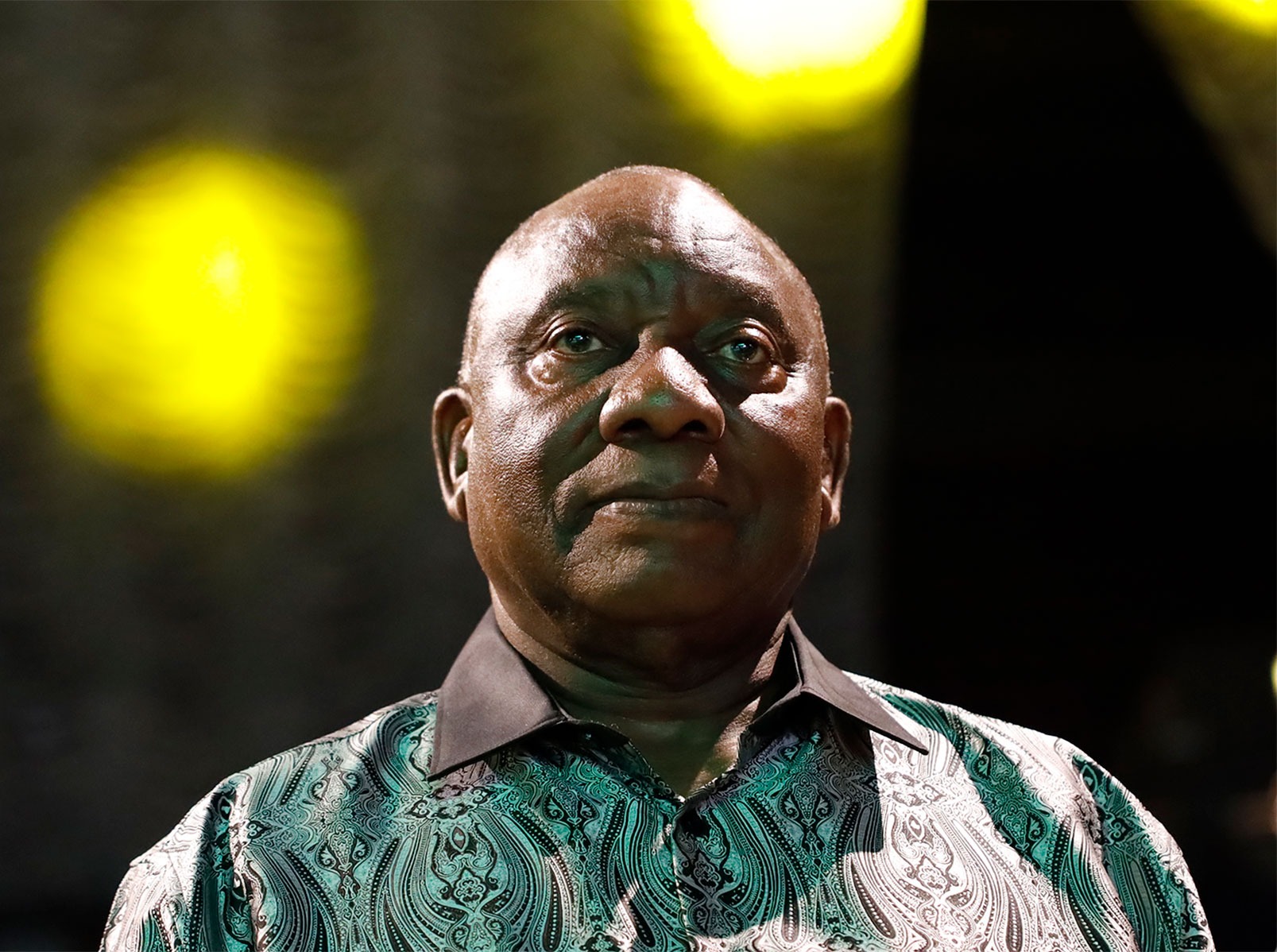
 President Cyril Ramaphosa. (Photo: Gallo Images / Sharon Seretlo)
 As the country moves towards the local government elections scheduled to take place between 2 November 2026 and 31 January 2027, the ANC has placed municipalities at the centre of its political strategy.
/file/attachments/orphans/WFD_1496_997476.jpg "ANC secretary-general Fikile Mbalula, Minister of Mineral and Petroleum Resources Gwede Mantashe and President Cyril Ramaphosa at the Moruleng Stadium in North West at the weekend for the party’s January 8 Statement. (Photo: Felix Dlangamandla)")
/file/attachments/orphans/6I1A0137_601338.jpg "President Cyril Ramaphosa dances with ANC officials at Moruleng Stadium, North West, at the weekend. (Photo: Felix Dlangamandla)")
Criss-crossing North West this week, ANC leaders saw first-hand the daily struggles facing residents of the platinum province, home to illegal mining, where water does not always flow, the electricity supply is intermittent, unemployment is skyrocketing and communities feel unsafe.
These problems are not unique to North West, but are common across the country – and where basic services fail, voters increasingly respond by turning away from the ANC and/or the polls.
/file/attachments/orphans/6I1A0040_881566.jpg "An ANC supporter waves a flag at the half-empty Moruleng Stadium, 65km north of Rustenburg, on 10 January 2026. (Photo: Felix Dlangamandla)")
Against this backdrop, the ANC’s January 8 Statement delivered at the weekend set the tone for what President Cyril Ramaphosa called a year of “decisive action”. At the heart of his address was fixing local government.
Last year, the Auditor General’s 2023/24 report painted a bleak picture of local government, with only 41 out of 257 municipalities achieving a clean audit – about 16% of all municipalities.
Read more: How’s your municipality faring? A visual breakdown of the latest municipal audits
Between 2019 and 2024, the former governing party’s voter support dropped by 17 percentage points nationally to 40%, leading to the formation of the Government of National Unity (GNU), which included the Democratic Alliance, Inkatha Freedom Party and the Patriotic Alliance. The party also failed to garner majorities in provinces such as KwaZulu-Natal, Northern Cape and Gauteng.
Anatomy of a slide
Delivering the party’s mid-term report in December, secretary-general Fikile Mbalula said the party’s decline had been long-standing rather than a sudden rupture.
According to Mbalula’s analysis, a mid-term review between the party’s 2022 and 2027 national elective conferences, the ANC’s misfortune dates back to 2016.
“The electoral setback suffered by the ANC and the democratic movement began in 2016 with the loss of major metros, accelerating with the emergence of over 80 hung councils after the 2021 local elections, and culminated in the 2024 strategic setback when the ANC lost its outright majority in Parliament, Gauteng and KZN,” reads his 294-page report.
In Johannesburg, Tshwane, Ekurhuleni, Nelson Mandela Bay and eThekwini metros, the ANC lost control in the 2021 local elections and was pushed to the opposition benches. Of SA’s eight metros, it only won above 50% in Buffalo City and Mangaung.
With the next round of local elections coming up, the party is determined not to let history repeat itself.
Ramaphosa has often said that public trust in local government was undermined by councillors who were distant, and as such, he urged councillors to reconnect with their wards to rebuild public trust, warning that those who failed in their duties or engaged in corruption should be removed from office.
“Local government remains the sphere closest to citizens’ daily lives, where the injunction of the Freedom Charter that ‘the people shall govern’, must find its most direct expression. We cannot accept dysfunctional, apathetic, uncaring local government,” Ramaphosa said.
‘More than just an election alarm’
/file/attachments/orphans/WFD_1486_477139.jpg "Pemmy Majodina at the Moruleng Stadium in North West at the weekend for the party’s January 8 Statement. (Photo: Felix Dlangamandla)")
Senior NEC member Pammy Majodina, however, told Daily Maverick that the decision to focus on local government had little to do with the upcoming elections.
“Elections will come and go, but services will not go once we fix them and our commitment since 2024 was to fix local government. We are trying to do that, if we fix local government, all of us, especially the members of ANC where we are governing; then people won’t have complaints.”
Majodina agreed with the view that the ANC was great at diagnosing its problems but thin on the implementation of solutions and accountability, which she admitted was changing only now.
“As of late, we have a six-month review of the decisions that we have taken. For instance, we hosted the Water and Sanitation Indaba in March. In September, we wrote to all municipalities to say, ‘what did you do in terms of closing the leaks, disconnecting illegal connections’, so we have a monitoring and accountability method now that we have embarked on to improve on the shortcomings that we have had of not following up on implementation of our resolutions,” Majodina said.
/file/dailymaverick/wp-content/uploads/2025/02/WhatsApp-Image-2025-02-19-at-17.11.11.jpeg "ANC NEC member Thoko Didiza. ( Photo: Phando Jikelo / Parliament of SA)")
NEC member Thoko Didiza echoed these sentiments.
“One of the things we need to do is to be intentional about execution, but that execution would require, in my view, certain elements.”
These elements, according to Didiza, include a “correct leadership” which she said the party already had – a leadership that was sensitive to why the ANC existed. Second, she believes it requires capacity, and people with the capability at local government to execute the “good policies and legal framework” that was there.
Blunt warning
In September last year, Ramaphosa summoned more than 4,000 councillors to Soweto and delivered a blunt warning: “Without you doing anything, we are dead; we might as well pack up.”
At that meeting, he did not shy away from the ANC’s local government failures, citing crumbling infrastructure, poor service delivery and declining audit outcomes. In a striking admission, he even acknowledged that DA-run municipalities often outperformed their ANC counterparts.
NEC member and first deputy secretary-general Nomvula Mokonyane said that the meeting had decided on a 10-point plan to be fully implemented this year.
“We are moving the issues beyond issues of plans, we are now focusing on implementation, holding each other accountable, evaluating the work that we are doing; these are some of the indicators of a renewed way of doing things,” she said.
Ramaphosa added, “Local government has a central role in economic development and job creation. We call on all municipalities to ensure that local economic development plans reflect the comparative advantages of each area and build partnerships with the private sector.” DM