




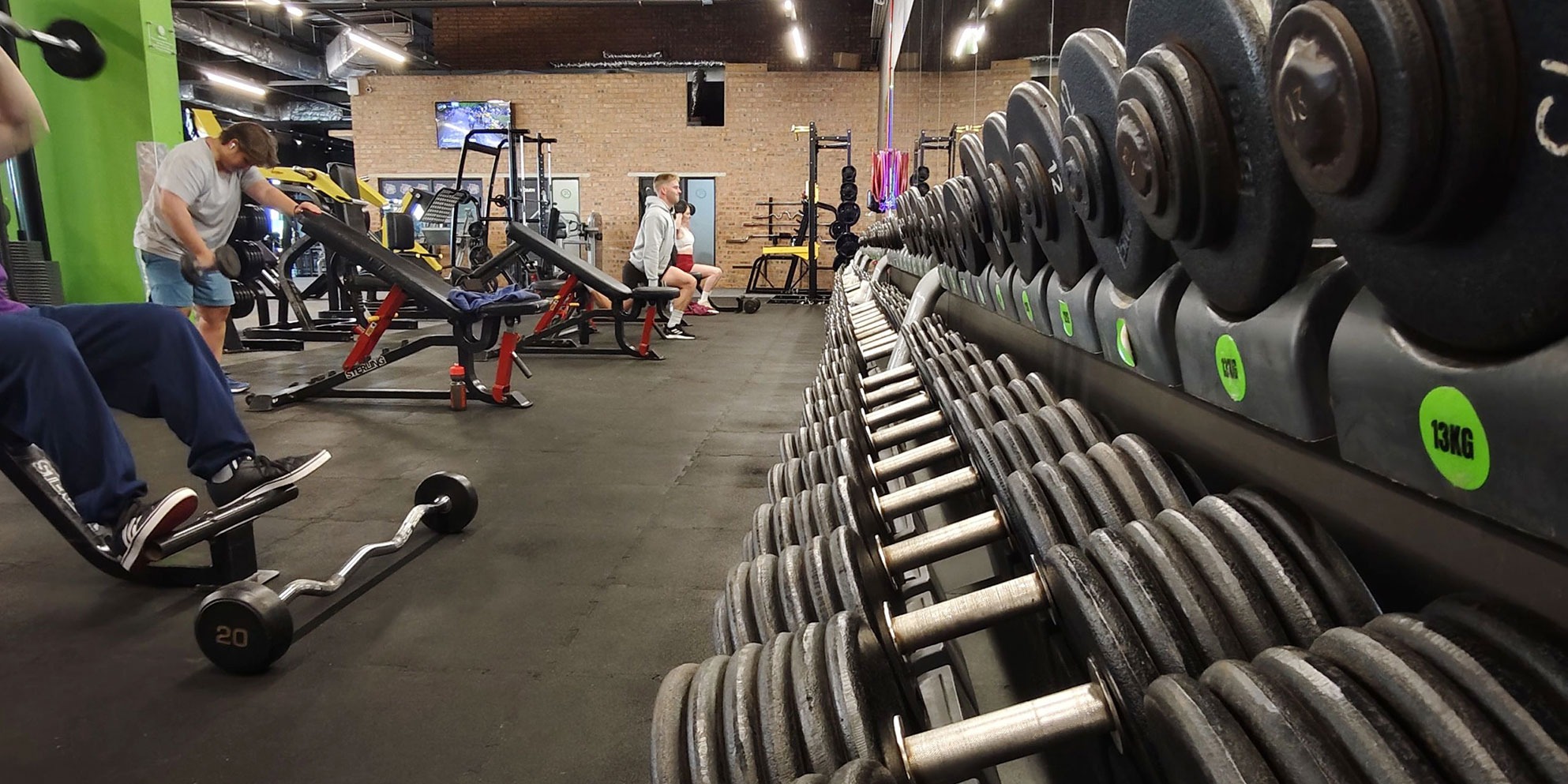
 A new year often comes with health and fitness goals, but many people might not know where to start. While traditional commercial gyms are a good option, there are many alternatives depending on what you want to achieve. (Photo: Supplied / Edge Fitness)
 A new year often comes with new challenges, new goals and new motivation to improve oneself and make “2026 your best year ever” (as many social media influencers have tried to convince me).
One of the most obvious places this outlook manifests is in the gym, where people are eager to improve their health, fitness or appearance, for any number of reasons.
But whether you want to lose weight, pack on muscle or just improve your mental health, there are a myriad training options to choose from – some more traditional and some you might not even know exist.
The traditional gym perspective
Traditional commercial gyms, with exercise equipment, spinning bikes, treadmills and weights, remain a popular option.
The head of fitness at Edge Fitness, Mike Huse, said the group’s facilities across the country have seen the usual New Year influx of members, which he said comes with pros and cons.
“People make the choice to correct some bad decisions and to improve their lives, so they join the gym. January, February and March are always good for business, but we usually see memberships fizzle out after that,” he said.
With more than 20 years’ experience in the fitness industry, Huse said commercial gyms will always appeal to certain people, and Edge Fitness tries to offer as many “boutique programmes” as possible to hook people and keep them interested.
“For many people, training with others and creating a community is the best way to keep them in the gym, and we try to do that through group training, boxfit, martial arts and other programmes. It all depends on individual needs.
“But if you prefer to just lift weights on your own, the traditional gym is still your best bet,” Huse said.
Brazilian jiujitsu
Martial arts has always been synonymous with fitness, but the idea of karate, boxing or any discipline that could get you punched in the face can be daunting for some. For that reason, grappling arts have gained popularity in recent years, especially Brazilian jiujitsu (BJJ).
/file/attachments/orphans/BJJ_551628.jpg "Brazilian jiujitsu black belt Chris Bright (right) demonstrates a technique during a training session. Besides the benefits of physical fitness, jiujitsu also provides a sense of community and self-defence training, while more serious athletes compete at local and international tournaments. (Photo: Supplied / Chris Bright)")
“BJJ really offers something for everyone. For professional competitors it is a very intense physical sport that requires hours of training and hard sparring. But if you are just looking to improve your health, lose weight or build confidence, it is very accessible to people of all ages and fitness levels,” BJJ black belt Chris Bright said.
Bright runs the PE Submission Fighting Academy, a martial arts gym in Nelson Mandela Bay that offers BJJ, boxing and mixed martial arts classes. And while his gym has produced world champion fighters, it is also offers classes for kids, beginners and women only.
“On any given night you can find teenagers, students, IT technicians, school teachers, accountants, mechanics, people from all walks of life, training together. They have a common goal – to improve themselves.”
A typical BJJ class lasts a little over an hour and consists of learning and drilling a new technique before participants engage in five-minute rounds of active “sparring”. It is a full body exercise with no emphasis on specific muscle groups.
As with most physical exercises, BJJ has proven to have significant mental health benefits, and Bright said many parents with autistic children have noted the positive impact of BJJ training on their children.
Being a martial art, the sport also doubles as a form of self-defence training, with techniques and positions aimed specifically at subduing opponents from compromising positions.
The sport does not require any expensive equipment to get started, and the difficulty level can be catered to each individual’s needs.
Much like wrestling, judo and other grappling sports, it does require close proximity and physical engagement with other people. However, classes should be monitored by experienced coaches who facilitate a safe and comfortable training environment.
Rock climbing
Since the introduction of speed climbing and bouldering as official Olympic sports in 2020, the popularity of rock climbing as a hobby and sport has skyrocketed.
But if the idea of clambering up a 15m wall in under 7 seconds, or dangling from a sheer cliff, does not appeal to you, facilities such as Valley Crag in Nelson Mandela Bay have made the sport more accessible.
/file/attachments/orphans/Valley-Crag-2_156512.jpg "Rock climbing has grown in popularity as both a hobby and a competitive sport. It offers various degrees of difficulty in a safe environment, and can be practised both indoors and outdoors. (Photo: Supplied / Valley Crag)")
“We see individuals come through our doors to try something new, or we host kids parties and corporate functions, and then people become hooked. On the day, they enjoy the activity, and the next day, when they feel how sore their muscles are, they realise that they can actually get a workout while having a lot of fun,” Valley Crag general manager Melanie Jacobs said.
While grip strength and upper body muscles are important, Jacobs said rock climbing is a full-body workout that requires just as much leg and core engagement, depending on the course.
“Besides physical strength, balance and coordination, cognitive function is also crucial. There are also immeasurable mental health benefits as the sport forces you to focus on the task at hand and to leave behind any stress and anxiety you might have carried with you.”
“And courses come in varying degrees of difficulty to cater for all levels. We have kids, people in their 70s, and even people that are wheelchair bound who participate.”
Jacobs said the initial interest often escalates, and people start attending their ClimbFit classes or take up other forms of training to improve their climbing abilities.
Because their facility is indoors, training is not weather dependent. However, there is also a large community of outdoor climbers for anyone looking to try something more adventurous.
The sport requires very little equipment to get started, and most climbing facilities should have the necessary gear available to rent for people just starting out in the sport.
Belly dancing
While the origins of belly dancing may be up for debate, it can be traced back to a couple of centuries ago, somewhere in the Middle East. But its reputation as a global dance form and popular exercise dates to the 1800s.
In Nelson Mandela Bay, Jessica Perelson and the Flame Lily Belly Dance Studio have developed a tight-knit community of women who find comfort in expressing themselves through this form of dance.
/file/attachments/orphans/Belly-Dancing-1_887097.jpg "Geared more towards women, belly dancing is a low impact activity that focuses on core strength. It also provides a safe environment for participants to build confidence and create body awareness and positivity. (Photo: Supplied / Flame Lily Belly Dance Studio)")
“Belly dancing offers a low impact, core centric form of exercise. The level of intensity can vary, and for truly professional dancers, it can turn into an intense cardio workout,” Perelson said.
She said the discipline had become very popular in recent years until the Covid-19 pandemic caused a significant drop in numbers. However, it is slowly recovering and she said the belly dancing communities across the country are becoming bigger and more popular.
“It offers exercise that is different from the mainstream. Not everyone is sporty and athletic, but it offers a way for anyone to be active, to have fun and to build confidence in themselves regardless of their body type, age and fitness level.
“For those same reasons we have seen the positive impact it can have on people’s mental health.”
Perelson said while there are studios who welcome men as well, most studios, like Flame Lily, are exclusively for women.
“This creates an environment where more women can feel comfortable and confident within a community of other women. They can let go and allow their emotions to flow freely and express themselves through their dance.”
Dog yoga
If this year is less about improving your physical fitness, and you are just looking for an activity to boost your mood, reach out to the team at Woodrock Animal Rescue in Gauteng and enquire about their dog yoga programme.
It started as a way for the animal shelter to raise awareness about its projects and raise funds for the day-to-day running of the facility, but dog yoga soon became a popular activity for corporate events.
/file/attachments/orphans/Dog-Yoga_982499.jpg "If relaxation, flexibility and mental health are a priority, dog yoga offers the opportunity to engage with therapy animals in a stress-free and controlled environment, and participants can gauge their own level of intensity of the actual workouts. (Photo: Supplied / Woodrock Animal Rescue)")
Woodrock’s head of innovation, Jax Martheze, said the shelter was not surprised by how popular the dog yoga events proved to be as they never failed to put a smile on participants’ faces.
“While there is a qualified yoga instructor, helping people through a series of poses catering to each person’s individual skill level, many participants just want to plop themselves on the floor and play with the dogs,” Martheze said.
She said the dogs used for yoga are all well-trained therapy dogs that have been specially selected to form part of the programme. The shelter also hosts events at specific locations, within a curated environment, for the best possible experience.
“All our therapy dogs are rescues, but pedigree, and undergo continuous behavioural programmes and medical checks to ensure the highest standards of health and safety, but also to give them the ability to interact with people in a meaningful way. We also prefer smaller breeds, because not all people are comfortable around bigger dogs.”
Martheze said because of their specialised training the therapy dogs are often able to identify people with pre-existing social or anxiety concerns in a crowd, and sit or interact with them throughout the session.
She said the popularity of the programme has highlighted the need for more events geared less towards physical training and more towards a mental health-focused approach.
“There are dog lovers who still want to do the headstands and more intense yoga poses, but for the most part people just want to giggle at the puppies and de-stress. They get to interact with the animals and other people in a completely safe environment,” Martheze said. DM