



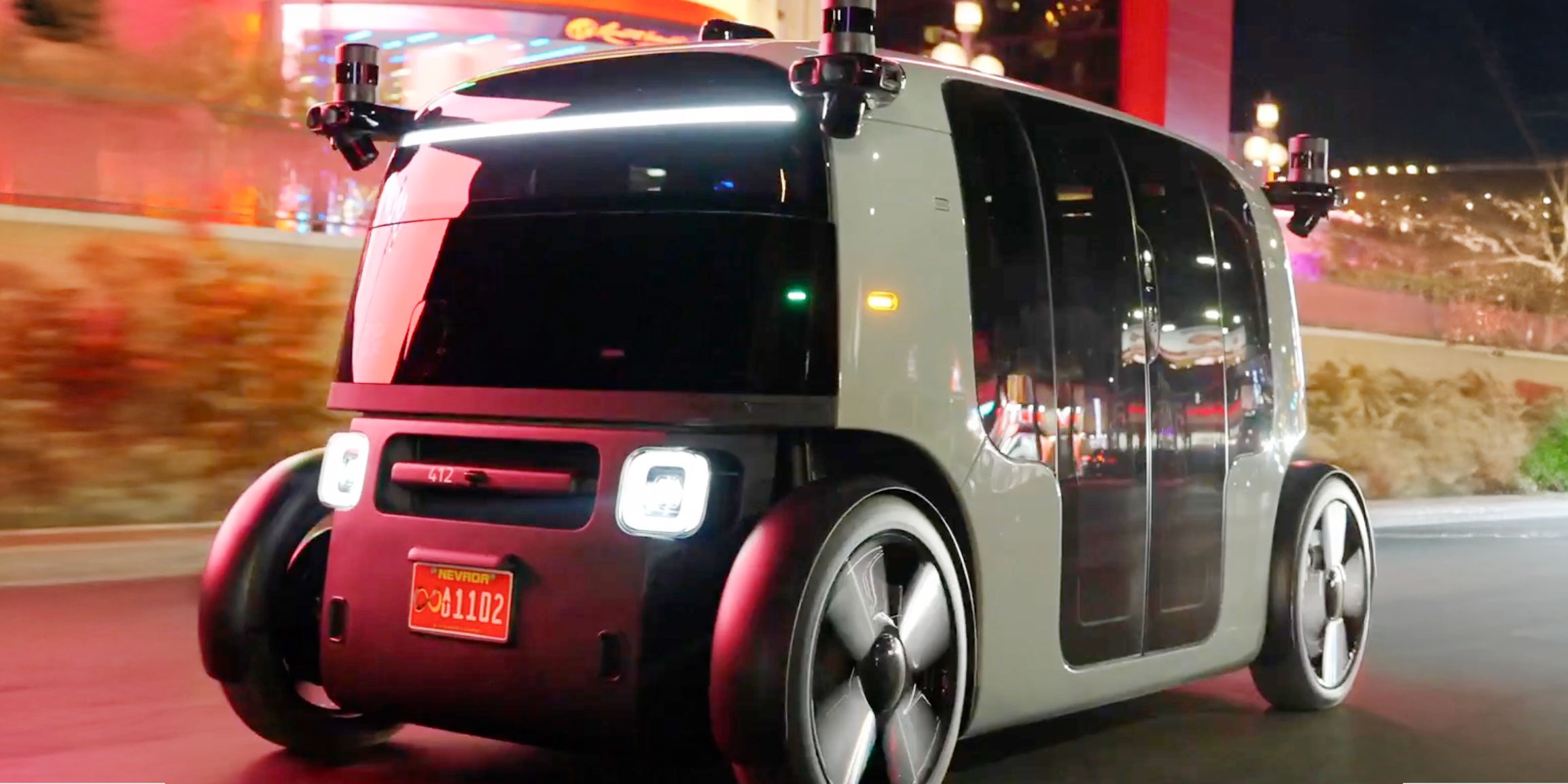
 A new generation of autonomous robotaxis, like this Zoox by Amazon, displayed at CES 2026 in Las Vegas, showcases how Physical AI is driving the next wave of innovation. (Photo: Supplied)
 A long time ago, I used to attend the Consumer Electronics Show (CES) in Las Vegas every year. I was living in LA at the time and was involved with various companies that were producing hardware and content at the intersection of tech and entertainment. It was great fun, but mainly restricted to games, toys and gadgetry.
The CES has grown into the most important venue to show hot-off-the-press, breakthrough consumer innovations across every field imaginable – all fuelled by advanced tech, including AI. This is the stuff that will soon end up on neighbourhood shelves, showroom floors and in virtual stores, replete with prices, return policies, customer support, terms and conditions and fancy packaging.
CES 2026 has just been held in Las Vegas. This year’s event sprawled across more than 2.5 million net square feet of exhibit space, hosting more than 4,000 exhibitors and attracting an estimated 140,000 industry professionals and sometimes overwhelmed buyers from 150 countries. Like most years, the show has attracted its own buzzword: “Physical AI.” (To be fair, the term has been in common use within AI for some time, but the consumer power of the CES drops it loudly into the centre of the public sphere). Things that use AI to operate and move in physical space are all the rage, from humanoid robots to kitchen appliances to toys to... autonomous vehicles.
It is this last sector that deserves some unpacking, largely because it is a raging battlefield with no victor yet in sight.
First, we need to back up. Self-driving vehicles have long been a dream, going back as far as Da Vinci (sort of – it was a sketch of a programmable spring-powered cart). This was followed much later by plans and prototypes in pretty much every decade of the 20th century. In the early 2000s, the US military (Defense Advanced Research Projects Agency, DARPA) realised that academic and corporate progress was stalling. So they launched a series of desert and urban races that became the “Big Bang” of modern AV technology.
While Elon Musk and Tesla have received most of the headlines since, the first serious AV attempt was cloaked in secrecy. It was Google, and it was 2009. The first public reveal was in 2010, and in 2016 the AV team was spun out as Waymo – now an independent Google-owned company and considered the leader in the field by most analysts. Musk first made mention of his AV aspirations in 2013 and went into full gear with his development programme for a driverless Tesla in 2016, right around the time that Waymo spun out.
That’s the potted history of the field. We leap forward to CES 2026 and the landscape is completely different, partially due to the arrival (unsurprisingly) of several Chinese entrants.
It’s a noisy and sparkling mess. Chaotic. Crowded. Innovation after innovation. An embarrassment of riches, perhaps. Hyperbolic claims. Lots of flash and gloss and bluster. Also, some real on-the-road successes. And while many of these vehicles have reached “Level 4” (truly driverless in extensively mapped and constrained urban areas like Waymo/Phoenix, or on freeways), no one has yet reached “Level 5” (driverless anywhere, anytime, under any conditions), which has been optimistically promised by some for 2026.
Here is the scrum:
Besides Waymo and Tesla, the CES had splashy announcements and showcasing of other US-designed competitors – Amazon’s robotaxi Zoox (yes, Amazon), Rivian and Kodiak (in partnership with Bosch). Then there is Lucid (their AV has been co-designed with Uber, which gives real go-to-market power for their planned 2026 roll-out) and California-based Tensor with their somewhat confusing claim to offer the “world’s first Level 4 autonomous car you can own privately”.
But wait, there’s more. Korea-based Hyundai recently acquired humanoid robot maker Boston Dynamics and is now talking to Nvidia about their AV aspirations. And China! I won’t even try to go too deep into the bustling crowd, some of whom were on display at the CES; the feature list is too long. A list of the major AV car manufacturers in China will give the gist: Geely, BYD, Xiaomi, Huawei, Pony, WeRide and presumably others that no one in the West has heard of.
Finally, the keynote address from Jensen Huang of Nvidia, who, while commenting enviously on the goldmine of data owned by Tesla, also announced Nvidia’s “Alpamayo”. It is a major new market for the company. It represents their move from providing just the “hardware” and “low-level software” for cars to offering a full “Physical AI” ecosystem that teaches vehicles to think and reason like humans. Huang described Alpamayo as the “ChatGPT moment for physical AI”, where machines transition from just reacting to their environment to actually understanding and reasoning through it.
This is all very, er, fast moving. A little like a sped-up sci-fi movie. There will be challenges (Waymo cars got confused this December during a power blackout in San Francisco and just stopped in the middle of the road). There will also be casualties – there are simply too many horses in this race and some are going to get exhausted and limp away. There will be pivots to other markets – trucks, planes, seacraft, industrial robots and consumer robots. There will be protests by both environmental and labour activists (against robotaxis), as well as price grumbles and accusations of class-based exclusion as the industry scales up commercial viability.
But here are the projections: 35% annual growth and a trillion-dollar market by 2035. Which means a tsunami of capital into the sector and the migration of some of the world’s smartest engineers into those companies racing for glory. We are witnessing an entire industry moving from prototype to explosive commercial deployment in real time.
Forget about LLMs and chatbots, which have lost a bit of lustre recently, mostly driven by hyperbole fatigue. Physical AI is where the action will be for the next few years because machines that think are simply not as interesting as machines that think and move. DM
Steven Boykey Sidley is a professor of practice at JBS, University of Johannesburg, and a partner at Bridge Capital and a columnist-at-large at Daily Maverick. His new book, It’s Mine: How the Crypto Industry is Redefining Ownership, is published by Maverick451 in South Africa and the Legend Times Group in the UK/EU, available now.