




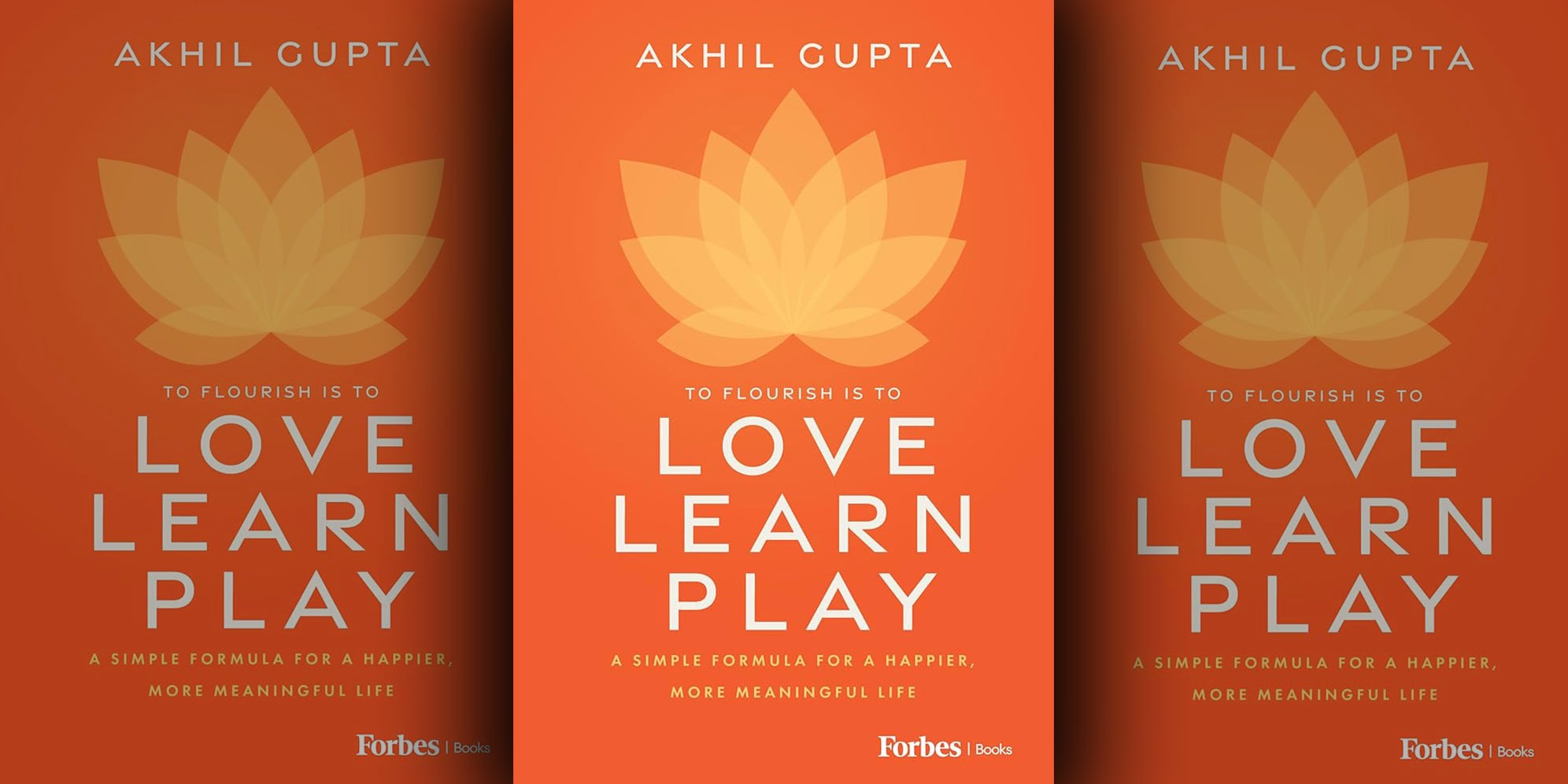
 Love, Learn, Play by Akhil Gupta is published by Forbes Books. (Image: Forbes Books)
 In his latest book Love, Learn, Play, Akhil Gupta – who Daily Maverick interviewed about his previous book, Bridges Across Humanity – draws inspiration from both ancient traditions and modern science to reveal that loving, learning and playing are not luxuries or ideals, but are core to our nature and essential flourishing. With clarity, humility and deep wisdom, Gupta challenges conventional success narratives to help readers reconnect with their authentic selves, dispel cultural myths and bring renewed meaning to every domain of life. Here is an excerpt.
***
How culture defines happiness
“Culture makes people understand each other better. And if they understand each other better in their soul, it is easier to overcome the economic and political barriers. But first they have to understand that their neighbour is, in the end, just like them, with the same problems, the same questions.” – Paulo Coelho
Anyone who has ever travelled abroad understands that every place has its own cultural norms. In some countries, smiling at passers-by is very normal. In others, it could be considered strange, disturbing and maybe even a bit scandalous. In certain regions people are expected to bow, and in very specific ways, for specific occasions. Failing to do so, even if by mistake, would be considered extremely rude.
This principle holds true in different parts of the same country as well. In the US, for example, people in big cities in the Northeast, such as New York City, mostly ignore each other on the street or during a walk in the park. However, when I was visiting Dallas and Austin, I was surprised that everyone I met while going for my walks greeted me with a genuine smile and waved hello. It is common practice in many parts of the South and the Midwest for people to greet strangers. Differences in cultural norms, however simple, can have significant impacts on happiness.
Participation in communal affairs and traditions can be paramount to happiness. Teatime is a good example. In many cultures, there are specific occasions or times of day reserved for gathering around with family, friends or others to enjoy some tea. There are lots of ritualistic elements built into this – the way the tea is prepared, how it is served, what it is served in, what it is served with, how to drink it, etc. People find bonding, happiness and meaning in such ritualistic practices. Similarly, every culture has its own holidays, its own assortment of spiritual and religious practices, and so on. I remember while growing up in India, we celebrated all the Hindu festivals but also Eid and Christmas – and I was always looking forward to the next holiday.
Like happiness, culture is a very broad topic. It has been defined in a multitude of ways by many different thinkers throughout history. We do not get to choose which culture or religion we are born into. As the prophet Muhammad said, “No babe is born but upon Fitra [natural way]. It is his parents who make him a Jew or a Christian or a Polytheist.”
Just as none of us were born with any preprogramming on how to view the world, so too did our species emerge without much guidance on how to understand the universe; we were given the hardware necessary to find meaning, but no instruction manual for how to do so. Since then, populations of human beings in different times and places across the world have been stumbling through, doing their best to figure things out or make meaning of their existence.
How temperaments and vocations influence happiness
By now it should be clear just how different we are in so many ways and how cultural differences contribute to how we each define, imagine and experience happiness in our lives. These differences also affect the pathways by which we each try to seek out happiness within our respective societies. One of the main tracks to fulfilment is our choice of vocation and how it may stem from one’s personality and temperament.
As human societies have become more complex over time, new vocational opportunities have continued to emerge, opening more possibilities for how we can fit ourselves into society. We all have our own preferences for which types of jobs we find fulfilling and enjoyable and which ones we don’t. Many of us are familiar with personality tests and frameworks, such as the Myers-Briggs Type Indicator, which attempt to systematise personality differences to help people figure out which career paths will make them most happy.
We are lucky that we have the freedom to choose which types of jobs, careers and social roles to pursue in our lives, but this has not always been the case in all times and places. Plato, in his Republic, imagined an ideal society in which people with certain proclivities would be essentially forced into one of three social classes that fit them best: rulers, traders or soldiers. He emphasised the importance of matching individuals with their natural aptitudes for the good of the state. Similarly, the four Hindu Varnas – Brahmanas, Kshatriyas, Vaishyas and Sudras – were indeed descriptions of social classes, but they were understood to correspond to the natural temperaments and proclivities of individuals. In the Bhagavad Gita, they are described as follows:
“Of Brâhmanas and Kshatriyas and Vaishyas, as also of Sudras, O scorcher of foes, the duties are distributed according to the Gunas (temperaments) born of their own nature. The control of the mind and the senses, austerity, purity, forbearance, and also uprightness, knowledge, realisation, belief in a hereafter – these are the duties of the Brâhmanas, born of (their own) nature. Prowess, boldness, fortitude, dexterity, and also not flying from battle, generosity and sovereignty are the duties of the Kshatriyas, born of (their own) nature. Agriculture, cattle-rearing and trade are the duties of the Vaishyas, born of (their own) nature; and action consisting of service is the duty of the Sudras, born of (their own) nature.”
Over time, the descriptive nature of Varnas began to erode. The concept of jati (birth-based groups) started to intertwine with the Varna system. The transformation from a descriptive framework to a prescriptive caste system was a complex process driven by a confluence of factors. The interplay of religious ideology, political power, economic forces and social norms contributed to the entrenchment of a rigid and discriminatory social order, which has been one of the banes of Indian society.
Recognising the different temperaments intrinsic to our society, the Bhagavad Gita presents three diverse paths to moksha (liberation), or the ultimate goal of flourishing. Each path is tailored to individual temperaments. Primarily, these are Bhakti Yoga (the path of devotion), which is ideal for those with an emotional nature; Jnana Yoga (the path of knowledge), suited for those with an intellectual inclination; and Karma Yoga (the path of action), for those with an active disposition.
Bhakti Yoga, the path of devotion, embodies the essence of love. It emphasises cultivating a loving connection with a higher power or a chosen ideal. This love is not possessive or conditional; it is a surrender of the ego to a greater force. In our daily lives, this translates to cultivating love and compassion for ourselves and others. When we approach relationships with empathy and kindness, we embody Bhakti Yoga. Just as Bhakti Yoga involves surrendering to a divine entity, it also means surrendering to love itself, allowing it to guide our actions and shape our interactions. This describes my mother’s temperament.
Jnana Yoga, the path of knowledge, directly corresponds to the act of learning. It involves the relentless pursuit of truth through intellectual inquiry and self-reflection. We delve into subjects that ignite our passion, seeking to understand the world and ourselves on a deeper level. This journey of learning becomes a transformative experience, leading to self-realisation and liberation from ignorance. This was the temperament of my father.
Karma Yoga, the path of selfless action, aligns beautifully with the concept of play. It emphasises performing one’s duties without attachment to the results, finding joy and fulfilment in the act itself. This mirrors the essence of play, where the process is paramount and the outcome is secondary. When we engage in activities with a playful spirit, whether it’s work, hobbies or social interactions, we embody Karma Yoga. We act with dedication and enthusiasm, not for personal gain but for the sheer joy of participation. This transforms mundane tasks into opportunities for self-expression and connection, fostering a sense of flow and engagement. Just as a child loses themself in play, a karma-yogi becomes absorbed in their actions, transcending ego and connecting with a deeper sense of purpose. This has been the guiding principle of my life.
When we align our vocation with our inherent temperament, we create fertile ground for happiness. A person with a natural inclination towards service may find immense satisfaction in healthcare, while an analytical mind might flourish in scientific research. This alignment transcends mere job satisfaction; it fosters a sense of purpose and fulfilment. DM
Love, Learn, Play: A Simple Formula for a Happier, More Meaningful Life is published by Forbes Books. It is available at a retail price of R596.