




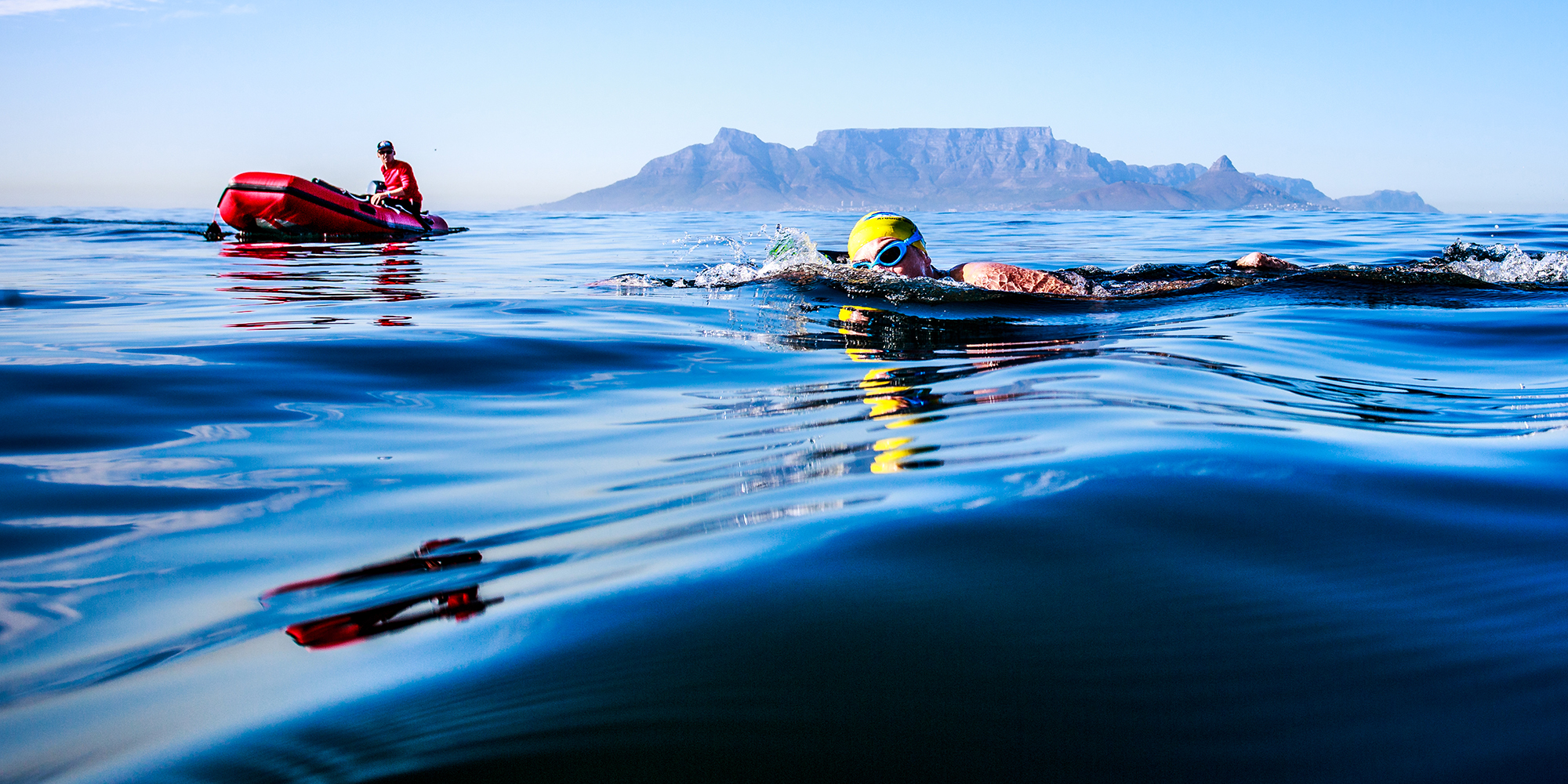
 There is no such thing as an easy Robben Island swim, even in perfect conditions. (Photo: Chris Hitchcock)
 /file/dailymaverick/wp-content/uploads/2025/10/label-Op-Ed.jpg)
The first mention of an attempted swim from Robben Island to the mainland is found in a short article in the Cape Times of 1876, neatly filed in the South African National Library. One can only assume that the hype of Matthew Webb’s English Channel success of the previous year motivated an enthusiastic Cape Town swimmer to attempt the feat. It was not successful.
It was 33 years later that Henry Hooper successfully swam the 12km from Robben Island to Roggebaai in a silk bather. In 1969, Pater Bales became the first South African to swim the English Channel, arriving in Dover having never worn a pair of goggles! He returned to Cape Town to a hero’s welcome and founded the Cape Long Distance Swimming Association to record and observe each sea swim in Cape Town. It followed English Channel swimming rules. A Speedo-styled bathing costume, a simple swimming cap and goggles is all they allowed. Nothing else!
Still only a few swimmers attempted the Robben Island crossing annually, until the 1980s when the numbers grew from one or two a year to one or two dozen.
A ceremony in Cape Town in 1989 marked the awarding of medals for everyone who had swum Robben Island since Henry Hooper. Internationally the Robben Island crossing had become known as a 7.4km icy swim with treacherous currents and changing seas, or the longer 12km swim from the island to Three Anchor Bay, which is no longer permitted by the authorities because it crosses harbour approach lanes.
Today, hundreds of athletes swim the famous route each year, which is still regarded as the pinnacle achievement for sea swimmers in Cape Town. Swimmers can expect sea temperatures of between 12°C and 15°C, a sea that can change abruptly, a fierce, beating sun and bountiful sea life, from jellyfish, blue bottles and seals, to dolphins, whales and, on rare occasions, sharks.
/file/dailymaverick/wp-content/uploads/2021/08/Phyllis-Annie_2.jpg "Robben Island during a 12-hour night vigil to pay homage to Nelson Mandela, Robert Sobukwe and Albertina Sisulu on 5 December 2018 in Cape Town, South Africa. (Photo: Gallo Images / Netwerk24 / Jaco Marais)")
/file/attachments/orphans/ED_390554_528210.jpg "Robben Island on 20 July 2022, South Africa. The island is most famous as the place where former president Nelson Mandela, the first democratically elected president of South Africa, was imprisoned. (Photo: Gallo Images / Misha Jordaan)")
/file/attachments/orphans/cldsa-history1_472878.jpg "The Cape Long Distance Swimming Association in the late 1960s. The association was formed to officiate and record Robben Island swims. (Photo: Cape Long Distance Swimming Association (CLDSA) / Wikipedia)")
The most common cause of failure is the freezing water. Hypothermia is the biggest challenge. Years of research show that cold acclimatisation is the most practical way of combating the cold. Two to three hours in a sea of 13°C requires serious training, fierce determination and an experienced seconding team. One needs the mental resilience of an astronaut to overcome these challenges.
Swimming the identical swim in a wetsuit cannot be compared to a skins or a naked attempt. Gone are the major obstacles. The icy sea, the blazing sun, blue bottles are no longer a problem. The neoprene suit improves buoyancy, makes the swimming style more efficient and faster and keeps out the killer freezing water. The only common denominator is the distance.
Read more: The loneliness of the long-distance swimmer: life, the universe and everything
/file/dailymaverick/wp-content/uploads/Oped-Cassar-SwimTW-inset.jpg "Capetonians Eddy Cassar and Gary Laing on their swim from Robben Island to Blouberg. (Photo: Supplied)")
The thrill of witnessing the rapid growth of the sport of sea swimming is wonderful and that many more people are taking up swimming is great. At the end of the day it makes for a healthier nation, but one cannot compare the depth of the challenge of a skins swim to that of a wetsuit attempt.
/file/attachments/orphans/600px-Peter_Bales_663660.jpg "Peter Bales, chairman and founding member of the Cape Long Distance Swimming Association.<br>(Photo: Open Water Pedia / Wikipedia)")
(Photo: Open Water Pedia / Wikipedia)
Eighty-five year old Peter Bales, who still swims regularly, says that in hindsight we should have created a wetsuit sea swimming association, totally separate from the Cape Long Distance Swimming Association which records skin Robben Island crossings only, since they are two very different feats. DM
Eddy Cassar first swam Robben Island in 1986 and has been swimming ever since. He is a life member of the Cape Long Distance Swimming Association and still swims Robben Island in skins.