




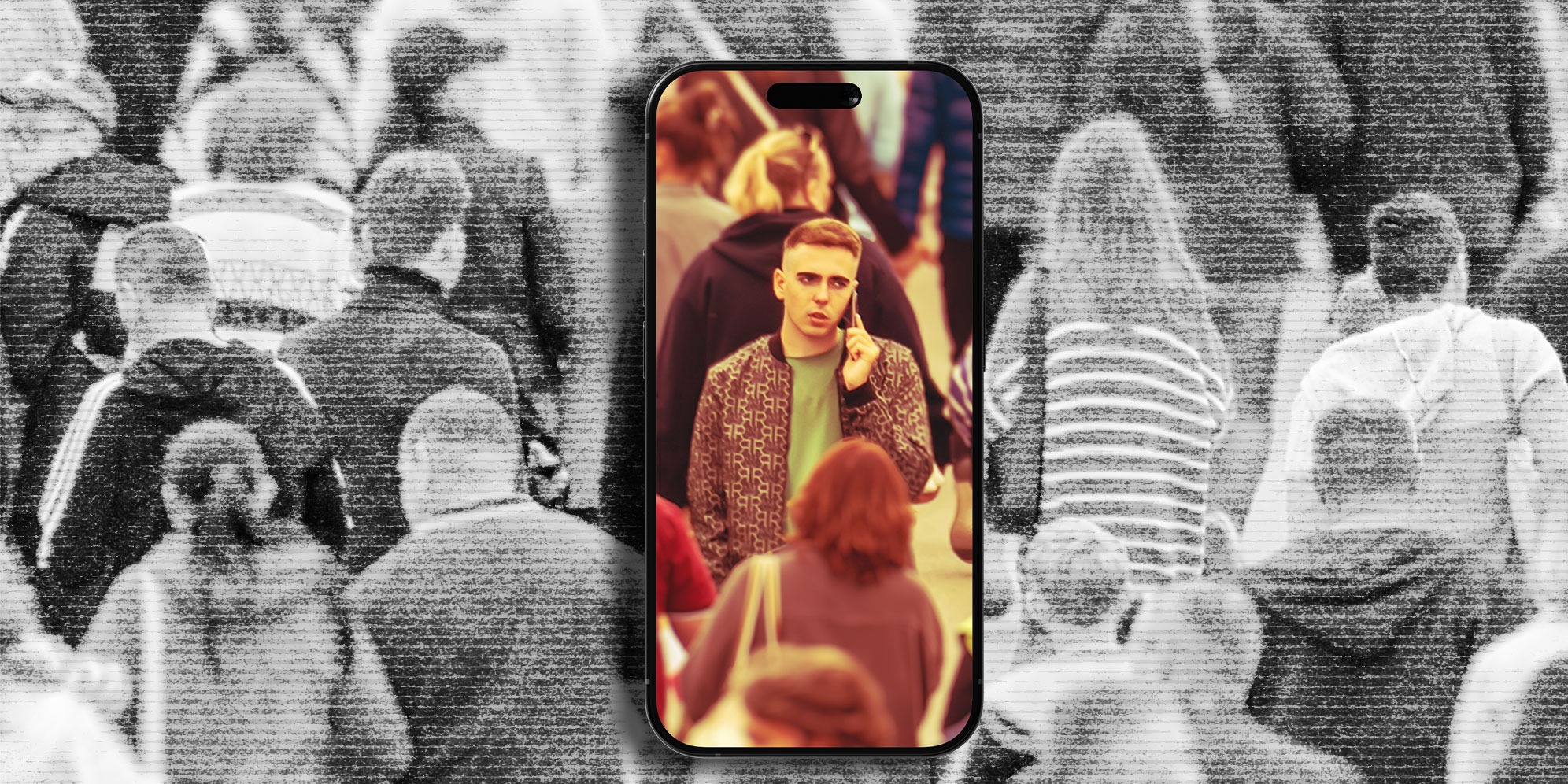
 Illustrative Image: Phone mock-up. (Photo: Resource Boy) | Crowd. (Photo: iStock) | (By Daniella Lee Ming Yesca)
 There was a moment during our family holiday when someone asked me where my phone was.
I am so pleased to tell you that I had absolutely no idea.
And in fact, after thinking about it for a moment, I decided to deliberately leave the phone at the property where we were staying, and head to the beach.
I knew the phone was somewhere in the house. I wasn’t worried about losing it. But the sheer pleasure of just leaving it behind, of not knowing, not caring and not worrying about it, was such a joy.
It reminded me of earlier, and what sometimes feel like less-complicated, times – when I could jump into a car and head off, not worrying whether I had this thing in my pocket.
It also reminded me of a time when I did have a phone but I controlled it, rather than it controlling me.
It was the early 2000s and, like other young men of the time, I loved my phone. It was a silver Motorola Timeport T250.
One of the reasons I bought it was because I simply fell for the idea that it was multiband. Basically, you could use it anywhere on Earth where there was a cellphone signal (in those days different parts of the world sometimes used different spectrum bands for cellphones).
Amazingly though, when I got to work I would put it in my jacket pocket, and hang my jacket on a central hook. I wouldn’t look at it again until the end of the day. Or, if I was expecting a call, perhaps at lunchtime.
If you are under the age of about 45 you might find that difficult to imagine. But it was what everybody I worked with did.
I only used the phone to make calls and to read SMSes.
Now I have come to understand, with some horror, that many people younger than me don’t take calls. They say that speaking to a real, live person makes them anxious.
This is a greater threat to humanity than Donald Trump. Because when we reduce communication to just text, or let emojis made by someone else do it for us, we become less than fully human.
After a few days back in the office (please feel free to join me in a collective moan at this thought) I thought it would be interesting to see what I had been doing on my phone.
I am not a member of the My-Phone-Cult, rather a paid-up subscriber with those who are not paranoid about Android.
It took me about five seconds to find out that my daily average screen time over the past seven days was about two hours and 17 minutes (to find your own on Android go to “settings”, search “screen time”, then “screen time goal” and then click on the graph icon in the top right-hand corner.
You will not be at all surprised to find out that most of my time was spent on WhatsApp.
I often think that if Meta shut down what is still a free service, our entire economy would come to a screeching halt.
Of course, my Android phone is not the end of my screen time. I don’t write on a phone, I do have a separate device for that.
And that happens to be part of my sellout to the cult.
It’s an iPad with a keyboard and my daily average since Monday this week is about three hours and 34 minutes a day. I must be honest here: It’s not the only device I use. I do spend a lot of time every day using a device that belongs to an employer. (To check yours in Apple to go to “settings”, search “screen time” and go from there).
Most of the time is not on WhatsApp (although finally, after a very long wait, there is a WhatsApp app for iPad), but on Google Documents. I have yet to be replaced as the writer of After the Bell by ChatGPT. (Never! – Neesa)
Interestingly, both Apple and Android include options to limit your screen time, to try to help you cut back on it.
If you do your own check and come away slightly concerned, just know that you are among a very large group of people who spend too much time looking at a screen.
Research has found that South Africans spend more time on their phones than virtually anyone else.
I think the reason for this is that, as fibre-based data becomes more available, the cheapest way to consume social media, or watch something, or simply entertain yourself, is to use your phone.
So many people don’t have a large TV or even a couch to sit on to watch it. So they sit wherever they sleep, or on a paint tin, or stand around, and use their phones.
While I have given up on New Year’s resolutions, there is one thing I’m going to try.
When I get home from work in the evening, I’m going to try to set the alarm for the morning and leave it in my room. To try to make sure I have a few hours every day when I’m not using it, and not looking at it.
I’ll know where it is. I just won’t care about it. DM