




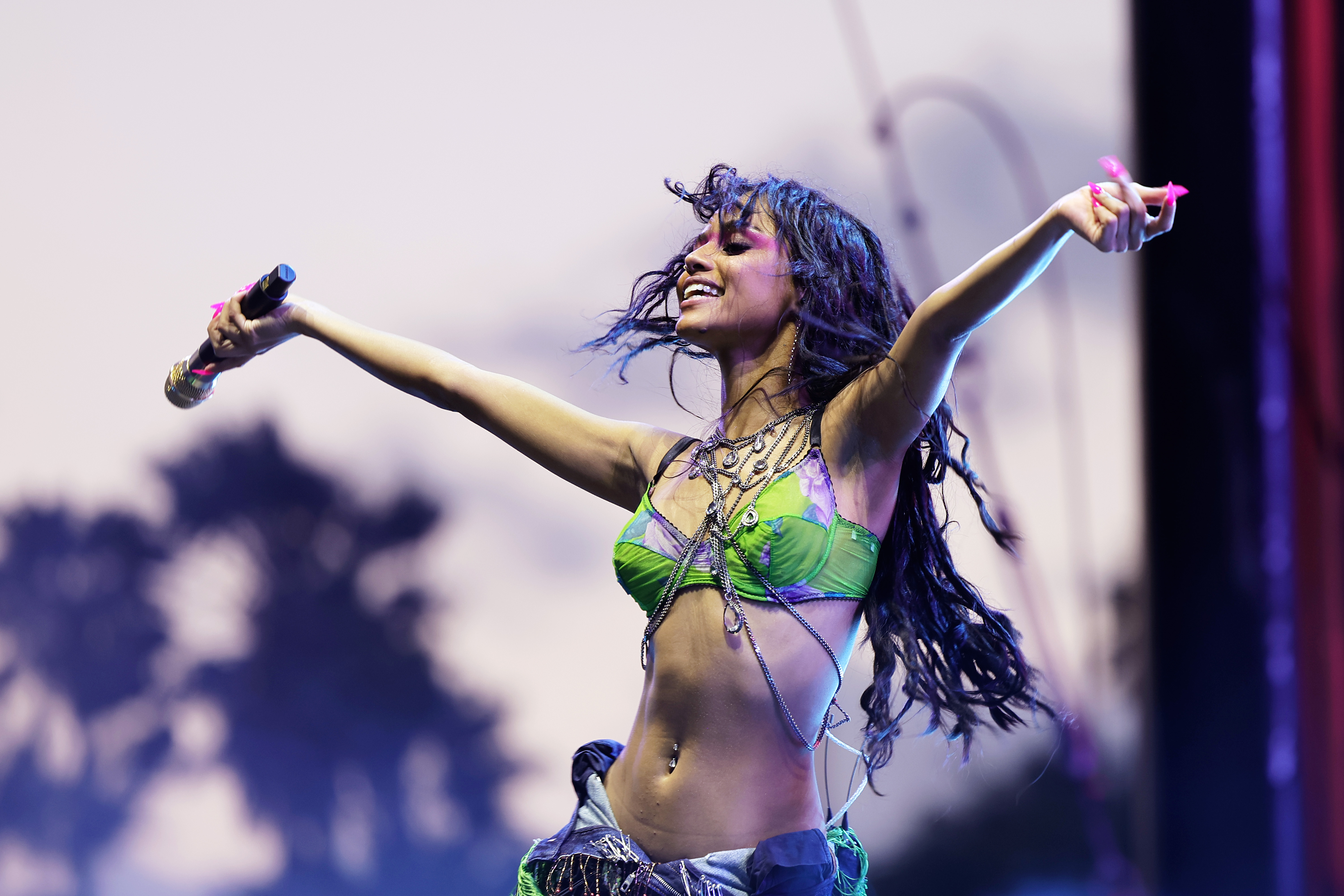
 Tyla performs on the Coachella stage during the 2025 Coachella Valley Music and Arts Festival on 18 April 2025 in Indio, California. (Photo: Maya Dehlin Spach / Getty Images)
 Buzz words and fads aside, 2025 was an underwhelming year in popular music. Albums that morphed into cultural movements like Charlie XCX’s Brat were at a premium abroad, while locally, though amapiano still slaps, the scene is just not churning out the hits quite like 2023.
However, where popular music faltered, the underground scene really began to simmer in ways that elicit genuine excitement about where the rest of the decade can be. Here are a few trends to look out for in 2026, both locally and abroad.
Is amapiano fatigue real?
We all have that one friend who is an edgelord preaching “amapiano is falling off”. But I’m glad to inform you and any other lovers of the log drum that this is simply not true.
Amapiano, or yanos, is still the number one genre in Mzansi and without a doubt our beloved Rainbow Nation’s most potent cultural export. What is true, though, is the growth of other genres in the country that are either a derivative of the now global genre or inspired by its aesthetics.
In 2025, 3-step and Afrotech took a leading role on South African and international dancefloors. Ciza’s Isaka was unequivocally the soundtrack of the year and will likely go down as the genre’s breakthrough record. 3-step is likely to be at the epicentre of South Africa’s biggest hits in 2026 and beyond.
Hip-hop was the greatest casualty in the rise of ’piano (I hope you read that with the thickest South African accent), but the genre is showing signs of not backing down without a fight.
Four Horsemen, Stogie T’s mammoth record with fellow stalwart Maggz and contemporary greats A-Reece and Nasty C, was the genre and community’s “moment of the year”. It’s celebration of penmanship and pure rap skill was a fitting finale to a year in which South African hip-hop had a bit of a reckoning.
The infamous 5FM interview between DJ Speedsta and K.Keed turned out to be a silver lining on what have been the genre’s cloudiest days since rappers were seen as nothing but “ama-YoYo” and “American wannabes” in the early 2000s.
It’s looking more likely that South African hip-hop in 2026 will be aiming to appreciate and celebrate the traditional aesthetics of rappers as the genre and community seek their voice and relevance once again. But while the purists find their mojo, the kids, as they say, are alright.
Remember I said yanos is influencing other genres? Well, hip-hop is one of them. Not directly though. Walk with me. The success of a South African sonic aesthetic has emboldened younger artists to lean into the tapestry of the country and carve a lane for themselves.
Imagine a classic mid- to late-2000s DJ Cleo beat, but with raps on it? Or a standard Big Nuz or Okmalumkoolkat instrumental with a rhyme here and there? Now imagine all the lyrics in Ispiroti (Pretoria slang) and you have my South African artist to watch in 2026: MfanaTouchLine.
The clear leader of the new school in the vein of fellow would-be king of the latest wave of ama-2K musicians, Sia_TheBee – the Hlaba o be wete hitmaker alongside Mr. Kay – MfanaTouchLine’s visual and sonic pallet feels like something straight out of Fakaza.com, a Nollywood DVD sold in Small Street and a DJ Bongz music video.
The “alt dolls” (alternative musicians – a term used to box the “unboxables”) are also steady on this wave. Q2K’s visual identity has dominated talk of their work thus far, but this has been changed by the summer hit December Bimbo and that verse by Barbieszn (who is that diva?) in the now viral AmaBallet video by choreographer Bhungane Mehlomakulu (@bhumehldiaries) and Latoya Mokoena (@latoya.mokoena).
Yes, gqomtrap, yanos and ballet. It’s distinctly South African.
Same goes for lekompo, the bourgeoning sound from Limpopo, whose pre-eminent artists – such as Kharishma, Khadeair and Janesh – made strides in Mzansi and abroad. A national hit beckons in 2026.
Some take the traditional route sonically, others blur the lines, none more so than Umzulu Phaqa. Seen most recently touring with Sjava, the Grammy hitmaker is fast gaining traction as a musician who seamlessly blends conventional Zulu music elements with English pop sensitivities.
2026 might be the year we see more of what I like to call the “Model C Bhinca” growing in popularity. These are artists who unashamedly intertwine their urban and traditional (sometimes rural) upbringing to tell the stories of modern South African youth.
A youth that have clearly made what was once “old and out” into “new and in”. Who would’ve thought jazz would land in this microwave meal era? Not me. But here we are with events such as Kids Love Jazz growing in prominence, with artists who are making it their own.
Then there are the R&B hitmakers. Nanette and Filah Lah Lah are growing in stature and the ground looks ripe for Lordkez. The singer, who recently collaborated with Cassper Nyovest on the remix of Aweh, the lead single on her EP You, Me and the 90s, looks set to solidify her status in the South African zeitgeist. She has the potential to shape the R&B landscape for the remainder of the decade, with 2026 likely to be her most decisive year if she is to do so.
Genre? What genre?
Beyond Africa, Latin music, particularly in the form of Bad Bunny, is forecast to have a major year, especially with the crooner headlining the Superbowl. K-Pop will do as K-Pop does, skilfully appropriating black American culture (and Tyla these days), and breaking streaming and YouTube records.
Beyoncé is also set to release in 2026. That’s it. That’s the statement… All jokes aside, the world’s biggest artist by cultural impact metrics is mooted to be taking a rock-’n’-roll-inspired direction for the last of her three-act album trilogy in the 2020s.
Should this be true, it wouldn’t necessarily be led by her, with artists such as Lizzo and Chappell Roan, among others, showing shades of inspiration from past greats such as Prince, Rick James and Kate Bush. Queen B will simply bring it to prominence in 2026.
Much like country music’s resurgence, the year could see the reimagined versions of the genre invented by Sister Rosetta Tharpe, and pioneered by Little Richard and later Elvis Presley and The Beatles, fuse traditional sounds with hip-hop, trap and pop as genre continues to be demystified.
For pop music, ’80s synthpop infusions might just be in their twilight. Not even a Doja Cat LP rooted in the genre, Vie, could do much damage on the famed Billboard Hot 100. The truth is, Brat changed the game.
In 2026, expect the rise of more electro-pop, UK garage, drum and bass and generally more high-tempo dance tunes akin to the 1990s and early 2000s. Listen to artists like PinkPantheress and Zara Larsson for a glimpse of what is to come.
And how could we talk international trends and not speak about the world’s pretty “it girl” from Joburg, Tyla? It’s taken some time but the reverberations of her popiano style are starting to be felt.
Ciara’s Low, Davido and Victoria Monét’s Offa Me, and Moliy and our favourite uppity African’s Body Go are clear indicators of the genre’s growing appeal. Prepare for more in 2026.
2025 will go down as more transitional than transformational, but there are tons of exciting trends to look forward to in 2026 both locally and abroad. And the omens are on our side.
2006 was the era of Justin Timberlake’s SexyBack and DJ Sbu’s Remember When it Rained. In 2016, it was the era of Beyoncé’s Lemonade and Emtee’s Roll Up. There is something about a year that ends with a six in this millennium, and I don’t think 2026 will disappoint. DM
S’bo Gyre is an entertainment specialist and freelance writer.
This story first appeared in our weekly DM168 newspaper, available countrywide for R35.
/file/attachments/2986/DM-19122025-001_613320_d2f06eb566b3d566ff7615022a5c63b9.jpg)