



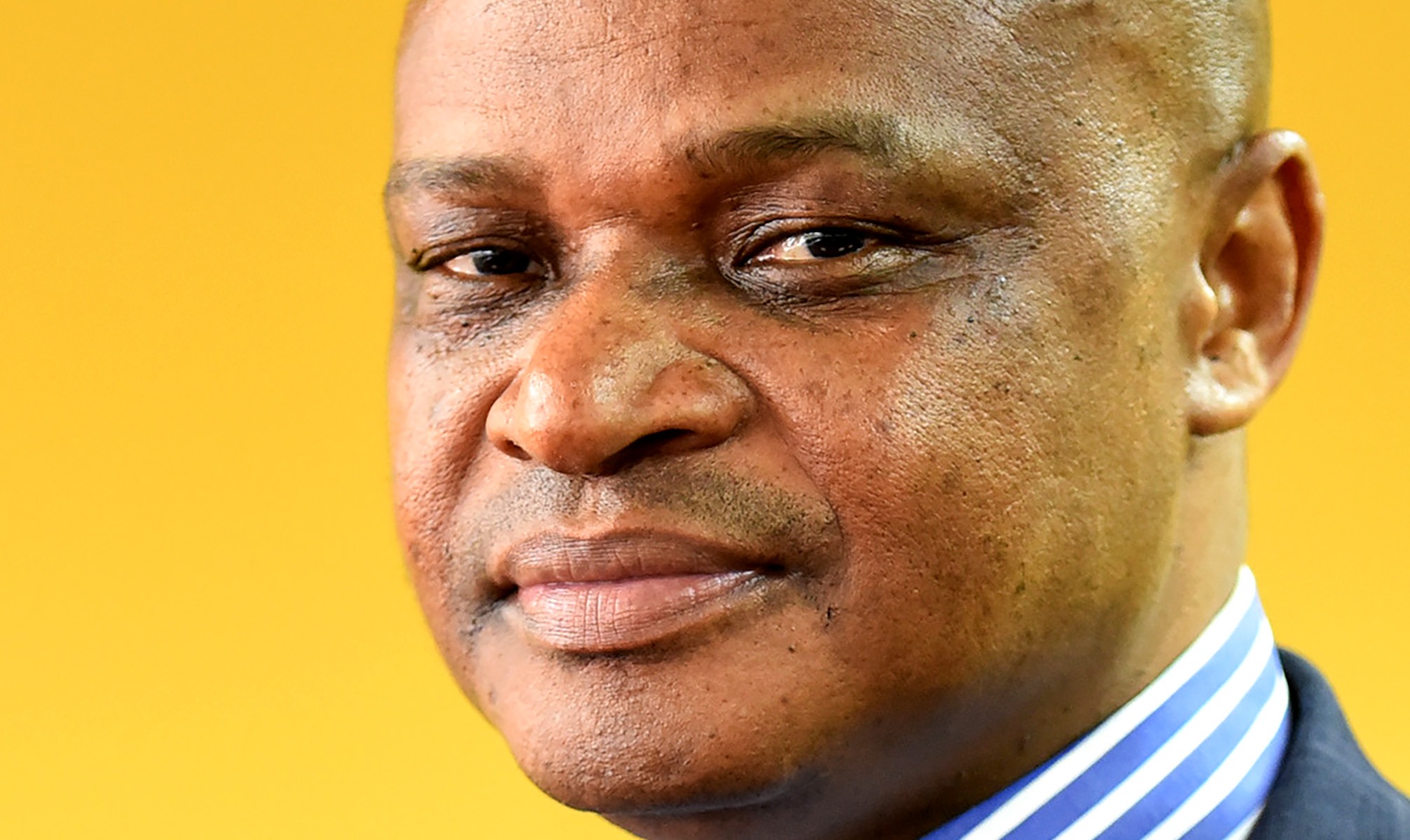
 Special Investigating Unit head Andy Mothibi takes over as National Director of Public Prosecutions on 1 February. (Photo: Gallo Images / City Press / Tebogo Letsie)
 /file/dailymaverick/wp-content/uploads/2025/10/label-analysis-2.jpg)
Special Investigating Unit (SIU) head Andy Mothibi will be South Africa’s next National Director of Public Prosecutions (NDPP) come 1 February, President Cyril Ramaphosa announced on Tuesday – and the appointment has been warmly received.
This is for good reason. Mothibi, by any measure, is an excellent candidate. A hardworking, unshowy technocrat, Mothibi has developed a reputation as something of a turnaround whiz, and there are few institutions in as much need of turning around as South Africa’s National Prosecuting Authority (NPA).
Mothibi was that rarest of characters: a solid Jacob Zuma pick.
Any legal-related appointments made by former president Zuma in 2016 were always going to be greeted sceptically, but if Zuma secretly hoped that Mothibi would underperform as head of the SIU, he was in for disappointment.
SIU has shot the lights out under Mothibi
Mothibi has been an excellent head of the once-troubled SIU, in terms of both its institutional culture and its performance. He has brought the unit to financial stability and reportedly secured unusually high staff morale after implementing an effective turnaround strategy.
In the 2023/24 financial year, under Mothibi, the SIU reported its highest recovery of stolen or misspent money, with R2.28-billion in cash returned to the state. In total, SIU investigations in that year saved the government an estimated R8-billion – a figure that includes not only cash recovered, but also contract payments stopped or assets preserved before they could be wasted.
Under Mothibi, the SIU has aggressively pursued civil asset freezes and forfeitures, played a key role in post-State Capture cleanup at state-owned entities, and gone after corrupt government officials. It has been a shining light within South Africa’s depleted criminal justice institutions.
Mothibi also has a richly varied professional history: from being a magistrate, to helping establish the SA Revenue Service, to working as head of compliance at South African Airways, to heading up risk units at Standard Bank and Nedbank. This is somebody who knows South Africa’s public and private sectors inside and out, which is both unusual and useful.
Little wonder that his appointment by President Ramaphosa as NDPP head has been warmly received across the political spectrum and by civil society.
It is a good outcome, but an unexpected one.
Panel findings will not be released
To recap: a panel to interview prospective heads of the NDPP was seemingly hastily convened by Ramaphosa in December. It was, to say the least, a strange panel, including just two lawyers and nobody with any prosecutorial experience.
The panel shortlisted six candidates and interviewed them. Mothibi was not among them.
“The panel concluded its process and submitted its report to the President on the 12th of December 2025. In its report, the panel advised the President that none of the interviewed candidates were suitable for the role of NDPP,” the Presidency stated on Tuesday.
But how did the panel come to that conclusion?
/file/attachments/orphans/WhatsApp-Image-2025-12-11-at-1609_858666.jpg "Adv Menzi Simelane appears as the first candidate on the second day of interviews before the Advisory Panel. (Photo: GCIS / Wandile Ngaxa)")
It was a no-brainer in the case of one candidate, Zuma’s problematic former acting NDPP head Menzi Simelane. But there was almost certainly at least one candidate fit for purpose: former Asset Forfeiture Unit (AFU) head Hermione Cronje.
Cronje, while a divisive figure within the NPA for her take-no-prisoners approach, was also the preferred candidate of the majority of legal experts canvassed by Daily Maverick, who were enthused by Cronje’s potential for achieving wholesale institutional reform. Of course, Mothibi was not on the menu for them to consider at that stage.
/file/attachments/2986/WhatsApp-Image-2025-12-11-at-1229_187469_864928_403df5bb14fe50619a43e70ec670ae54.jpg "Adv Hermione Cronje appears as the first candidate on the second day of interviews before the Advisory Panel for the selection of the National Director of Public Prosecutions, chaired by Minister of Justice and Constitutional Development Mmamoloko Kubayi, at the Auditor-General South Africa offices in Pretoria. (Photo: GCIS / Wandile Ngaxa)")
The answers as to why the panel considered Cronje and the five other shortlisted candidates not to be “suitable” are presumably contained in the panel report, which a number of civil society figures have called for to be released.
But that’s not going to happen, the Presidency told Daily Maverick on Wednesday.
“It won’t be made public,” said spokesperson Vincent Magwenya.
“There’s no legal or any other basis for doing so. We also have to respect the professional standing of the interviewed candidates. Non-suitability for the NDPP role does not mean they can’t be suitable for other roles elsewhere. The purpose of the report was to assist the President in carrying out his constitutional and legal mandate, not to have a public debate about the interviewed candidates.”
Magwenya also reminded Daily Maverick that Ramaphosa had “gone beyond the letter of the law” in attempting to make the NDPP selection process more transparent.
/file/dailymaverick/wp-content/uploads/2025/08/Z63_2830.jpg "Soon-to-be-retired NDPP head Shamila Batohi at Daily Maverick's The Gathering in 2025. (Photo: David Harrison)")
This is true, and deserves credit: the NPA Act simply requires the President to appoint an NDPP, and Ramaphosa is the first president to at least attempt some semblance of a public process – even if in this case it turned out to be somewhat meaningless in the end.
The ultimate outcome has not, unfortunately, been transparent.
We don’t know why the panel rejected all the candidates it shortlisted. We don’t know why Mothibi, who would obviously have been a frontrunner from the start and would definitely have secured multiple nominations, declined to be shortlisted.
/file/dailymaverick/wp-content/uploads/2025/09/0N5A3728-1.jpg "File photo: Advocate Andy Mothibi of the Special Investigating Unit (SIU) briefs members of the media to update the public on the interim report into the investigation at Tembisa Hospital. (Photo: Jairus Mmutle / GCIS)")
What that would suggest is that Mothibi did not want the job of NDPP. Why that was, he will certainly never disclose now. News24’s Karyn Maughan suggested, however, that it might have something to do with the far higher salaries earned at the SIU.
Ramaphosa clearly succeeded in prevailing upon him – but how, exactly, we don’t know. Maybe he promised to match or beat Mothibi’s SIU salary. Maybe he persuasively appealed to Mothibi’s sense of patriotic duty.
Mothibi’s age the only significant concern
Or maybe Ramaphosa pointed out what many observers have identified as the only real drawback of Mothibi’s appointment: that at the age of 63, as things stand, he can do the job for only two years before mandatory retirement.
Two years is far too short to achieve much at the NPA, as surely outgoing NDPP head Shamila Batohi would attest, given the challenges she has faced, even after seven years.
“Either [Mothibi] is effectively a caretaker NDPP, or there is an intention to amend the legislation [to allow him to serve longer],” legal academic Dr Jean Redpath told Daily Maverick on Wednesday.
If the legislation doesn’t change, a new NDPP would need to be appointed in 2028. It is possible that Ramaphosa could still be President at that point, depending on the ANC’s internal processes, given that the next general elections are only in 2029.
If so, Mothibi’s appointment could be Ramaphosa’s low-risk way of kicking the can down the road, knowing that he may have another bite at the cherry.
Doorstepped by journalists on Wednesday, Ramaphosa appeared to present himself at least partly as a victim of circumstances: having been told by his panel that none of his candidates was suitable, and “because of the shortness of time” until Batohi’s term expired in February, he simply had to appoint someone.
But what Ramaphosa did not explain is why he delayed the selection process so much, with the DA having warned the President for months in advance that the clock was ticking to appoint Batohi’s successor. The “shortness of time”, in other words, was self-inflicted.
Regardless of the behind-the-scenes machinations, South Africa has emerged with a solid NDPP appointment. But even a turnaround wizard like Mothibi will need far more than two years to achieve significant results at this difficult institution. DM