




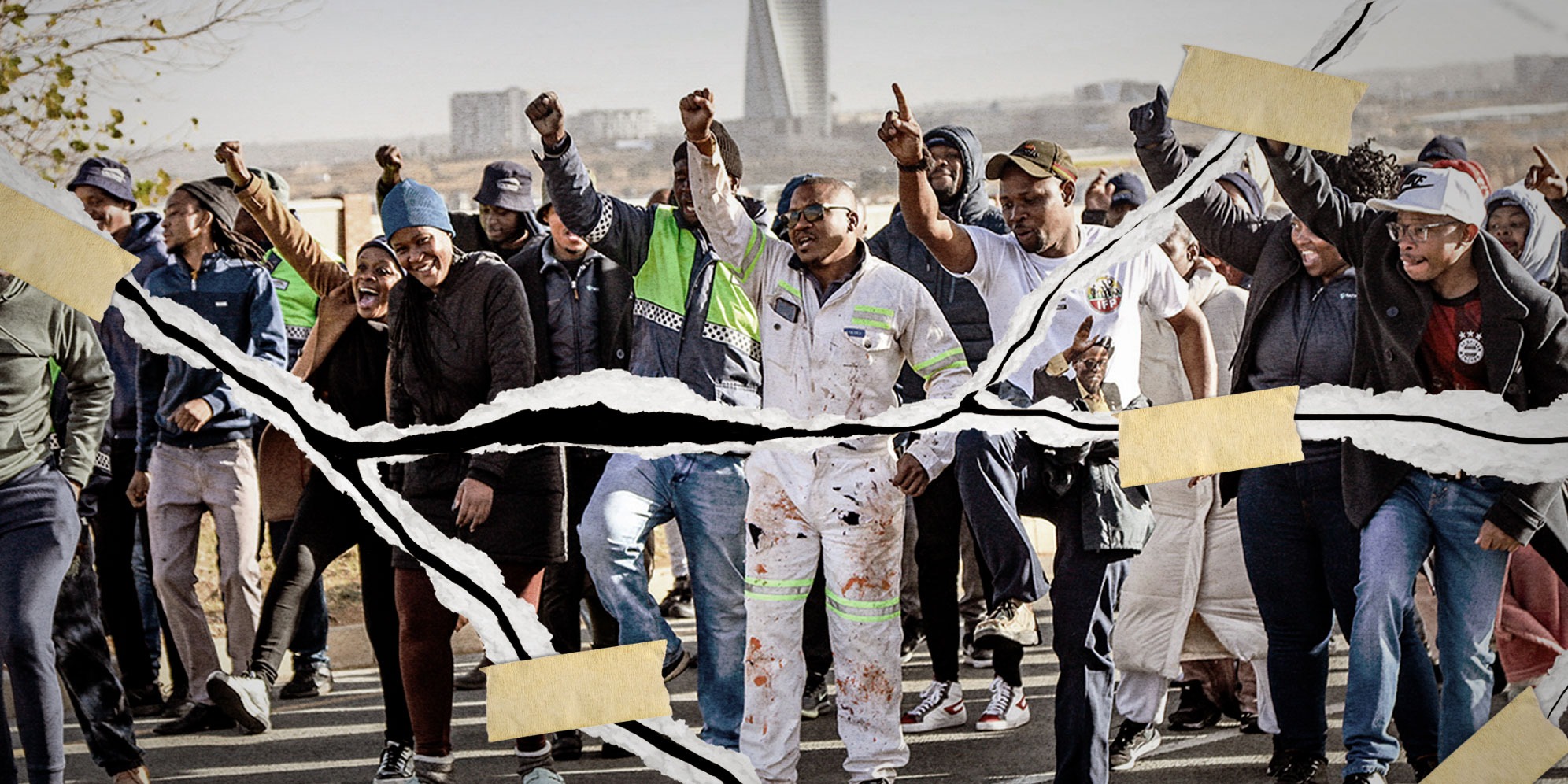
 Illustrative Image: National Union of Metalworkers of South Africa (Numsa) members on an indefinite strike on 8 July 2024 in Midrand, South Africa. The workers were demanding a 13% pay increase and 60% medical aid contribution, among other things. (Photo: Gallo Images / OJ Koloti) | Tape. (Image: Istock) | (By Daniella Lee Ming Yesca)
 /file/dailymaverick/wp-content/uploads/2025/10/label-analysis-2.jpg)
For investors and business people the major focus of the moment is the progress the national coalition appears to be making in important reforms in the government.
The fact that the rand is stronger against the (weaker) dollar, that inflation is low and fuel prices are coming down significantly may make many people feel slightly more confident.
As always the major threat to this comes from our politics.
And for the moment President Cyril Ramaphosa appears to be stronger in the ANC than he has been for some time. He emerged from the party’s National General Council last month in an enhanced position, and none of his rivals or potential successors appeared to put their heads above the parapet.
But in the meantime there are other structural shifts under way in our politics that can sometimes appear almost obscured.
/file/dailymaverick/wp-content/uploads/2025/03/0000212685.jpg "File photo: NUMSA members during a wage increase protest in Johannesburg. (Photo: Gallo Images / Foto24 / Felix Dlangamandla)")
In the final weeks of 2025, Natasha Marrian reported that the country’s biggest trade union, Numsa, had written to Cosatu proposing talks between them.
Given how difficult the expulsion of Numsa was a decade ago, and how emotional it was for those involved, this is an important moment.
But it is also a sign that Numsa can see how the ANC, and the alliance and what used to be called the Congress Movement, is splitting apart.
The critical issue on which Numsa was expelled was its refusal to continue to publicly support the ANC (in the end Numsa started its own party, the Socialist Revolutionary Workers’ Party – which was a massive failure).
/file/dailymaverick/wp-content/uploads/2025/08/Z63_2850.jpg "Zingiswa Losi speak at the Daily Maverick's The Gathering 2025. (Photo: David Harrison)")
On Tuesday, while speaking at the commemoration of the death of former SACP leader Joe Slovo, Cosatu president Zingiswa Losi confirmed that: “We welcome the invitation by Numsa to have a meeting to wage a way forward of how we’re going to unite the workers in our country.”
Presumably supporting the ANC will not be a condition this time around. Especially considering that several of Cosatu’s biggest affiliates also no longer want to support the ANC.
At the same event, Losi also said: “As the working class we need a strong Communist Party. A Communist Party that is rooted in Marxism-Leninism. A Communist Party that is responsive to the material conditions of our people. A Communist Party that is fearless in confronting both capital and internal decay.”
/file/dailymaverick/wp-content/uploads/2025/05/WhatsApp-Image-2025-05-01-at-14.47.05_6ecf9584.jpg "File photo of Cosatu president Zingiswa Losi, President Cyril Ramaphosa and SACP general secretary Solly Mapaila at a Workers’ Day rally in Mpumalanga. (Photo: DIP / ANC HQ)")
Important series of crossroads
Cosatu may now be at an important series of crossroads of its own.
Considering how the federation has been growing weaker since Numsa’s expulsion, and the proliferation of political parties and unions in different sectors, perhaps the biggest question is how far it is prepared to go to create more worker unity.
It seems likely that talks between Cosatu and Numsa will be productive. But at some point there are likely to be discussions about the political role a combined affiliation should play.
/file/dailymaverick/wp-content/uploads/2025/05/WhatsApp-Image-2025-05-01-at-14.47.14_89705589.jpg "SACP general secretary Solly Mapaila at the Workers’ Day Rally in Middelburg on 1 May 2025. (Photo: DIP / ANC HQ)")
Considering the deep history between Cosatu and the SACP, and the historical concept that the SACP should be the “workers’ party”, along with Losi’s comments on Tuesday, it might appear that Cosatu could support the SACP.
This would be a game-changer for the SACP, as it could provide the party with money and organisation, along with hundreds of thousands of members.
But some in the union movement blamed the SACP for Cosatu’s decision to expel Numsa.
This would lead to calls for Cosatu to not be affiliated to any political party. That it should just exist for the interests of workers.
This however reignites a debate in unions that goes back to at least the 1950s, about whether a union should exist only to look after its members or to play a political role.
In many countries, including our own, unions have played a hugely political role (our current president formed the National Union of Mineworkers, which then played an important role in creating Cosatu).
It’s hard to imagine that a newly configured Cosatu, which would include Numsa, could remain apolitical for long. At the same time there is likely to be pressure on the SACP to remain in the alliance in some form.
/file/dailymaverick/wp-content/uploads/2023/04/AV_00007131-1.jpg "ANC veteran Joe Slovo on 27 October, 1994. (Photo: Gallo Images / Sunday Times / Jon Hrusa)")
On Tuesday, President Cyril Ramaphosa told the Slovo commemoration that if the SACP left the alliance it “would be a historic mistake” and that as a result, “state power can be wrested from our hands”.
Understandably, his point is that if members of the congress movement compete against each other, they will all be weaker. The recent history of the union movement proves this.
But SACP General Secretary Solly Mapaila also said on Tuesday that if his party did not leave the alliance it could not restore itself.
He said that: “Even this thing called a GNU has failed dismally. Capital says that now we have the GNU we will bring investment. We need to transfer the wealth of our country to our people, transfer land to our people.”
This illustrates the real difference between the SACP and Ramaphosa’s reform agenda. Ramaphosa’s ANC and the national coalition are currently focused on improving the state and enabling the private sector.
Redistribution of wealth
The SACP, to no one’s surprise, wants the redistribution of wealth.
Certainly, it does appear that there is no going back now. The SACP is going to compete against the ANC in the local elections this year and beyond. The question for workers is whether they are able to unify themselves and retain that unity.
But there may be little value in having a single unified workers’ federation that involves unions whose members all vote for different political parties. The real prize would presumably be a union movement that is able to have political power through one political party.
But considering the very real differences in the lived experiences of union members, this seems unlikely. One of the real divisions in the movement has been between workers in the state (teachers who belong to the South African Democratic Teachers Union [Sadtu] and nurses and others who belong to the National Education, Health and Allied Workers Union [Nehawu], for example) and those in the private sector (including many members of Numsa).
It is entirely possible that these divisions play out into discussions about which party to support.
All of this makes one dominant workers’ federation supporting one political party relatively unlikely – despite what might be the strong efforts of a reconfigured Cosatu.
On the surface of our politics the middle ground appears to be in control. The government’s reform agenda continues and the coalition appears relatively secure. But given the structure of our society, workers movements could still play a critical role, and may well drive our politics to the left, over the longer term.
If they can unify themselves. DM