




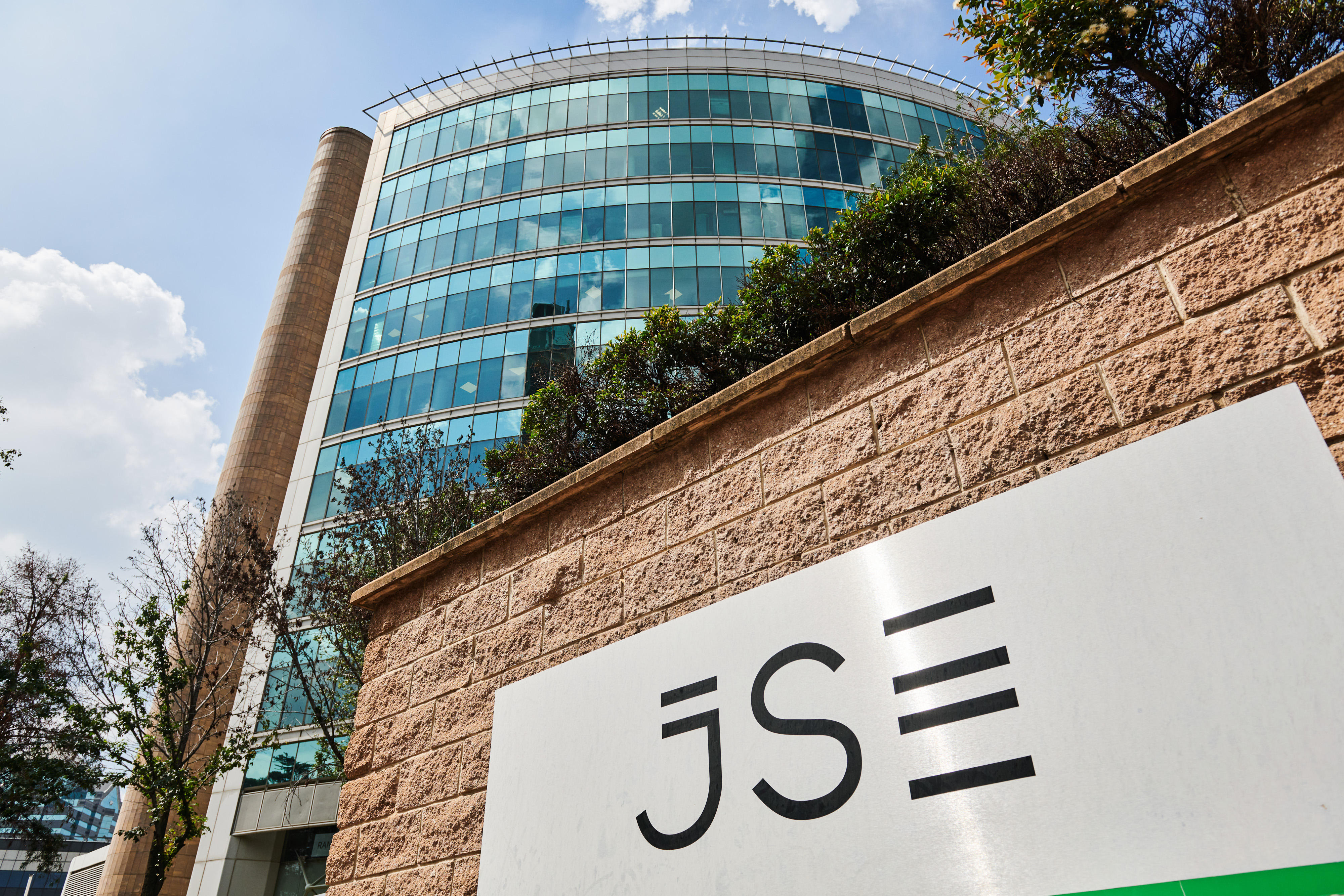
 The Johannesburg Stock Exchange (JSE) Ltd. in Johannesburg, South Africa, on Wednesday, Feb. 26, 2025. The South African cabinet met on Monday to consider changes to the budget after Finance Minister Enoch Godongwana had to delay his annual announcement because of a disagreement over a proposed increase in value-added tax. Photographer: Waldo Swiegers/Bloomberg via Getty Images
 /file/dailymaverick/wp-content/uploads/2025/10/label-analysis-2.jpg)
There is little JSE bell ringing to start 2026 – well at least until Canal+ comes to town. For the new year the local bourse is continuing its diet, shedding weight in the form of helium hopeful Renergen and private education giant Curro.
Read more: Gold, gigabytes and good shoes feature in our 2026 stock picks
But leaving the JSE isn’t as simple as leaving a star review and closing the app. It involves financial gymnastics and some cash payouts. And if you look closely at the paperwork for both deals, you’ll notice PSG fingerprints everywhere.
The mechanics of the delistings are fascinating, because for the retail investor, the difference between a clean break and a fractional entitlement is usually a headache.
The Renergen equation
First up is Renergen. The Virginia gas project operator is being swallowed whole by the Nasdaq-listed ASP Isotopes (ASPI). For local shareholders it’s a share swap. You hand in your Renergen shares, and you get ASPI shares in return.
But of course it’s not that simple. The exchange ratio was set at 0.09196 ASPI shares for every Renergen share.
For shareholdings that don’t divide perfectly into that ratio, it’s quite the pickle. Let’s say you held 1,000 Renergen shares: 1,000 x 0.09196 = 91.96 ASPI shares.
Here is the kicker: The JSE does not do decimals when it comes to share certificates. You cannot own 0.96 of a share. So, what happens to that dangling fraction?
This week, Renergen and ASPI triggered the Fractional Entitlement clause. You get your 91 whole shares, and the remaining 0.96 is paid out in cash.
But at what price? Well, they take the volume weighted average price (VWAP) of ASPI on the JSE from New Year’s Eve (LDT+2), which was R95.14792 (now the decimals matter), and then (per standard listing requirements) they discount it by 10%.
So, instead of getting the full market value for your fraction, you get paid out at R85.63313 per whole share equivalent. And who drew up this complex plan? The transaction and designated adviser guiding Renergen through this complex maze was PSG Capital.
Securing the Curro bag
Today, 7 January 2026 (actually midnight last night) marks the termination date for Curro’s derivative contracts as the company undergoes a massive unbundling and capital payment.
Read more: Lessons in enterprise: Jannie Mouton’s moment, from PSG to Capitec, then on to Curro
Curro shareholders are receiving a basket of assets that looks like a Jannie Mouton greatest hits compilation:
For every Curro share held, investors receive: 0.00284 shares in Capitec (CPI), 0.07617 shares in PSG Financial Services (KST) and a cash capital payment of 85.837 cents.
Curro, originally a PSG baby, is bowing out by distributing shares in PSG Financial Services (and its sibling Capitec) back to its investors. For the average holder of Curro shares, this is just a bit of admin. But for the traders holding single stock futures on Curro, this morning was chaos.
According to the JSE Market Notice released, you couldn’t just keep holding a Curro future because Curro effectively ceased to exist as a single tradeable entity yesterday.
Zombie stocks
Instead of just closing everyone out, the JSE created a Frankenstein instrument called a Basket Future (BSK150). If you were long on Curro futures yesterday, you woke up today long on a basket containing Curro, Capitec and PSG Financial Services.
This ensures that value isn’t destroyed, but it forces traders to suddenly have exposure to three different volatility profiles instead of one.
Read more: 2026 brings fewer tailwinds and tougher choices for SA investors
Delisting is often framed as a failure or a retreat. But looking at the Renergen and Curro files, it looks more like a transformation. Renergen is chasing the Nasdaq liquidity dream via ASPI, and Curro is unlocking value by handing the underlying assets back to shareholders.
But whether it’s fractional cash payouts or basket futures, the lesson for 2026 is clear: if you want to play on the JSE, you better have a calculator and, maybe, a wealth manager on call. DM