




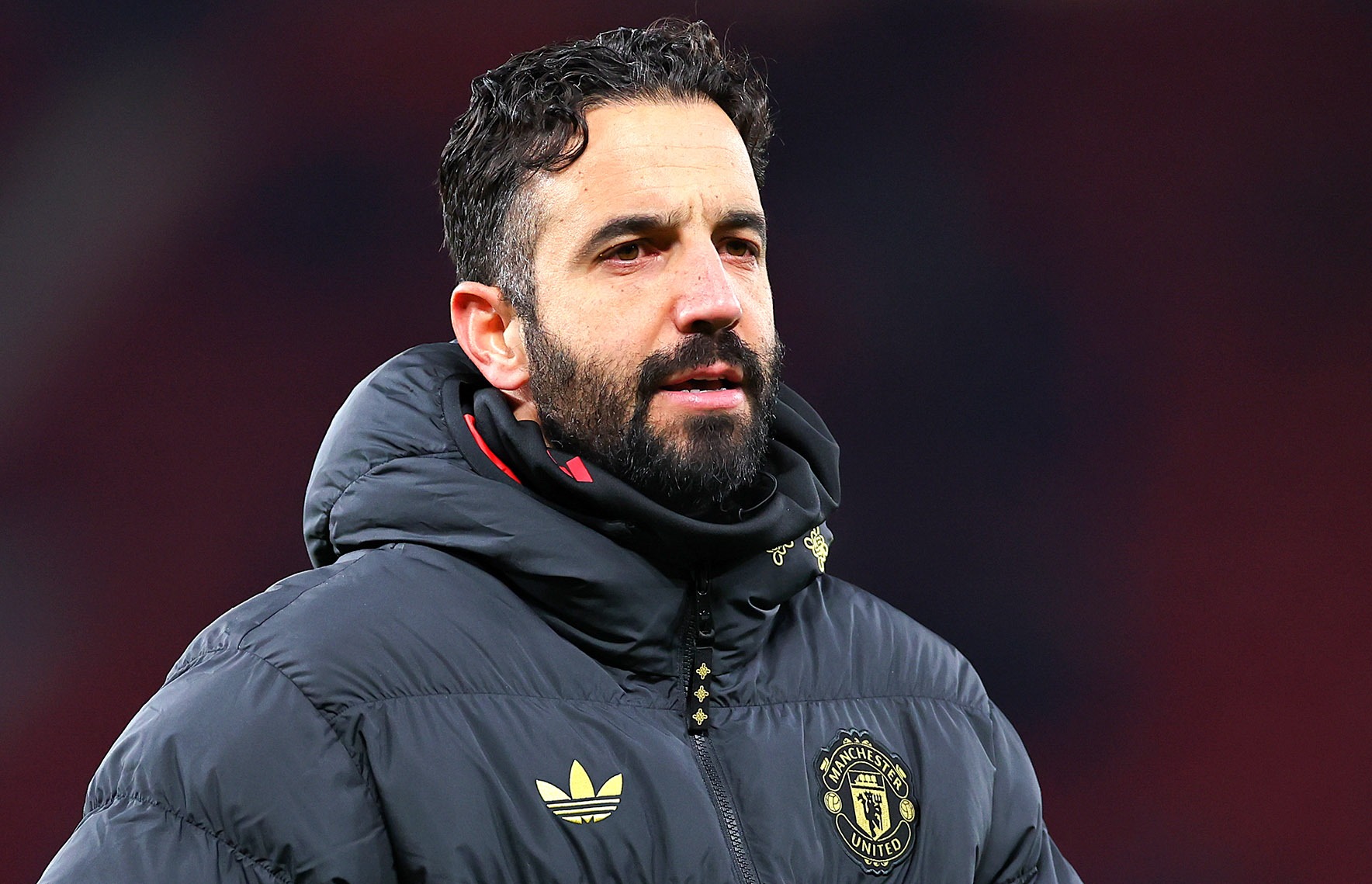
 Former Manchester United head coach/manager Ruben Amorim. (Photo: Robbie Jay Barratt - AMA / Getty Images)
 Manchester United’s sacking of Ruben Amorim marks the culmination of the latest failed chapter in the club’s post-Alex Ferguson story, this one defined by public barbs, stubborn tactics and utterly dismal form.
The Portuguese coach, hired in November 2024 to replace Erik ten Hag, frequently sparred with pundits and hinted at a power struggle with senior figures within the club when he repeatedly defended his defensive strategy after appalling initial league performances that marginally improved this season.
The latest in a long line of managers who have tried and failed to bring back the good times that flowed under Ferguson, Amorim had hinted for a couple of weeks that he was not pleased with the level of interference from United’s board.
/file/attachments/orphans/2213947488_460806.jpg "Replacing Sir Alex Ferguson, who departed in 2013, has been difficult for Manchester United. (Photo: James Gill - Danehouse / Getty Images)")
Sunday’s explosive press conference following their 1-1 draw with Leeds United, in which he even name-checked pundit Gary Neville, appeared to be the final straw.
“If people cannot handle the Gary Nevilles and the criticisms of everything, we need to change the club,” Amorim said. “I just want to say that I came here to be the manager of Manchester United, not to be the coach. And every department – the scouting department, the sports director – needs to do their job.”
Neville responded by comparing it to former Chelsea manager Enzo Maresca’s similarly cryptic complaint, that led to the Italian leaving on New Year’s Day, suggesting Amorim was playing a dangerous game and signalling unrest within Old Trafford’s power structures, saying the comments “are never usually good”.
From the outset, Amorim stood squarely behind his trademark back three system of either 3-4-3 or a slight variation of 3-4-2-1.
Tactical inflexibility
Senior figures, including director of football Jason Wilcox, reportedly urged tactical flexibility but Amorim remained unmoved until finally in late December, he briefly shifted to a back four, partly due to the mounting pressure, poor results, player injuries and international absences for the Africa Cup of Nations.
/file/attachments/orphans/2231621205_512454.jpg "Jason Wilcox, Director of Football at Manchester United. (Photo: Nigel French / Sportsphoto / Allstar via Getty Images)")
In a comment last week about the transfer window, he said his 3-4-3 formation would not work unless the club spent “a lot of money”.
Many expected Amorim to be sacked after last season. Their 15th‑place league finish with 42 points was their lowest in more than 50 years and worst since the 1973-74 relegation season.
Their ugly loss to Tottenham Hotspur in the Europa League final in May prompted another outburst, in which Amorim told reporters he would leave “without compensation” if the club’s board felt he was not right for the job.
Amorim’s press conferences were both raw emotion and a breath of fresh air for media in a league full of managers’ measured responses. In the aftermath of a 3‑1 defeat to Brighton last season, he labelled his side “maybe the worst team in Manchester United history”.
United spent approximately £250-million to try to change that, making them one of the highest gross spenders in the Premier League, but still the results did not show the level of improvement the club demanded, with their shocking loss to League Two club Grimsby Town in the League Cup in August among the most shambolic results of his coaching tenure.
Last March, with the club struggling, United co-owner Jim Ratcliffe described him as an outstanding young manager “and I think he will be there for a long time”.
In October he said that Amorim needed three more years to prove himself, comparing his tenure to Mikel Arteta’s early struggles at Arsenal.
Sunday’s press conference, however, suggested that faith had slipped. Amorim refused to clarify whether he still enjoyed boardroom support, insisting he was the “manager, not the coach” despite his head coach job title.
He implied he was digging in his heels to stay for 18 months — “or when the board decide to change”.
This veiled referencing of his contract and consistent mention of the hierarchy’s inadequacies suggest a behind-the-scenes authority clash, perhaps the tipping point that prompted his dismissal.
That was supported on Monday when a United source said that the club “developed an expert leadership team that enables the club to operate at the highest levels. While the head coach is a key part of our ecosystem, they do not sit above it.”
Who next?
After the sacking of Amorim, the club that has had 10 permanent or interim coaches since Ferguson they must once again search for someone who can right the ship, and restore it to its former glories.
Among the suggested favourites to take over what is touted as football’s most difficult job are Maresca, who dramatically left Chelsea on New Year’s Day, Oliver Glasner, Gareth Southgate, Michael Carrick, Xavi Hernandez, England manager Thomas Tuchel and United’s interim coach Darren Fletcher.
/file/attachments/orphans/2254594302_742906.jpg "Matheus Cunha of Manchester United is challenged by Anton Stach of Leeds during a Premier League match at Elland Road on 4 January 2026 in Leeds, England. (Photo: Michael Regan / Getty Images)")
Maresca sits near the top of the list – available, ambitious, and with a fresh Club World Cup trophy from his Chelsea stint. But tensions over support and recruitment that ultimately prompted his exit from the west London club last week suggest that United would be replacing one disgruntled manager with another.
Maresca has also been linked to the Manchester City job as Pep Guardiola’s successor, although United can offer an immediate return to the dugout that could be attractive to the Italian.
Moves from Chelsea to Manchester have historically not worked well. Jose Mourinho lasted barely a season between 2016 and 2018, and Dave Sexton had little success at Old Trafford in his stint in the 1970s.
Crystal Palace boss Glasner brings a compelling blend of pragmatism and structure. He delivered the London club their first major trophy when they won the FA Cup last season, and reshaped a mid-table side into one of the league’s most organised units with the same 3-4-3 that Amorim was so committed to.
Glasner could be tough to pry away from Palace, although his contract situation and his own ambitions make him a realistic target, especially if United wait until summer. He is on contract until June, and has yet to commit his long-term future.
There is also a perception that the 51-year-old manages the media – and, by extension, pressure – better than Amorim did, a non-trivial edge at Old Trafford.
Xavi represents a different kind of bet: identity and ideals over immediate pragmatism. Free since leaving Barcelona in 2024, he remains associated with a possession-first, youth-forward model that seeks control through the ball.
Reports have long suggested that he is open to the Premier League and specifically intrigued by United, yet his lack of English top-flight experience means adaptation – and patience —would be essential. If United want a cultural restructure more than a quick fix, Xavi fits, although early turbulence during a period of adjustment is likely. Reuters/DM