




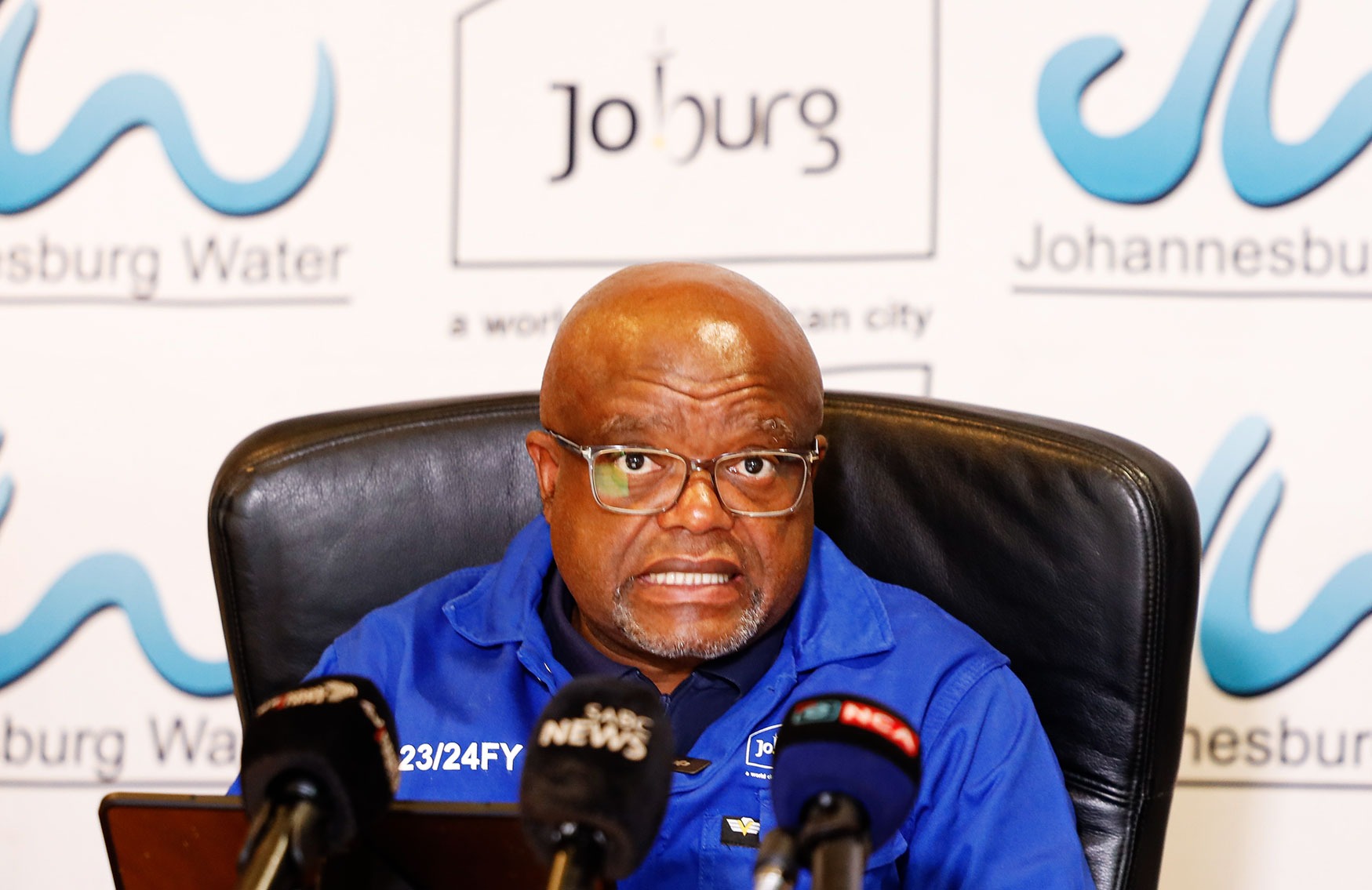
 Johannesburg Mayor Dada Morero briefs the media on Rand Water maintenance at Turbine Hall on 5 January 2025. (Photo: Gallo Images / Sharon Seretlo)
Naledi-Water-ThirdPhase
Johannesburg Mayor Dada Morero briefs the media on Rand Water maintenance at Turbine Hall on 5 January 2025. (Photo: Gallo Images / Sharon Seretlo)
Naledi-Water-ThirdPhase Johannesburg residents have been warned to brace for more water outages as Rand Water and Joburg Water begin the third leg of maintenance on their systems. This leg will see the Eikenhoff pumping station shut down for 54 hours, running from 6-8 January 2026, leading to low water pressure and limited or no water supplies.
Residents have been warned that it could take up to seven days for water supplies to be fully restored.
At a media briefing held at the Turbine Hall in Newtown on Monday, 5 January, Joburg Water advised that the planned maintenance work would affect the following reservoirs:
- Roodeport Deep: supplying Hamberg, Rand Leases, Roodepoort and Creswell Park;
- Meadowlands Reservoir 1 and 2: supplying Meadowlands (all zones & extensions), Tshepo Themba, Dube, Central Western Jabavu & Extension 1, Mofolo Central & North, Orlando West, Zondi and Mmesi Park;
- Fleurhof: supplying Fleurhof, Lea Glen and the surrounding areas;
- Doornkop: supplying Eldorado Park, Nancefield, Pimville and Devland;
- Braamfischer: supplying Braamfischer, Meadowlands and Mmesi Park.
Reminder of the #RandWaterMaintenance tomorrow, 6 Jan 2026 at 04:00 – 8 Jan 2026 at 08:00. This maintenance will affect parts of Soweto and Roodepoort.
— Johannesburg Water (@JHBWater) January 5, 2026
Once maintenance is completed it will take between 3-5 days for recovery.
📍 Affected Areas 👇#JoburgServices#WeServceJoburg pic.twitter.com/0TTI84hWLM
Johannesburg Mayor Dada Morero said reservoirs had been filled up to 70% in advance of the maintenance programme to manage high demand and that both roaming and stationary tankers would be deployed to supply the affected areas.
“We acknowledge the inconvenience that this maintenance will cause to households, businesses and institutions across Johannesburg,” Morero said. “However, this work is essential to safeguarding the city’s long-term water security, and we will continue to work with Rand Water and key stakeholders to manage this maintenance, prioritising our residents’ interests.”
/file/attachments/orphans/ED_591685_960035.jpg "Johannesburg Mayor Dada Morero briefs the media on Rand Water maintenance at Turbine Hall on 5 January 2025. The briefing provided a comprehensive overview of the scope and objectives of Rand Water’s Phase 3 planned maintenance. (Photo: Gallo Images / Sharon Seretlo)")
The Phase 1 maintenance period, which took place from 13-15 December, resulted in frustrated residents in areas such as Midrand losing water supply for nearly a week. Daily Maverick has reported that during Phase One, parts of the Commando System linked to Hurst Hill 1 and 2 unexpectedly faced outages despite not being scheduled for maintenance.
However, Joburg Water said the Phase Three maintenance plans were smaller in scope and should lead to fewer disruptions.
It said that Phase Two, originally scheduled for 19-21 December, was halted due to a technical failure and would take place later this year, before June 2026. It was unable to provide exact details as the maintenance schedule had not yet been set by Rand Water.
Contaminated tap water treated
On 30 December, Joburg Water issued an alert, warning residents of water supplies contaminated by sewage along Albertina Sisulu Road after residents complained about smelly tap water. The contamination affected parts of the Johannesburg CBD and Bezuidenhout Valley.
Morero said the contaminated water system had since been flushed with chlorine. The contamination was a result of a blocked sewer manhole leaking into a damaged pipe. Both the affected manhole and pipe had since been fixed.
“As of 4th January 2026, water quality results show significant improvement with only two of the seven sampling points still failing to meet the minimum drinking water standards,” Morero said.
A later advisory, published by Joburg Water on 5 January, said the most recent testing did not detect E. Coli at any sampling points, confirming that there is “currently no evidence of faecal contamination” in the affected area.
“From a public health perspective, the system is therefore considered clear of faecal pollution,” the advisory says.
However, the sampling showed higher than normal levels of coliform bacteria, which are typically found in soil, water and human and animal digestive tracts. As a result, water supplies in the affected area have been restricted while Joburg Water chlorinates the area. Normal supplies could be restored within the next few days, when the water is declared safe for human consumption. DM