




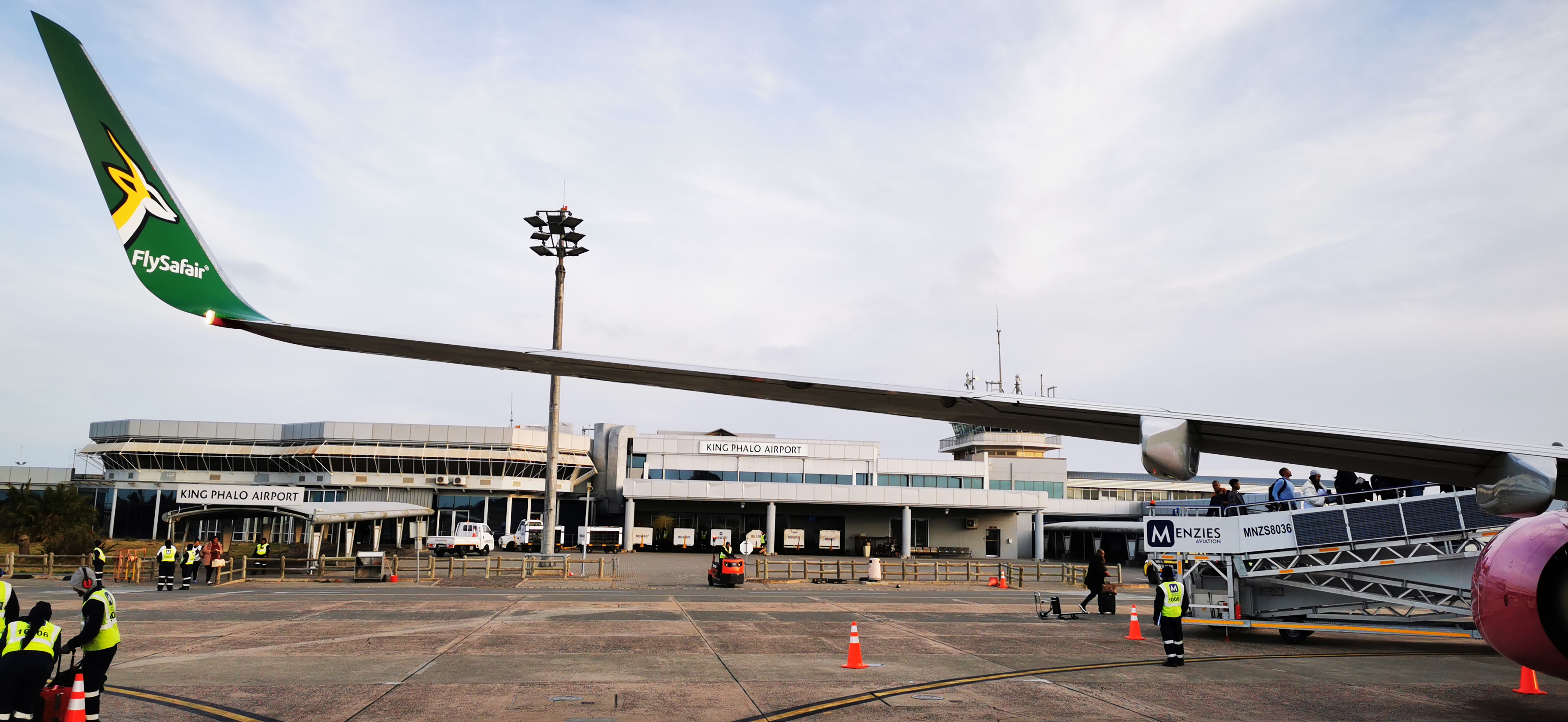
 There have been staff capacity issues and failures of navigation systems at busy airports, including King Phalo. Photo: Jocelyn Adamson
 Google search traffic for Chris Rea’s Driving Home for Christmas peaked around 24 December 2025 – with South Africa ranking at 35 out of 44 regions to search for the term. A week and a bit later, on Sunday, 4 January 2026, you could bet that many South African families stranded at OR Tambo International Airport wished they had taken the late singer’s words to heart.
To be fair to the nation’s Air Traffic & Navigation Services (ATNS), given the extent of the operational crisis a year ago, the fallout from just one day of hell is a relatively positive sign.
Read more: Air Traffic and Navigation Services: On the runway to nowhere
By Monday morning, ATNS was able to share a statement with Daily Maverick to announce that operations had stabilised: “ATNS confirms that air traffic operations at OR Tambo International Airport are normal this morning, with services continuing as planned.”
Not a staffing issue
A key part of the statement addressed alleged human resources challenges: “ATNS further clarifies that the flight diversions experienced yesterday afternoon were not caused by human resource constraints, but were the result of severe weather conditions, including thunderstorms which disrupted approach paths.”
However, this pivots from ATNS’s earlier admission on Sunday, where it explicitly cited “temporary human resource constraints at the Air Traffic Control station” as a primary driver of the delays.
It is a contradiction that domestic carriers are not allowing to slide.
‘Invisible infrastructure’ collapse
Airlink, the country’s largest independent regional airline, offered a far more scathing assessment of the Sunday chaos. In a direct rebuttal of the weather narrative, the airline laid the blame squarely on management failures.
“The delays stem from the Air Traffic Navigation Service’s failure to ensure it has sufficient staff to accommodate and manage the normal scheduled traffic,” the airline said in a statement released on Sunday evening.
More concerning for frequent flyers is Airlink’s revelation on the “invisible infrastructure” – the data and regulations that keep planes in the sky.
Read more: Airlink plays the network game with no interest in the low-cost fight
According to the airline, the disruption was exacerbated because several instrument flight procedures for OR Tambo remain suspended. Some were withdrawn as recently as 9 December “after ATNS failed to renew their validity before they expired”.
A crisis of capacity
This paperwork paralysis, where airports are physically operational but legally inaccessible during poor visibility, is the hallmark of a structural crisis that has plagued South African aviation since mid-2024.
By late 2025, the Airlines Association of Southern Africa (AASA) had already labelled the situation an “economic disaster”.
In a shocking admission of capacity constraints last year, it was revealed that ATNS was attempting to maintain 388 national flight procedures with only two permanent staff members and a handful of contractors.
Acting CEO Matome Moholola candidly admitted the state entity is “unable to compete with the oil money in the UAE or with the dollar-based salaries abroad”.
So while international hubs like Cape Town and OR Tambo have been prioritised to keep the tourism economy alive, regional nodes like Richards Bay and Mthatha have faced indefinite suspensions and route collapses.
Ground control to major bomb
Transport Minister Barbara Creecy has not slept on the crisis. After describing the expert findings on ATNS as revealing “grave and material issues”, she placed ATNS CEO Nosipho Mdawe on precautionary suspension and appointed a Ministerial Intervention Team.
The team has had to make the hard choice of saving the vital international airports while allowing the others to suffer temporary paralysis.
While this strategy has probably saved the country’s broader economy from total logistics collapse, Sunday’s disruption is a clear warning sign.
For now, the stabilise and rebuild mission continues, with a focus on accelerated recruitment and infrastructure upgrades. But for the travellers stuck on the tarmac this past Sunday, the promise of a long-term recovery offers little comfort against the reality of a holiday that ended in frustration. DM