



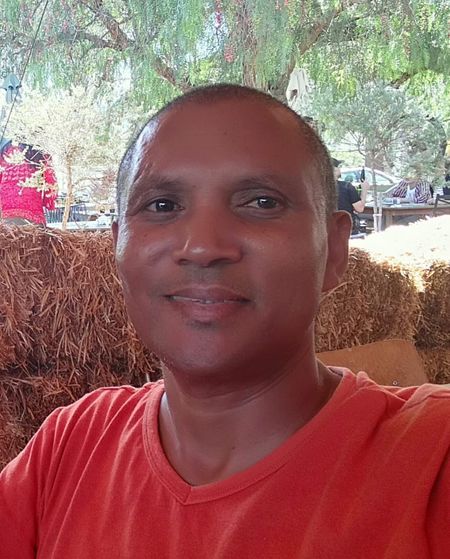
 Isgak Omar (58), known as Gakie, with his painted face, tongue-wiggling tactics and dazzling dance moves, has been part of the Kaapse Klopse since the age of six. (Photo: Supplied / Isgak Omar)
 As tens of thousands of performers prepare to take to Cape Town’s streets on 5 January for “Tweede Nuwe Jaar” – the annual Kaapse Klopse street parade – celebrations were almost overshadowed by an urgent court battle over a venue and parade routes.
The carnival, rooted in the history of slavery, forced removals and community resilience, will go ahead despite renewed tension between organisers and the City of Cape Town over how one of the city’s most significant cultural events is managed.
Euphoria in te run-up to Monday’s event was almost derailed by an urgent court bid by the Cape Town Minstrel Carnival Association (CTMCA) over the use of Vygieskraal Stadium, compounded by a late change to the traditional parade route into Bo-Kaap. According to CTMCA spokesperson Sedick Soeker, the City initially turned down their application to use the venue despite compliance with the usual requirements and without providing reasons.
A midnight ruling on 30 December by Western Cape High Court Judge James Lekhuleni ordered the City to make a venue available for CTMCA competitions on 1, 10, 17 and 24 January. The City appealed on New Year’s Eve but failed, and on New Year’s Day indicated it would take the matter to a full bench. On Sunday, 4 January, City spokesperson Luthando Tyhalibongo said: “The City have filed the appeal and await a date from the court for the hearing.”
The City has distanced itself from the revised parade route. The Kaapse Klopse Karnival Association (KKKA) applied for the march to follow the Fan Walk down Somerset Road and into Cape Town Stadium. Muneeb Gambeno, a KKKA director, said the route change “brings the event closer to home”.
An estimated 20,000 performers will march from Chiappini Street along Somerset Road into the stadium from 11am to 5pm, followed by KKKA competitions until 10pm. Major road closures are expected along Somerset Road, Green Point Main Road, Prestwich Street, Chiappini Street, Ebenezer Road and Waterkant Street from 6am to 9pm.
A living tradition in motion
Isgak Omar’s troupe, the Juvie Boys Entertainers from Lentegeur, is one of 16 affiliated with the KKKA, which comprises about 20,000 members who will take part in the parade. Dressed in flamboyant costumes of glittering satin and bold colours, they mesmerise close to 100,000 spectators each year.
/file/attachments/orphans/IsgakOmar2_231294.jpeg "Isgak Omar (58), known as Gakie, during the Kaapse Klopse parade. (Photo: Supplied / Isgak Omar)")
Speaking to Daily Maverick on 22 December, Omar said: “What the [Klopse] do is what the late Taliep Petersen always spoke about – we make people happy and bring out the smiles that light up their faces. The idea is to showcase the culture through dancing, glittering satin outfits and the playing of banjos and tambourines. That’s why I dance and wiggle my tongue at the same time.
“It is amazing to see how thousands of people descend on Cape Town to witness the parade. Through the hysteria and deafening celebration, you wouldn’t believe how many people shout at you as you dance in the streets.”
Every year, people arrive in the early hours with picnic bags and chairs to secure a view as the troupes make their way along the route to the music of tambourines, banjos and saxophones. Even those with two left feet join in, creating a single, joyful celebration of music, dance and heritage.
Rooted in history
Delving into the history of the Kaapse Klopse, Gambeno explained that the tradition evolved from mid-19th-century Cape Malay slave celebrations into one of South Africa’s most vibrant cultural expressions. Today it blends music, dance and elaborate costumes in the annual parade, previously known in the Cape Malay community as “Tweede Nuwe Jaar”.
Omar, a veteran performer, first donned his colourful satin outfit and dancing shoes at the age of six. Many early memories have faded, but the forced removals from District Six in the 1960s remain vivid. In February 1966, the apartheid government declared Cape Town's multicultural District Six a whites-only area under the Group Areas Act, triggering mass forced removals of more than 60,000 residents.
Omar recalls: “The forced removals did not destroy the spirit of the Klopse. It was our culture – part of who we were – and despite everything that was taken from us, we preserved it and kept going. Our family was moved to Hanover Park, but the tradition moved with us. We joined the Mississippi’s Troupe, and over the years I became part of several troupes. For 42 years, the Klopse has remained part of my life, and at the age of 58 I am still entertaining the crowds. The Klopse runs in our blood, carried from one generation to the next.”
/file/dailymaverick/wp-content/uploads/2022/09/Minstrel3-1.jpg "Isgak Omar of the Cape Town Ghoema Minstrels. (Photo: City of Cape Town)")
Today, the Omar-established Cape Town Ghoema Minstrels perform at events including official City functions. “One day I’ll hang up my dancing shoes, but not before a few more parades,” he laughs.
A taste of what’s to come
On 13 December, the KKKA Kaapse Klopse Voorsmakie kicked off the season, offering a preview of the 2026 parade with music, colour and rhythm. Gambeno said the event allows troupes to showcase their performance and style, building excitement for the full parade.
This year marks the fourth year of the partnership between KKKA and Hollywoodbets, which continues to support the minstrel community. “Tradition has to evolve,” Gambeno said. “Fifteen years ago, you would see much smaller bands. Today, you see precision marching bands, but you still hear the ghoema beat. That balance is how tradition survives beyond our lifetime.”
/file/attachments/orphans/mapnuwejaar_402738.png "Several roads will be closed for the 'Tweede Nuwe Jaar' celebrations. (Map by Daniella Lee Ming Yesca)")
Living archive of shared heritage
Western Cape MEC for cultural affairs and sport Ricardo MacKenzie emphasised that the Klopse is more than a celebration, but a living archive of the province’s shared heritage. “The festival brings together communities across ages and backgrounds, fostering mutual respect and a sense of belonging. It also preserves histories often excluded from formal records,” he said.
MacKenzie added: “We share in the vision to see the Klopse Festival continue to grow sustainably while remaining true to its cultural roots, including elevating the carnival’s profile locally and internationally.” DM