



 P47 EducationPotterton
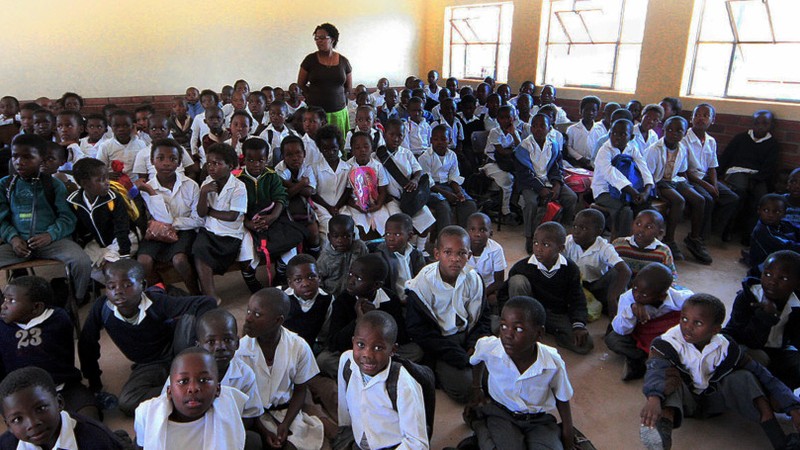
 Some of the six-year-olds in our refugee school project struggle to adjust to routines. I think of Mpho (Gift), who was always in trouble for not following directions or not keeping her hands to herself. Sometimes, she threw tantrums. She was repeatedly spoken to for screaming, throwing pencils, running away from her teacher or refusing to go to another classroom for a time-out.
Many teachers have had similar experiences with children who don’t seem ready for school. Teachers are sometimes unaware of the dynamics of complex trauma and easily mistake its manifestations as wilful disobedience, defiance or inattention. This leads them to respond as though it were mere “misbehaviour”.
Mpho lives with a single mother in a low-income inner-city neighbourhood. Children in such circumstances are at greater risk when they start school. Researchers say that the “neurocognitive and social emotional skills integral to self-regulation undergird early learning and are likely to be compromised for children growing up in poverty and other adverse circumstances”.
Today’s planners can use data and AI to understand difficult social and economic contexts more precisely. Instead of just focusing on daily news (waves), they can look for deep, slow-moving forces (tides) such as automation, demographic shifts and resource scarcity that cause challenges in schools.
A recent Christmas YouTube video quipped: “Santa has a list of good children and a list of bad children. The good children will receive lots of presents, and so will the bad children. In fact, the only ones who won’t benefit are the poor. That’s because Santa judges every child’s goodness largely on parental income.”
This is the harsh reality the Minister of Basic Education must confront. Her ambitious plan to revamp the system is built on key pillars:
- Integrating Early Childhood Development into basic education;
- Intensifying foundational skills like reading for meaning;
- Introducing a new General Education Certificate in Grade 9; and
- Scaling up the Three-Stream Model (Academic, Technical-Vocational, Technical-Occupational).
/file/attachments/2986/Siviwe-Gwarube-scaled_305923_048bccf0a78a9572be8996240b89aef1.jpg)
The Minister of Basic Education understands that choices, willpower and action, not just external forces, shape the future. She needs her planners to use new tools and visualise new possibilities and overcome the tendency of slow, top-down decision-making disconnected from on-the-ground realities:
- Deal with infrastructure delays and overcrowding. Many provinces, especially Gauteng, struggle with delays in completing new school buildings and upgrading existing facilities. This means that schools are overcrowded, and some rely on temporary structures. There is still a stark divide between well-resourced former “Model C”/private schools and underresourced township and rural schools that still need laboratories and libraries.
- Address chronic funding shortfalls. There is a persistent problem with inadequate funding, particularly in provinces like KwaZulu-Natal. This lack of money hampers the ability to maintain facilities, hire qualified staff and provide necessary learning materials. The minister will have to persuade the Treasury to challenge inefficiencies and underspending. Politicians must play an active role in stopping the leakage of funds and procurement scandals at various levels that divert resources from classrooms.
- Deal with teacher shortages. The system continues to grapple with a shortage of qualified teachers in some subjects. This shortage affects the quality of education, which leads to larger class sizes and a decline in individual student support. Teachers also complain of high workloads and low morale, administrative burdens, large class sizes and challenging working conditions. We must value, support and multiply teachers, for a teacher’s spark can ignite a young mind.
- Make sure the curriculum is relevant. The focus on expanding Early Childhood Development and foundational skills like reading for meaning is crucial.
- Deal with social issues and safety. Gang violence, bullying and gender-based violence in and around schools create unsafe learning environments. School feeding schemes are critical in dealing with poor nutrition, but they face logistical challenges. More resources are needed to make schools safer, and police and social workers need to stand proud. The time has come to bring big food companies in to make nutrition programmes more effective. No child should learn in fear or hunger.
- Improve technology and keep it safe. Unequal access to digital devices and digital literacy skills is a challenge, but closing this gap is crucial for a modern economy. Reliable internet access remains uneven, and this digital divide limits learning, particularly in rural areas.
The time is ripe for big tech companies to step in and help with technical know-how and deal with the tremendous backlogs. Their legacy can be more than gadgets – it can be the cultivation of enlightened minds.
The minister cannot ignore the issues of teen pregnancies and fragile mental health. These are silent cries, woven into the daily fabric of school, and are concerns that are easily overshadowed by infrastructural needs. But schools must be places of second chances and unwavering support, where young mothers can reclaim their futures, and no anxious mind feels alone.
The minister’s challenges are formidable – she faces a maze of choices and must find a path through a labyrinth of needs. The central challenge must be to break the ongoing cycle of inequality by fixing the foundation: ensuring every child, including Mpho, reads with understanding and calculates in the earliest grades. At the same time, the summit must be transformed; upper grades need to be dynamic, skills-focused and relevant.
The education budget, like the national fiscus, is not infinitely large. This ambitious transformation must be engineered within tight budgets, against a headwind of social storms. This will only happen through practical, unwavering support for every teacher, the nation’s backbone. These solutions can only work with the help of the community, where parents, businesses and every citizen become guardians of the children.
The wish list is long, the year short and the work hard. Let’s ensure Mpho’s future is bright. DM
Dr Mark Potterton is the principal of Sacred Heart Primary School and the director of the Three2Six Refugee Children’s Project.
This story first appeared in our weekly DM168 newspaper, available countrywide for R35.
/file/attachments/2986/DM-19122025-001_407439_c8ee56123400b25d4c3a51565fceafd7.jpg)