



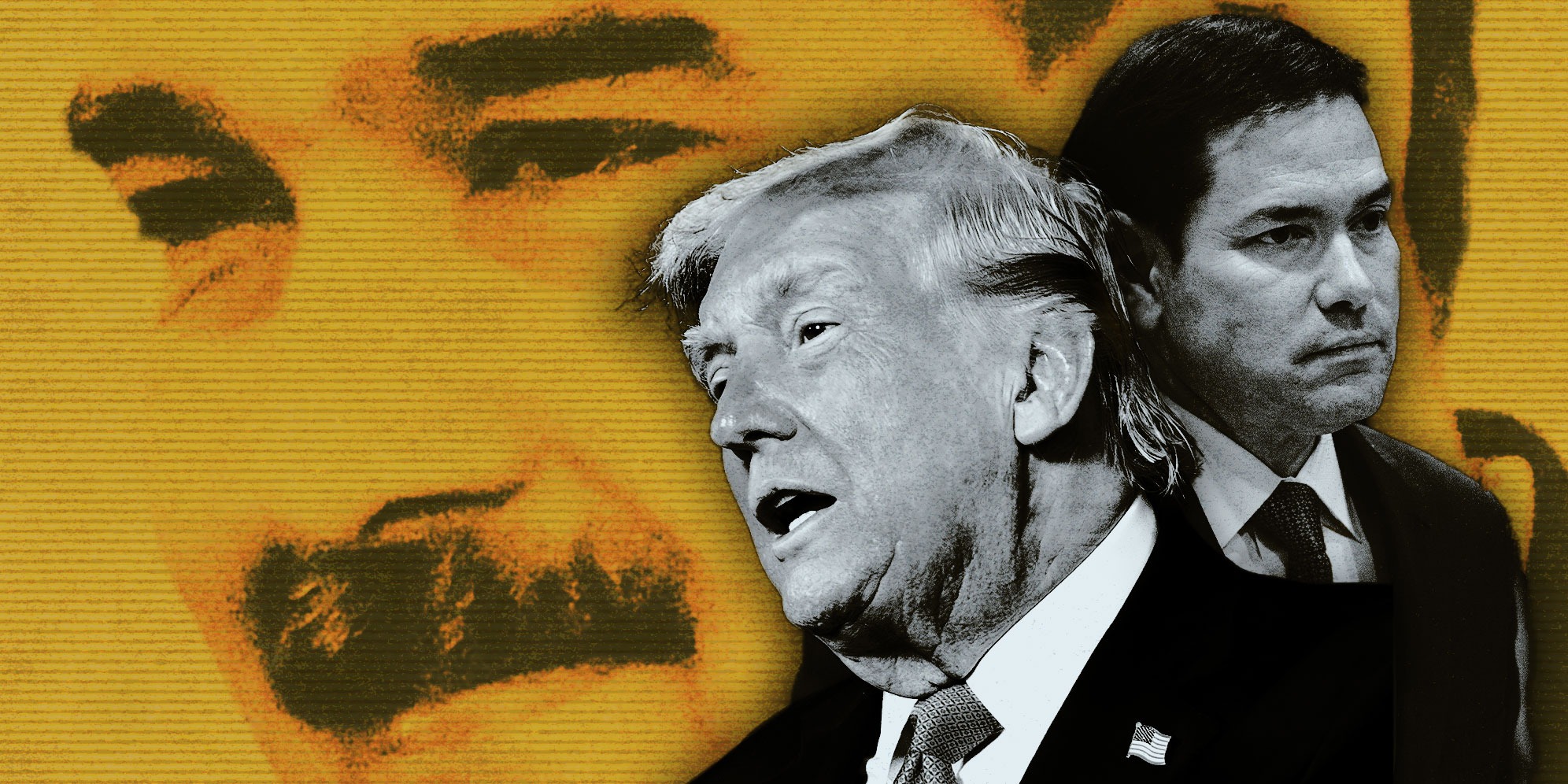
 Illustrative image: Venezuelan President Nicolás Maduro. (Photo: Carolina Cabral / Getty Images) | Us President Donald Trump. (Photo: Nicole Combeau / Pool / EPA) | US Secretary of State Marco Rubio. (Photo: Will Oliver / EPA) | By Daniella Lee Ming Yesca
 On 3 January, US military forces arrested an authoritarian Latin American leader. He faced the music in the US court system and was sentenced to 40 years’ imprisonment.
We need to recall that this occurred in 1990. The leader was Panama’s Manuel Noriega, a man who was unquestionably a drug trafficker and all-round lowlife. Over the years, few tears have been shed for Noriega’s removal from power.
Perhaps we need to ask if events in Venezuela were meant to connect to that earlier anniversary. Trump has been known, after all, to aim for grand, public gestures to emulate — and supersede — earlier successes by others.
/file/dailymaverick/wp-content/uploads/Noriega.jpg "Panamanian dictator Manuel Antonio Noriega (left) salutes troops at an undisclosed location in Panama in 1985. (Photo: EPA/STF)")
The military operation
And so, early in the morning of 3rd January 2026, the US carried out a fiendishly complex, multiforce military operation that included some 150 aircraft, Delta Force special operations troops, secret high-tech engagements, and CIA and FBI resources aimed at decapitating the Venezuelan government.
The US forces made effective use of cyberwarfare capabilities that blacked out much of the capital city of Caracas, as well as smart bomb and missile attacks on military facilities throughout the city and several other sites to suppress resistance. An undercover CIA team had apparently been inserted earlier to ascertain the routine movements of Nicolás Maduro and his wife to pinpoint their locations in preparation for the attack.
/file/attachments/orphans/13616089_410363.jpg "Venezuelan President Nicolás Maduro and his wife, Cilia Flores, arrive at the Federal Legislative Palace in Caracas, Venezuela, on 15 January 2024. (Photo: Rayner Pena R / EPA)")
In a midday media conference following the nighttime raid, US President Donald Trump and his secretaries of defence and state, as well as the chairperson of the Joint Chiefs of Staff, all praised the success, precision and rapidity of the military operation. In extolling the operation, Trump said he had watched it on live electronic feeds and, he marvelled, the reality of the raid was just like watching a television show. (For Trump, does this mean reality is almost as dramatic as a television action drama?)
However, the political and economic sides of this operation, once the first blush of success has faded, will present a much more tangled, confused and confounding texture. This will also include efforts to justify this assault and the potential impact on the behaviour of other nations, something we will explore below.
Once the Venezuelan defence forces were neutralised, the heavily trained and prepared Delta Force personnel entered Maduro’s residence.
They quickly captured Maduro and his wife and transported them to a helicopter assault ship, the USS Iwo Jima, in the Caribbean Sea close to Venezuela. The ship headed north to the US naval base at Guantánamo, Cuba, from where the couple were flown to New York City for incarceration in the Metropolitan Detention Center before they face what will certainly be unpleasant fates at the hands of federal prosecutors and the courts.
Meanwhile, in New York City, the federal attorneys of the Southern District of New York unsealed their 25-page indictment against Maduro, a document first drawn up in 2020. Now updated, it includes heavy-duty narco-terrorism and weapons charges.
Then there was the Trump media conference on Saturday. In his opening remarks, Trump emphasised his frequently repeated charges that Venezuela under Maduro’s leadership is a corridor for narcotics and fentanyl illegally entering the US, thereby harming the security of the nation and leading to the deaths of many thousands of its citizens, and that Maduro had been tightly tied to the gangs and narcotics smuggling networks.
/file/attachments/orphans/13589769_216299.jpg "President Donald Trump. (Photo: Doug Mills / Pool / EPA)")
This followed the recent run of deadly US attacks on small boats in the Caribbean Sea and Pacific Ocean, in which the crews were accused, without proof, of drug running. (However, most experts, including those from the US Drug Enforcement Administration, agree that the vast majority of illegal narcotics entering the US come via Mexico, with the primary source of fentanyl and its precursor chemicals being China.)
Disconcertingly, these actions have followed a Trump presidential pardon given to the former Honduran president Juan Orlando Hernández. He had been convicted of narcotics trafficking, acts about which there was little dispute.
A shift to oil interests
During his media conference on Saturday, as Trump waded more deeply into his remarks amid a hodge-podge of explanations, his emphasis inexorably began shifting from the heretofore preeminent drug issue and the kleptocratic-authoritarian nature of Venezuela’s government. There was a vague statement that the US would “run” the place until a more democratic government was installed, now that Maduro was on his way to a long stretch in a US prison.
But then, jarringly, Trump cast the spotlight on Venezuela’s oil resources — who owns them, who deserves to own them, and how they will be controlled in a presumably new and more democratic future benefiting Venezuelans — and Americans. Trump has long held an obsession that US oil companies were unfairly evicted from Venezuela, but now a path is open to right those grievous wrongs.
However, the Venezuelan oil issue is more complex than the simplistic portrayal provided by the Trump administration. Vast oil reserves in that country were first confirmed in the 1920s and 30s, and then developed largely by a group of US companies. Then, in 1976, the Venezuelan government engaged in a wave of nationalisations of the sector, similar to efforts in other nations such as Saudi Arabia.
In subsequent negotiations, arbitrations and extended legal proceedings, the foreign companies were promised compensation and partially paid out. At the time, the US government was reportedly more concerned that Venezuelan oil should enter the global market to offset production restrictions by Middle Eastern nations rather than over the ultimate ownership of the sector.
Over time, Venezuelan production of oil has dropped significantly and now comprises only about 1% of all oil being lifted globally. (China is a key purchaser; Venezuela subsidises oil shipments to Cuba as well, and the latter may well be negatively affected by the new events.) US sanctions have affected Venezuela’s capability to export, but so have maladministration, mismanagement and corruption by the Venezuelan national oil company.
It should be noted that Chevron, one of the US oil majors that has operated in Venezuela for decades, has continued to operate in that country and was permitted to export the country’s heavy, sulphur-rich petroleum under an exemption to US sanctions.
US refineries along the Gulf of Mexico coast had earlier been specifically configured for that grade of petroleum, but, over time, most of those refineries have been reconfigured to deal with a different grade of raw stock from elsewhere, such as the product of oil shale reserves. Accordingly, it will not be an easy, quick shift to refine Venezuela’s oil in the US, even if output volumes do rise.
As part of this shift towards his obsession with oil, it was notable (and very likely over-enthusiastically) that Trump said major US oil companies would be champing at the bit to invest vast billions of dollars to renew and revive Venezuela’s oil fields. However, this may fly in the face of the risks of investing in an unstable political and economic landscape, making such investments unlikely.
Moreover, Trump indicated that the resulting surge of oil exports — and revenue flows — would benefit the people of Venezuela, those who have fled that country (close to eight million of them), the oil companies and the US.
Political uncertainty
In Venezuela itself, the crucial issue of political stability is murky. Trump and company originally indicated they had been in communication with the then vice-president, Delcy Rodríguez, but that choice may be a non-starter. After she was sworn in as the new national leader, she went on air demanding proof of life of her former boss and promising to oppose US efforts in her country. She is no political neophyte and has had a key role in administering the country’s energy sector.
Meanwhile, there are also the uncertain circumstances of Edmundo González, the opposition candidate generally believed to have won the 2024 election against Maduro (with its thoroughly cooked results), and of the Nobel Peace Prize winner, María Corina Machado (whom Trump and his team effectively dismissed as a potential leader even after she had earlier publicly thanked the US president for his increasing pressure on her nation’s rulers).
/file/dailymaverick/wp-content/uploads/2025/10/2193176136.jpg "Opposition leader María Corina Machado during an anti-government protest on 9 January 2025 in Caracas, Venezuela. (Photo: Jesus Vargas / Getty Images)")
The Trump team has spoken of being in control of the country until a fair, just, democratic transition can be undertaken, but just how that will happen without buy-in by current or potential leaders (or how long it will take) has been left extremely vague. So, too, is the possibility of US military “boots on the ground.”
Collectively, this means any political succession in Venezuela is up for grabs, with the various political factions in the country, plus the bureaucracy, the military and the country’s violent gangs (it has a very high level of violent killings, much higher than either the US or South Africa). All of these elements may want a say in things.
Not surprisingly, TV broadcasts have already shown armed, irregular militias (or gangs) patrolling Venezuelan streets. There are also the inevitable reports of citizens rushing to stock up on food, medicines and fuel — if they can afford it. Watch for shortages or worse.
Domestic and international legal issues
Within the US, the administration’s actions are also generating increasing discontent. First is the question of whether this military action was legal under US law, let alone the murkier waters of international law.
In an attempt to wade through the legal issues, Professor Jack Goldsmith, a former US assistant attorney-general, provided an initial assessment, writing: “The main precedent DOJ [Department of Justice] could cite is President George H.W. Bush’s invasion of Panama in 1989 to arrest and bring strongman General Manuel Noriega to justice in the United States, in part for drug trafficking.
“Some will seek to distinguish the Noriega matter from the Venezuela invasion on the grounds that Panama Defense Forces had recently killed a US Marine and the Panamanian National Assembly had declared that a state of war existed between the Republic of Panama and the United States.
“But the Panama precedent will nonetheless matter to the Venezuela attack due to this 1989 opinion by then-Assistant Attorney General Bill Barr, issued six months before the invasion. That opinion justified FBI arrests in foreign countries under domestic law even if doing so violated international law. It specifically concluded:
1. The FBI’s statutory arrest authority ‘authorize[s] extraterritorial investigations and arrests.
2. The President could lawfully order an extraterritorial arrest pursuant to the FBI’s statutory arrest authority even if it violated customary international law in impinging ‘on the sovereignty of other countries’.
3. Even if those FBI authorizing statutes were limited by customary international law, the Constitution’s ‘Take Care’ Clause empowered the president to authorize federal agents to make arrests abroad that violate customary international law. (The opinion here relied on In re Neagle, the main Supreme Court precedent for the president’s ‘protective power’ that has been invoked in recent domestic deployments.)
4. Article 2(4) of the U.N. Charter, which prohibits the ‘use of force against the territorial integrity’ of any state, does not ‘prohibit the Executive as a matter of domestic law from authorizing forcible abductions’ abroad. Put another way, ‘as a matter of domestic law, the Executive has the power to authorize actions inconsistent with Article 2(4) of the U.N. Charter’.
5. The president has authority to delegate these powers to violate international law in extraterritorial enforcement actions to the Attorney General.
6. A U.S. arrest abroad ‘in violation of foreign law does not violate the Fourth Amendment’.
“President Trump in his press conference today did not provide a legal justification for the invasion. But Secretary of State Marco Rubio represented to Senator Mike Lee that the arrest of Venezuelan President Nicolás Maduro and his wife for violating U.S. law was the primary justification for the Venezuela action.
/file/dailymaverick/wp-content/uploads/2025/06/13106066.jpg "US Secretary of State Marco Rubio. (Photo: Chris Kleponis / Pool / EPA-EFE)")
“And at today’s press conference Rubio said that ‘at its core, this was an arrest of two indicted fugitives of American justice, and the Department of War supported the Department of Justice in that job’. This rationale is consistent with Secretary of Defense Pete Hegseth’s claim that it was a ‘joint military and law enforcement raid’ and General Dan Caine’s claim that it was an ‘apprehension mission’.
“Given these explanations, the Barr opinion justifying extraterritorial law enforcement actions will likely be presented as the main domestic legal foundation for the action.”
Goldsmith concludes:
“In sum, it would not be terribly hard for the Justice Department to write an opinion in support of the Venezuela invasion even if the military action violates the U.N. Charter.
“To repeat, that does not mean that the action is in fact lawful — and it pretty clearly isn’t under the U.N. Charter. It only means that the long line of unilateral executive branch actions, supported by promiscuously generous executive branch precedents, support it.
“As I wrote in connection with the Soleimani strike: ‘our country has — through presidential aggrandizement accompanied by congressional authorization, delegation, and acquiescence — given one person, the president, a sprawling military and enormous discretion to use it in ways that can easily lead to a massive war. That is our system: One person decides.’
“This is not the system the framers had in mind, and it is a dangerous system for all the reasons the framers worried about. But that is where we are — and indeed, it is where we have been for a while.”
The gang of eight firestorm
The Trump administration is probably triggering a firestorm with Congress by having failed to consult with the “Gang of Eight,” the senior leadership from both parties in both houses of Congress of the Armed Services and Intelligence Committees, as events were being planned and, in fact, asserting they did not do so for fear of leaks to outside sources. This is something for which there has been no track record, unlike Hegseth’s leaks on a social media network.
/file/dailymaverick/wp-content/uploads/2025/05/GettyImages-2212157361.jpg "The US secretary of defence, Pete Hegseth. (Photo: Ken Cedeno / UPI / Bloomberg via Getty Images)")
The War Powers Act of 1973 calls for a president to explain to Congress his decision to introduce the military into hostilities within 48 hours of such an event and to seek congressional endorsement within 60 days (extendable to 90 days). So far, the Trump administration has given no indication that it will fulfil either obligation.
There is also the matter of this Venezuelan assault going 180 degrees against the promises Trump made during his presidential campaign of drawing the line at foreign interventions and those so-called forever wars — an outcome that this military action could easily provoke. Such circumstances could drive a wedge deep into the Trump Maga base and make real problems for the Republican Party in the upcoming mid-term elections, now just 10 months and a bit into the future.
Regional and global repercussions
Finally, but not least important, is the effect this intervention and the capture and trial of a government head may have on other nations.
First is the possible impact on neighbouring nations should the political situation in Venezuela become unstable, generating new waves of refugees and exiles and rendering the entirety of the northern tier of South America less friendly to investment and growth. While some Latin American nations seem predisposed to be supportive of the US action, the government of neighbouring Colombia is not, and Brazil is not likely to be supportive either.
A more frightening possibility is that this military snatch and grab of Maduro and the possibility of American “boots on the ground” while Venezuela painfully reestablishes a sense of political stability will provide a preemptive cover of legitimacy for any future actions undertaken by Russia against the officials in the Zelensky government in Ukraine as part of its invasion of that country or by China towards leaders in Taiwan as Beijing continues to assert the island is a breakaway province that must be reunified politically with the mainland.
One thing we can say for sure is that this action represents yet another deep wound to the ideas and ideals of international law and the peaceful settlement of international disputes. It may well become a painful demonstration of the Tom Friedman/Colin Powell “Pottery Barn Rule”: If you break a country, you own it, and its problems now become your problems. DM