




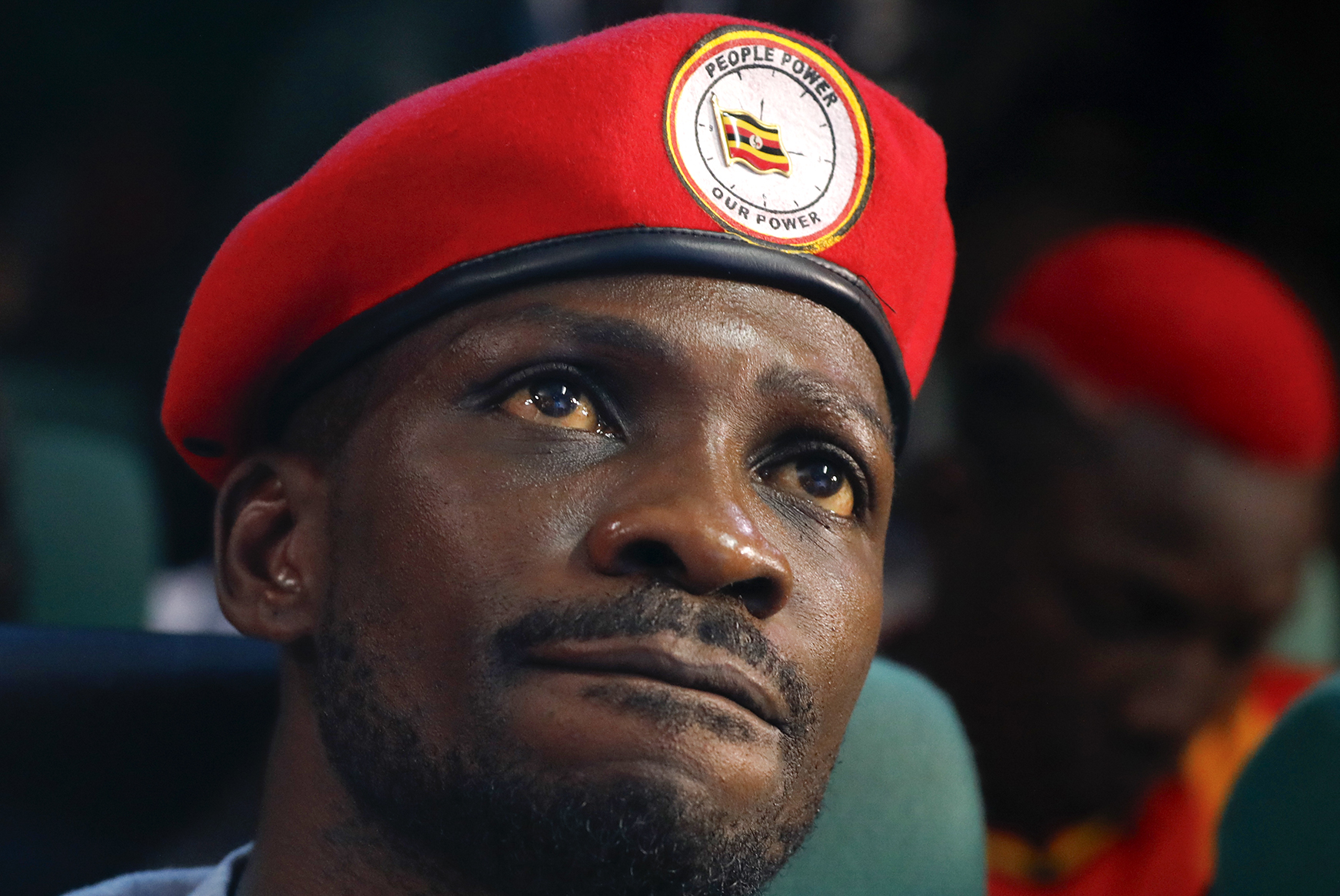
 The Ugandan opposition, led by the charismatic rock-star-turned-activist Robert Kyagulanyi Ssentamu, better known by his stage name Bobi Wine. (Photo: EPA-EFE / Dai Kurokawa) uganda-democracy-op-ed
 /file/dailymaverick/wp-content/uploads/2025/10/label-Op-Ed.jpg)
We live in an age of geopolitical turmoil and distraction.
Around us is a “new normal” – war in the centre of Europe, populist politics, visceral nationalism, xenophobic reaction to immigration, trade wars, the decline of UN authority, the weakening of international law, difficulties in distinguishing fake from real news, and the emergence of an illiberal world order shaped more by the needs of autocrats than the values of democrats.
Unsurprisingly, in such an environment, people turn inwards, looking less to promote values abroad than protect their gains at home.
/file/attachments/orphans/13548445_955012.jpg "Uganda's opposition National Unity Platform (NUP) leader Robert Kyagulanyi, known as Bobi Wine (centre), arrives for a presidential campaign rally in Katogo zone, Kira Division, Wakiso District, Uganda, on 1 December 2025. The Ugandan general elections will be held in Uganda on 15 January 2026. (EPA / Isaac Kasamani)")
But there is hope. And it comes from an unlikely place – Uganda – where an opposition is attempting against all odds to unseat an authoritarian who has held firmly onto the reins of power for nearly 40 years. The opposition, led by the charismatic rock-star-turned-activist Robert Kyagulanyi Ssentamu, better known by his stage name Bobi Wine, has resorted to nonconfrontational Gandhi-like tactics in defeating the regime in the forthcoming 15 January presidential election.
Wine recently contributed to a Playbook for Democrats, which outlines how democrats can use media and other democratic tools to unseat authoritarians like ageing Ugandan President Yoweri Museveni. The former general overthrew the government of Milton Obote in taking office 40 years ago this month.
Democracy eroded
/file/dailymaverick/wp-content/uploads/2023/12/Yoweri-runner-up.jpg "President of Uganda Yoweri Museveni. (Photo: Jack Taylor / Getty Images)")
Multiparty democracy, which was reintroduced in Uganda in 2006, has been steadily eroded as Museveni has sought to stay in power. In the run-up to the January 2021 election more than 50 people were killed in a process that unsurprisingly was widely believed to have been rigged. Uganda may be nominally a democracy, but it is run by people who wear the same old boots.
Ahead of the 2021 poll, Wine was arrested for allegedly violating Covid-19 protocols and released, only to be rearrested. In an eerie repeat of the fate of Dr Kizza Besigye – the veteran opposition leader who stood against Museveni in 2001, 2006, 2011 and 2016, every occasion being marked by fraud and violence – following the contentious 2021 poll Wine was placed under house arrest and his home surrounded during the counting process.
Already this time, the regime has increased its harassment of the opposition, interfering with rallies, hindering Wine’s movements and randomly firing teargas at opposition events, if nothing else to remind Uganda’s 46 million people who is in charge.
In the run-up to the poll over the next two weeks we can expect worse as Museveni’s son, also a general, Muhoozi Kainerugaba, stamps his particularly brutal brand on the proceedings. Known for his Tweetstorms, including his threats to behead Wine or hang Besigye, who has been imprisoned on treason charges for more than a year, members of his Patriotic League of Uganda are manoeuvring into positions of power.
For all of the familiarity of violence, patronage and interference, the succession race makes this election a little different. If Muhoozi were to take over, Western actors would wish they had spoken up sooner rather than too late. Never mind his rants against Wine and others.
In March 2022, he expressed support for the Russian invasion of Ukraine, tweeting that “the majority of mankind (that are non-white) support Russia’s stand in Ukraine”.
In a March 2023 tweet he stated: “Call me a ‘Putinist’ if you will, but we, Uganda, shall send soldiers to defend Moscow if it’s ever threatened by the Imperialists!”
He has also criticised Western “pro-Ukraine propaganda” as “useless”. And in July 2025, he tweeted: “My hero President Trump, please do not turn against President Putin and Russia. You will immediately have problems with 80% of mankind. We support the position of Russia. They are fighting a just war.”
Bloodbath warning
Uganda’s population, which is expected to more than double to above 85 million in the next 25 years, is one of the most youthful worldwide. With nearly 80% under 25, and a median age of under 18, it could be expected that more Ugandans identify with the 43-year-old Wine than the 81-year-old Museveni.
Wine warned in a recent interview that Uganda’s coming election is in danger of becoming a bloodbath like that in Tanzania this past October, where thousands are believed to have been killed by security forces.
“The regime has once again unleashed brute force,” says Wine. “They follow us everywhere, and they keep teargassing us along the way. They have confiscated all the sound systems. They’ve arrested more than 400 people of my campaign team. Largely 90% of my campaign team is in prison right now.”
With few exceptions, external actors have become markedly less outspoken on governance and human rights violations in Africa than at any time since the end of the Cold War. This highlights geopolitical shifts and rivalries.
Caught in the middle are African people. More than 90% of Ugandans reject one-party rule, according to Afrobarometer’s polling, while 81% prefer democracy over other forms of government. Only 55% see the last election in 2021 as free and fair, and 54% believe they are living in a democracy, even with problems.
Uganda received about $2.1-billion in official development assistance in 2022, for which read mostly Western aid. But little of this shapes development prospects unless the politics are right.
Since independence, Uganda has received $60-billion in Western development assistance of the $1.7-trillion delivered cumulatively across sub-Saharan Africa since 1960. Yet Africa’s share of global per capita income has more than halved from 30% to less than 15% over this time. Put differently, while the average wealth worldwide has grown (in real terms) more than threefold from $3,664 to $11,579 over this time, Africa’s has scarcely improved from $1,142 to $1,581.
Uganda’s share of global per capita income is just 8%. With more than nine out of every 10 Africans living under various shades of authoritarianism, getting the politics right is a critical first step to development.
The struggle led by Wine is an example to democrats everywhere. If he succeeds in Uganda, democracy everywhere would be the winner. For the West, it is in its enlightened self-interest to protect the democratic process, the best investment it can make in African development.
For, if not, Africans will realise they are on their own, foretelling a great migration to places with greater freedoms and opportunities. DM
Tendai Biti is a human rights lawyer and former minister of finance in the unity government (2009-13) in Zimbabwe. Greg Mills and Luis Ravina are with the University of Navarra. All three are members of the Platform for African Democrats.