




 P24 Brooks future
 /file/dailymaverick/wp-content/uploads/2025/10/label-analysis-2.jpg)
There is an old adage that says predicting the future is harder than predicting the past. Nevertheless, I was again tasked with this challenge for 2026.
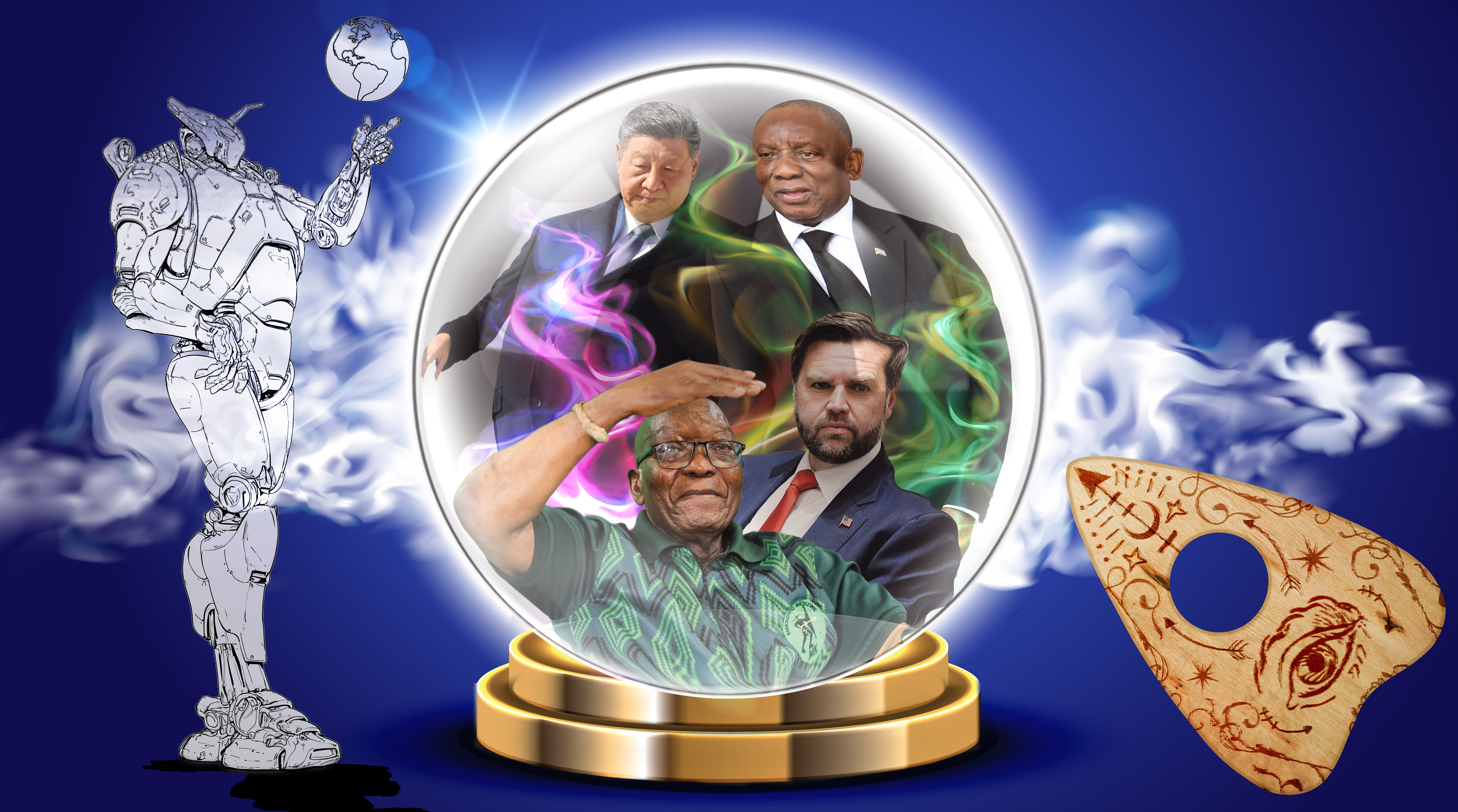
I have consulted a Ouija board, observed a scratched and banged-up crystal ball, looked at two cups of tea leaves, had a palm reading and was dealt a hand of tarot cards. So we take a deep breath... and here we go.
Global trends
AI boom or bust? Despite the massive rush to insert artificial intelligence (AI) into almost every aspect of business and professional activities, and with the way more and more routine work (and people who do it) is being replaced by various AI functions, a classic speculative boom among the companies in the field is coming.
The use of AI will continue to grow, but the bubble collapse is as certain as the sun rising in the east, as less expensive and ever-simpler-to-use versions come on stream. In 2026 we may well learn how the last person in the buying queue during the great tulip bubble felt the morning after that collapsed. Investment advisers beware – and investors too.
Autonomous warfare? In conflict zones around the world, a revolution in kit is just over the horizon, encouraged by vicious yet unsettled conflicts and rapid technological development. The first intelligent autonomous weapons systems are likely to make their appearance in 2026.
They will replace or supplement drones controlled by human operators, despite fears that such weapons systems will – or could – operate beyond human intervention or adherence to any version of morality or norms of warfare.
The race will be on to deploy such devices because they will become increasingly inexpensive and easy to manufacture, replacing human warriors. This could well make conflicts more likely wherever unresolved tensions could break into open warfare.
Sustainable fusion reaction? Somewhere in some laboratory in Europe, China or the US, or perhaps via competition or collaboration among them, a controlled fusion nuclear reaction lasting longer than fractions of a second will be generated.
Despite actual commercial applications still being in the future, fusion reactions will create great excitement about generating unlimited electrical power.
Artificial life? In another lab, somewhere, the first artificial life form that replicates itself and draws energy from its environment will be created. It will be a major step towards producing specialised compounds for disease control and even, eventually, for the insertion of synthetic genetic material to correct human genetic problems.
This manufactured life will also generate a huge debate about the relationship between life and any divine presence and powers. (Mary Shelley, where are you now?)
Of course, the possibility of someone using this technology to design heretofore unknown biological weapons will make the furore over Covid-19’s origins a minor itch by comparison.
Alien life? Less likely but still possible, in 2026 astronomers will detect repetitive electronic signals from a relatively close star indicating complex thought and technological prowess. The idea that life (and humanity) is not unique to our planet will produce yet another shockwave to religion and philosophy, but it may fuel an anti-science reaction as well.
AI literature? The first entirely AI-written novel will be an unexpected bestseller and a serious contender for the Pulitzer Prize. The race will be on for an AI “novelist” to become a serious challenger for the Nobel Prize for Literature with a work or series of works, as the Nobel bequest says, “of the ideal type”.
Musical compositions and films, videos and other streaming material, all produced by AI, will become popular favourites, provoking a massive squabble over royalties and residuals – as well as protests by out-of-work creatives.
The revolt against the electronic world? In response to all these and other scientific and technological advances and the increasing capture and use of individual personal data, there will be a rising anti-technology movement that will begin to make itself felt in politics and society more generally.
Region by region
In America, the race for the 2028 presidential election is now on as a growing list of real, viable candidates emerge in the Democratic Party, now that California governor Gavin Newsom has much more than hinted at his intentions.
They include other governors such as JB Pritzker, Josh Shapiro, Jared Polis, Andy Beshear and Gretchen Whitmer, senator Mark Kelly and, less likely, popular figures such as Pete Buttigieg and Alexandria Ocasio-Cortez.
/file/dailymaverick/wp-content/uploads/2023/05/11499697.jpg "California Governor Gavin Newsom, right, is expected to challenge for the US presidency in 2028. (Photo: EPA-EFE/JOHN G. MABANGLO)")
Among Republicans, JD Vance and Marco Rubio will be the apparent successors to an increasingly enfeebled incumbent president. This is because few other challengers will be able to position themselves for a race requiring gargantuan fundraising efforts, and simultaneously embracing and separating from the incumbent president. A stunning revelation from among the thousands of pages of Jeffrey Epstein documents will probably be a game changer.
/file/attachments/2986/13492738_680496.jpg "US Vice-President JD Vance. (Photo: EPA / Aaron Schwartz / Pool)")
Meanwhile, political junkies will be firmly fixed on 2026’s mid-term election. Democrats will ride the dissatisfaction over cost-of-living crises and the almost weekly revelations of malfeasance, corruption and insider dealing among Republican officials and the Trump family and inner circle, all eager to make financial hay while the sun still shines. It will be impossible to avoid a flood of reporting, polling and comments from talking heads across every platform.
The US president’s announcement that South Africa is not to be invited to the 2026 G20 in Florida will now set off a scramble for an alternative venue versus a collective tugging of forelocks by other members.
Overlapping, preventable outbreaks of measles, chicken pox and rubella will occur where vaccine resistance has taken hold, and the secretary of health and human services will resign when a national panic ensues about the spread of these diseases.
Something new — or nothing — out of Africa?
Although predictions of which countries will face coups or civil unrest – fuelled by kleptocratic natural raw materials exploitation in association with an external player or two – cannot easily be identified, they are almost certain, especially in West Africa.
Simultaneously, flawed elections will generate military power seizures, triggered by fraud in counting ballots or decisions by incumbent governments that their opponents were ineligible to run.
There will be other outbreaks of civil war fuelled by food and fuel shortages or environmental collapses such as failed rains, and such crises will spill over to neighbouring nations because of the movement of impoverished, hungry refugees and insufficient resources to help.
The ghastly civil war in Sudan will continue, producing what the International Rescue Committee has termed the world’s single most horrific humanitarian crisis. There are millions of refugees, still more facing starvation, and the hundreds of thousands of deaths of people just trying to survive the carnage. This misery will continue.
Even those countries blessed with abundant oil, natural gas and gold mining will continue to suffer kleptocratic regimes and exploitation by shadowy foreign investors. In sum, for Africa, more of the same.
And for South Africa?
Upcoming local elections will generate further fragmentation of the ANC as a national force. In the results, the ANC will find few safe zones, given the success of an often chaotic MK party in KwaZulu-Natal, or the DA and several of the mini-parties in Gauteng.
In turn, this will provoke a revolt among ANC party stalwarts and a push to replace the top leaders with a cohort of younger, lesser-known individuals. But it will not stop the disintegration as several regional party bigwigs defect to other parties – or simply retire from active politics.
/file/attachments/orphans/WFD_9264_581176.jpg "President Cyril Ramaphosa arrive at the 5th National General Council of the African National Congress held at Birchwood hotel in Boksburg on 08 December 2025. (Photo: Felix Dlangamandla)")
Meanwhile, the country’s economy will continue to be unable to grow sufficiently to absorb the millions of younger, unemployed people who are desperate for work.
There will be a low-level stream of street protests, and some government facilities will be attacked. Big investors will begin to reconsider the structure of their new investments, leaning more towards automation as a workforce stability mechanism, rather than taking a chance with younger, poorly educated job seekers.
The repo rate will start to climb again in response to a lack of support from portfolio investors because of the political instability. It will lead to the collapse of several home financing institutions.
One unexpected outcome will be the natural slowing of immigration from neighbouring nations as their economic fortunes slowly begin to rise, in contrast to South Africa’s weaknesses.
Several bright stars in the sky will be the global success of South African vocal artists. Tyla will capture a whole sweep of Grammys and several South African classical singers will gain rave reviews in the US and Europe for performances in leading opera houses.
The East is stumbling?
In many ways, 2026 will be a make-or-break year for nations like China, Japan, India and Korea. Several of them will be forced to deal with economic stresses related to sluggish domestic demand and increasingly competitive external markets for their products – as well as the continuing uncertainties brought on by the US-instigated tariff and trade warfare. The tariff and trade wars will push manufacturers and researchers to find alternatives to some rare earths crucial to high-tech industries.
Although the leadership of the governments of the four leading nations will remain largely stable, in China, look for a continuing replacement (or purging) of top civil service and military figures as Xi Jinping seeks to further consolidate his authority in his current term as president.
/file/attachments/2986/13472065_616418.jpg "Chinese President Xi Jinping disembarks from a government plane upon arrival at Gimhae airport in the southeastern port city of Busan, South Korea, on 30 October 2025. (Photo: EPA / Yonhap)")
In Japan, Prime Minister Sanae Takaichi will wrestle with the reality of a government that depends on small right-wing parties for parliamentary support for her plans.
The key driver of regional uncertainty will be China’s decisions about Taiwan. Will this be the year it tries to squeeze the ring around Taiwan tightly via military demonstrations to make its intentions regarding the island’s reincorporation into China more manifest? Or will such actions push other Asian nations into more obvious oppositional stances towards China, especially if the US continues its brand of strategic ambiguity on this issue?
But on the outcome of this question, our crystal ball has gone dark and the Ouija board produces gibberish. Logic says China is not yet ready to make its move, but logic may not be the guiding factor here, as opposed to ideology and history.
The other major uncertainty is North Korea and a lack of clarity over the command and control of its small nuclear arsenal, and a similar lack of understanding about its military doctrine for the possibility of the use of those weapons.
Taken together, these questions will continue to lead Japan, Korea, India and even the nations of Southeast Asia into a more coordinated approach to dealing with potential conflicts – although not yet in any kind of broad, formal alliance.
Europe at a crossroads?
The war in Ukraine will continue to dominate developments in 2026, either by the fighting itself or in the aftermath of any peace accord.
The most likely scenario, despite US President Donald Trump’s flawed efforts to insist that Ukraine must accept a peace largely on Russia’s terms, will be continued, drawn-out attritional warfare, with growing destruction on both sides of the front as the civilian (and military) costs of the war continue.
/file/attachments/orphans/13608912_887480.jpg "US President Donald Trump (right) meets Ukrainian President Volodymyr Zelensky in Florida, United States, on 28 December 2025. (EPA / Presidential Press Service Handout)")
However, there is a growing chance that parts of the Russian state (and population) will begin slowly walking away from responses to the Kremlin’s increasing demands for manpower and a further diversion of resources to fund the war, even as its oil and natural gas export earnings enter a rapid decline.
Meanwhile, many EU and Nato members will continue supplying military equipment to Ukraine, ensuring it can continue resistance to Russian attacks, albeit at great cost.
Elsewhere in Europe, governments facing elections will see growing pressures from groups akin to Germany’s AfD as voters respond to price rises and downward funding pressures on popular government services. Be prepared to witness large public protests against various governments, although they will be insufficient to actually bring down those governments. The year 2026 will not be a pretty picture for fans of stability, however.
And there it is. Check back next December to see how we did. DM
This story first appeared in our weekly DM168 newspaper, available countrywide for R35.
/file/attachments/2986/DM-19122025-001_613320_d2f06eb566b3d566ff7615022a5c63b9.jpg)