




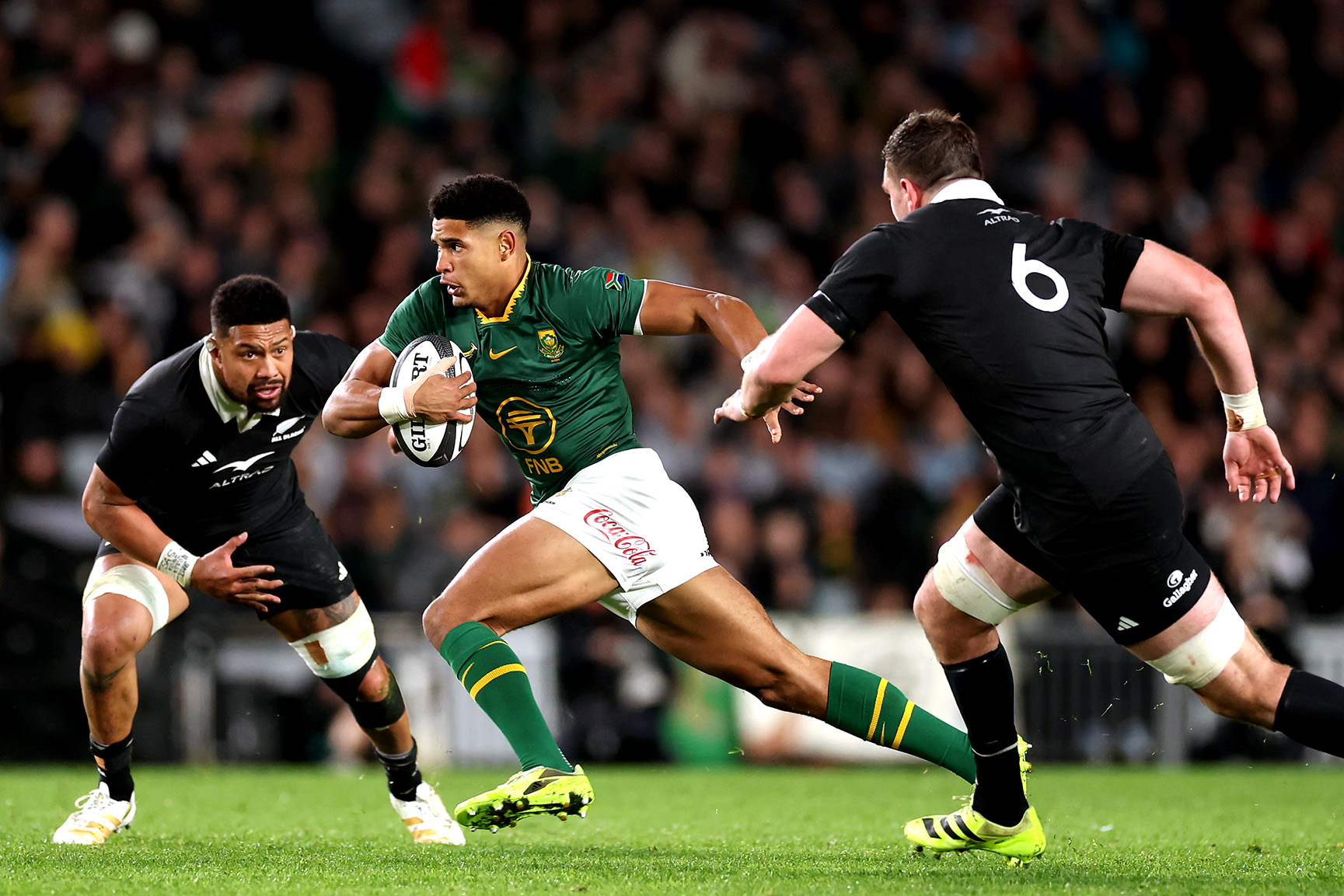
 Sacha Feinberg-Mngomezulu of South Africa makes a break against New Zealand at Eden Park on 6 September 2025 in Auckland, New Zealand. (Photo: Phil Walter / Getty Images)
 The third year in a Rugby World Cup cycle is usually the most complex because the next global showpiece is fast approaching and it represents the last chance for Test coaches to experiment.
It’s always a balancing act between finding the missing pieces of the squad jigsaw and game plan while maintaining positive momentum.
But Rassie Erasmus and the Springboks are no “usual” coach and Test outfit. And the 2026 season is not “usual” in any way, shape or form. Erasmus will be pushed to his innovative best as he plots and calculates a season that looks tougher than any other third-year-in-a-cycle in memory.
Read more: Victorious vision for a nation: Rassie Erasmus has redefined what leadership looks like
Although RWC 2027 in Australia and winning an unprecedented third consecutive title remains the major goal for this Springbok group, the reality is that they cannot look much beyond 2026.
That’s because of two significant factors: the inaugural Nations Championship and a resumption of full tours against the All Blacks are both happening in 2026.
As the reigning world champions and the undisputed No 1 team in the world, the Boks must show up every week expecting to win whatever silverware is on offer.
This is both the joy and burden of earning the moniker of “best team in the world”. Every other nation wants your scalp and bragging rights.
/file/attachments/2986/2233958747_219660_e58e1c7752dfc4f2ffca2d022c041564.jpg)
Greatest rivalry
Since 1996, there hasn’t been a “proper” Test series between the Boks and All Blacks in the amateur sense of the term.
They have met three times in a season on several occasions since the game went professional 30 years ago – but those matches have always formed part of the Rugby Championship or World Cup.
It was Sean Fitzpatrick’s 1996 All Blacks that last embarked on a three-Test tour, sprinkled with midweek clashes against provincial teams.
/file/dailymaverick/wp-content/uploads/2025/04/96237773.jpg "Springbok flank Ruben Kruger is tackled playing against the All Blacks in Durban on 17 August 1996. (Photo: David Rogers / Getty Images)")
Three decades on, fully fledged tours are back on the menu as the All Blacks return for a seven-game sojourn, including three Tests on South African soil.
A fourth Test forms part of the series, but it’s set to be played elsewhere, with London and Dublin mentioned as possible venues.
The tour has been marketed as Rugby’s Greatest Rivalry, which has led to some grumbling from Six Nations countries. The reality, though, is that it’s factually true.
Since world rankings began in 2003, the All Blacks have spent a total of 747 weeks as the No 1 team. The Springboks, currently No 1, are a distant second at 297 weeks. Ireland has had a total of 74 weeks at the top and England has enjoyed 40 weeks.
When it comes to winning percentages in Test rugby, the All Blacks have a 76% winning ratio. The Boks are second on the all-time list with a 64% winning percentage. Next are England with a 56% winning ratio.
Throw in four World Cups for the Boks and three for the All Blacks, and it’s clear from the stats which the two most dominant teams in the sport are.
The four-Test extravaganza could be overkill if it happened often, but in the context of a three-decade hiatus, it feels seismic.
Read more: Boks vs All Blacks Greatest Rivalry series set to change rugby’s quadrennial narrative
Putting together such a spectacle in the professional era didn’t come without collateral damage. The 2026 Rugby Championship has been postponed to 2027.
The South African Rugby Union (Saru) and New Zealand Rugby (NZR) kept their southern hemisphere partners Rugby Australia and the Argentina Rugby Union in the loop about developments – but only as a courtesy.
Once Saru and NZR decided to resume tours to maximise their commercial value, with the All Blacks and Boks the two most successful teams in rugby history, Australia and Argentina were bystanders waiting to see what crumbs fell from the table.
One concession is that the 2027 Rugby Championship will be a double round, which is not normally the case in a World Cup year, while the All Blacks will still meet the Wallabies for the Bledisloe Cup in 2026.
Adding to the Greatest Rivalry offering, the Bok women, who made a breakthrough quarterfinal appearance at the 2025 World Cup, are also included.
Before the men’s third Test at FNB Stadium, which should attract a crowd of 90,000, the Bok women meet New Zealand’s Black Ferns in a curtain-raiser. That should be a magnificent occasion.
/file/dailymaverick/wp-content/uploads/2025/08/2227465914-1.jpg "Aseza Hele of the Springbok Women in action against New Zealand on 2 August 2025. (Photo: Ashley Vlotman / Gallo Images / Getty Images)")
Nations Championship
Adding to the tough men’s schedule in 2026 is the new Nations Championship. It doesn’t add games to the schedule as it takes place in the existing July and November windows, but it adds even more competitiveness.
It’s a competition featuring 12 teams from the northern and southern hemispheres played in one calendar year.
It’s a joint venture between South Africa, New Zealand, Australia and Argentina Rugby (Sanzaar) and the Six Nations. Matches will be played in the two existing Test windows in July and November.
The four Sanzaar nations – plus invitational teams Japan and Fiji – will represent the southern hemisphere in the new competition. They will play against the Six Nations teams: England, France, Ireland, Italy, Scotland and Wales.
There is a “Finals Series” at Twickenham on the last weekend in November to crown the winner of the contest between the best Sanzaar team and the best Six Nations team.
Read more: Is Nations Championship in 2026 a bold new era for rugby with ‘genuine global relevance’?
The Boks have the luxury of playing at home for the opening rounds, starting with a clash against England at Ellis Park on 4 July. By contrast, England meet the Boks and then play Fiji at a neutral venue, believed to be Loftus Versfeld, before going on to Argentina to play the Pumas in Buenos Aires.
They will traverse about 28,000km in three weeks and cross multiple time zones.
The same will apply to other northern hemisphere sides, adding to the difficulty.
And if you thought the Boks would only be focused on the All Blacks, think again. Asked which matches he was most looking forward to in 2026, star flyhalf Sacha Feinberg-Mngomezulu replied: “England at home. That is the one.”
Women go professional
And in another groundbreaking initiative, the women’s game will go fully professional in 2026 with a new competition.
Until 2025, the Bulls Daisies were the only fully professional team in the country, but, with added commercial income, another five teams can afford to pay players a small wage. It’s a vital step in improving the Bok women’s competitiveness at Test level.
/file/dailymaverick/wp-content/uploads/2025/03/TL_2380177.jpg "Patience Mokone celebrates her try with Bulls Daisies teammates during the Premier Division final against Western Province at Loftus Versfeld on 29 March 2025. (Photo: Gordon Arons / Gallo Images)")
“When we repositioned our commercial programme, we made it very clear to sponsors: you can’t come in and be involved only with a men’s team,” Saru chief executive Rian Oberholzer said.
“If you want to be involved, you are going to sponsor the men’s team, the women’s team, the U20s, the men’s Sevens, the women’s Sevens.” DM
This story first appeared in our weekly DM168 newspaper, available countrywide for R35.
/file/attachments/2986/DM-19122025-001_407439_c8ee56123400b25d4c3a51565fceafd7.jpg)