




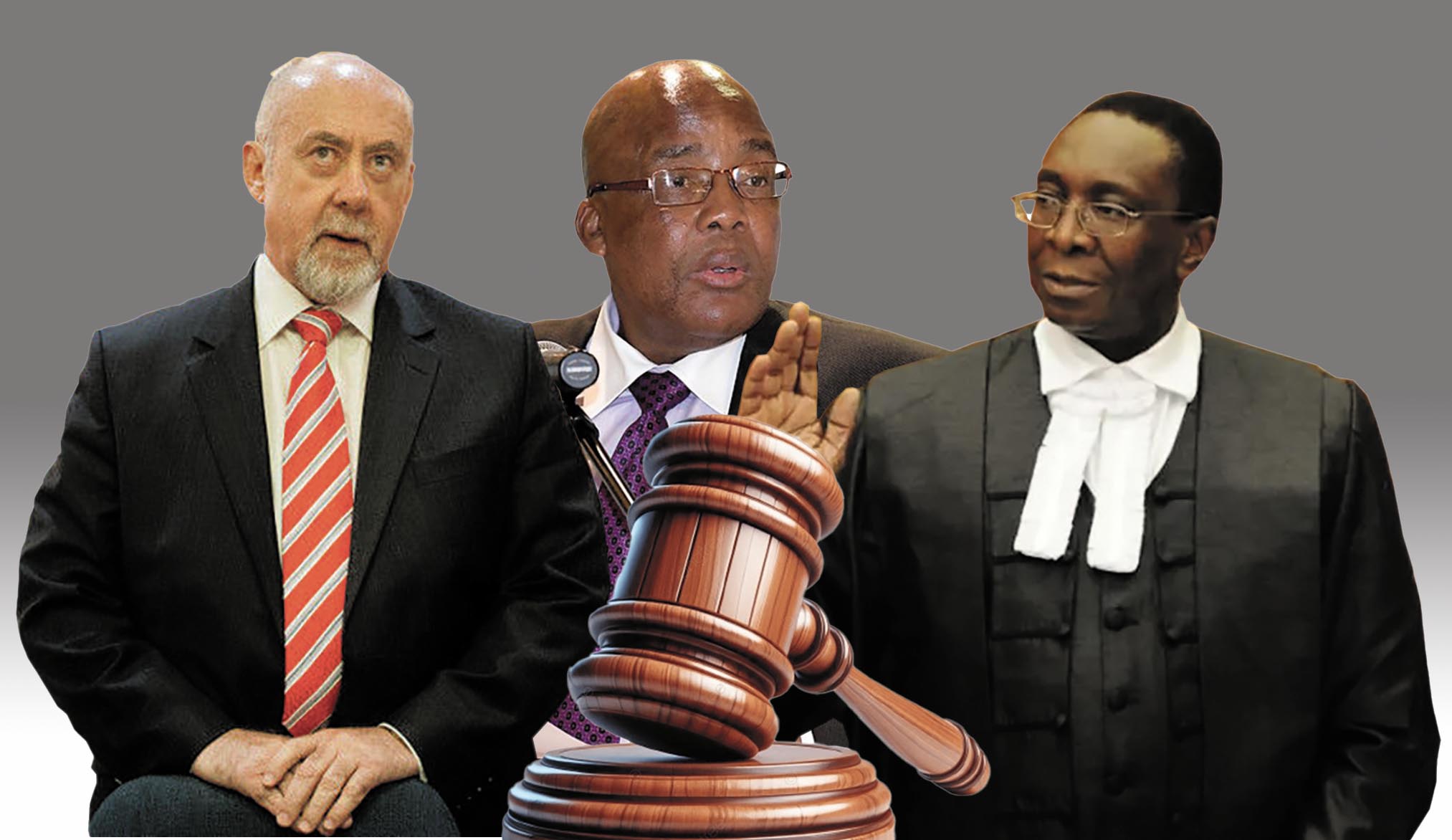
 From left: Cardiologist Dr Wouter Basson, Health Minister Aaron Motsoaledi and Deputy Chief Justice Dunstan Mlambo. (Photos: Getty Images / Gallo Images)
 Decades after the end of the infamous Project Coast, the man dubbed “Dr Death” is expected to appear in the high court in early 2026. This time, Dr Wouter Basson (75) won’t be in the dock. Instead, he is appealing to the court to have the misconduct charges he faces dropped.
The cardiologist has faced censure from the Health Professions Council of South Africa (HPCSA) for more than two decades after it filed misconduct charges against him in 2000 for his activities while he was the leader of the apartheid-era chemical weapons programme known as “Project Coast”.
His hearings have been a stop-start affair interspersed with legal challenges. In 2019, the Constitutional Court ruled that the panel hearing Basson’s disciplinary case should recuse itself, based on bias. Then, in 2024, the HPCSA gave him notice that it would restart the proceedings with a new adjudication panel. This is the decision he is challenging.
“The complaints were laid against me about 20 years after the alleged unprofessional conduct by people who were not involved and without any personal knowledge of the alleged conduct. About 25 years has lapsed since the filing of the complaints against me,” Basson says in an affidavit filed at the Gauteng Division of the High Court in Pretoria.
He also points out that the charges he faces are similar to the criminal charges on which he was acquitted in 2002.
“The prosecution appealed that judgment to the Supreme Court of Appeal as well as the Constitutional Court, and both courts dismissed those appeals,” Basson argues.
/file/dailymaverick/wp-content/uploads/2024/03/12-Wouter-Basson.jpg "Dr Wouter Basson, who headed the apartheid government’s Project Coast. (Photo: Lulama Zenzile / Gallo Images / Die Burger)")
He says he will suffer “severe prejudice” and that his rights to a fair hearing and process, fair administrative action, freedom of trade, trade and profession, and privacy and liberty will all be infringed if the HPCSA is allowed to continue with the proceedings.
In response, the HPCSA’s legal and regulatory affairs head, Prenitha Kantha Padayachee, deposed an affidavit saying Basson is not giving the court the full picture. She says that, as the guardian of the medical and dental professions, the HPCSA has an obligation to act where there is “prima facie evidence” of misconduct.
She explains the long history of the case, all the way from 2000, and says the HPCSA has spent the past few years trying to set up a new inquiry, but the issue of Basson’s funding became a sticking point.
“I point out that a key issue which contributed to the delay in the matter is a recurring theme in the correspondence from the applicant’s attorneys that they are awaiting confirmation from the State Attorney, on behalf of the Department of Defence, that the State will resume financial cover for the applicant’s legal costs.”
Padayachee also reveals that the council had debated whether to continue with the Basson prosecution because of the costs.
“The costs of starting the matter afresh could be considerably high as the organisation has already spent about R5-million in the prosecution of this matter,” an internal memo dated 10 June 2020 states.
The council, however, decided to continue due to concerns about “public scrutiny”.
The case is set down for argument in February 2026.
Political party funding
As South Africans prepare to vote in a much-anticipated local government election, My Vote Counts has returned to the Constitutional Court to battle political party funding. The organisation had previously won a case that forced all parties to declare their funding. But now the organisation says the Political Party Funding Act and Electoral Matters Amendment Act contain worrying loopholes.
My Vote Counts questions the rationale behind the R100,000 threshold set for declaring donations, saying Parliament provided no justification for this threshold. It also questions the “excessive limit of R15-million per donor per annum”, saying the number was set without supporting studies, research or evidence.
Since the laws were passed, the limits have been increased to R200,000 and R30-million, respectively, through a presidential proclamation.
The case was first argued in the Western Cape Division of the High Court in Cape Town, and the court ruled against My Vote Counts. Parliament argues that the organisation has not made out a case for direct access to the Constitutional Court, saying the case should first be appealed in the Supreme Court of Appeal.
“There is a disclosure threshold and donation limit in place which will bind parties in the 2026 local elections. My Vote Counts’ difficulty is that it does not agree with the limits. It is not that the position is unregulated,” says Parliament’s chief legal adviser, Zuraya Adhikarie.
Home Affairs Minister Leon Schreiber has also submitted an affidavit opposing the case, saying “there is no reason this court should hear this matter directly from the high court”. He also argues that My Vote Counts failed to properly argue its case in that court.
/file/dailymaverick/wp-content/uploads/2025/08/P24-ED_548146.jpg "Home Affairs Minister Leon Schreiber at the Meetings Africa Trade Show in Sandton on 25 February 2025. (Photo: Luba Lesolle / Gallo Images)")
Several political parties have been cited in the case, including the ANC, DA, ActionSA and EFF. President Cyril Ramaphosa is cited as a respondent in the case and says he will abide by the ruling. The court has yet to provide directives in the case.
National Health Insurance
National Health Insurance (NHI) will remain a contentious issue in 2026, with new cases filed in the Constitutional Court related to the legislation.
In September, the court heard arguments in a case brought by Solidarity, which is challenging the government’s decision to promulgate the law. There are two more cases, which the court has decided to combine for a single hearing. They are appeals brought by Minister of Health Aaron Motsoaledi and Ramaphosa, respectively, against the Board of Healthcare Funders and the South African Private Practitioners Forum.
Although no court date has been given, the court instructed the parties to file written arguments by November 2025, suggesting that the cases could be heard early in the new year. Ramaphosa and Motsoaledi are appealing against a May 2025 high court judgment in which Ramaphosa was ordered to provide the record of decision that led to the signing of the NHI Act.
In an affidavit filed at the Constitutional Court, Nicholas Crisp, the Deputy Director-General in the Department of Health responsible for the NHI, has told the court that the high court did not have the jurisdiction to make its ruling.
/file/dailymaverick/wp-content/uploads/2023/09/MC-Moonlight-Bhekisisa_2.jpg "Dr Nicholas Crisp, Deputy Director-General in the national Department of Health. (Photo: Leila Dougan)")
“The issues raised relate to the constitutionally derived powers of the president, which are exercised through his sole discretion. A decision on these powers and how they are exercised, and which court has the necessary jurisdiction to exercise oversight, is integral to the interests of justice as well as for legal certainty,” Crisp says.
The Board of Healthcare Funders has responded, saying that Ramaphosa and Motsoaledi are “intent on delaying while continuing to roll out the NHI – and therefore the challenges to the president’s assent to the NHI Bill need to be determined [as] expeditiously as possible”.
Road Accident Fund
Personal injury lawyers have challenged a directive introducing compulsory mediation in all civil cases in the Gauteng Division of the High Court. It was issued by newly appointed Deputy Chief Justice Dunstan Mlambo while he served as the division’s judge president.
His order was in response to the court being overwhelmed by litigation related to the Road Accident Fund (RAF), which created a backlog in the Pretoria and Johannesburg courts. Gauteng deals with 45% of all litigation in the country and, as the country’s economic hub and seat of government, many of the cases are complex. It also deals with the majority of RAF cases.
/file/dailymaverick/wp-content/uploads/2025/07/ED_360363-1.jpg "Deputy Chief Justice Dunstan Mlambo. (Photo: Gallo Images / Daily Maverick / Felix Dlangamandla)")
The Personal Injury Plaintiff Lawyers Association, which brought a review application calling for the directive to be scrapped, argues that it is unfair to litigants.
“This matter is of public importance. The poor and vulnerable who are unable to afford mediation will be severely prejudiced and experience a violation of their right to equal protection under the law and access to court,” association chairperson Justin Erasmus says in court papers. He also argues that the volume of mediations will be unmanageable.
The RAF, which is listed as one of the respondents in the case, has opposed the challenge, denying that mediation will increase costs for accident claimants.
A hearing date is yet to be set, but directives issued by the court show that all relevant arguments had to be filed before the end of 2025. The matter will be heard by a full Bench of judges drawn from a different division of the high court. DM
This story first appeared in our weekly DM168 newspaper, available countrywide for R35.
/file/attachments/2986/DM-19122025-001_613320_d2f06eb566b3d566ff7615022a5c63b9.jpg)