




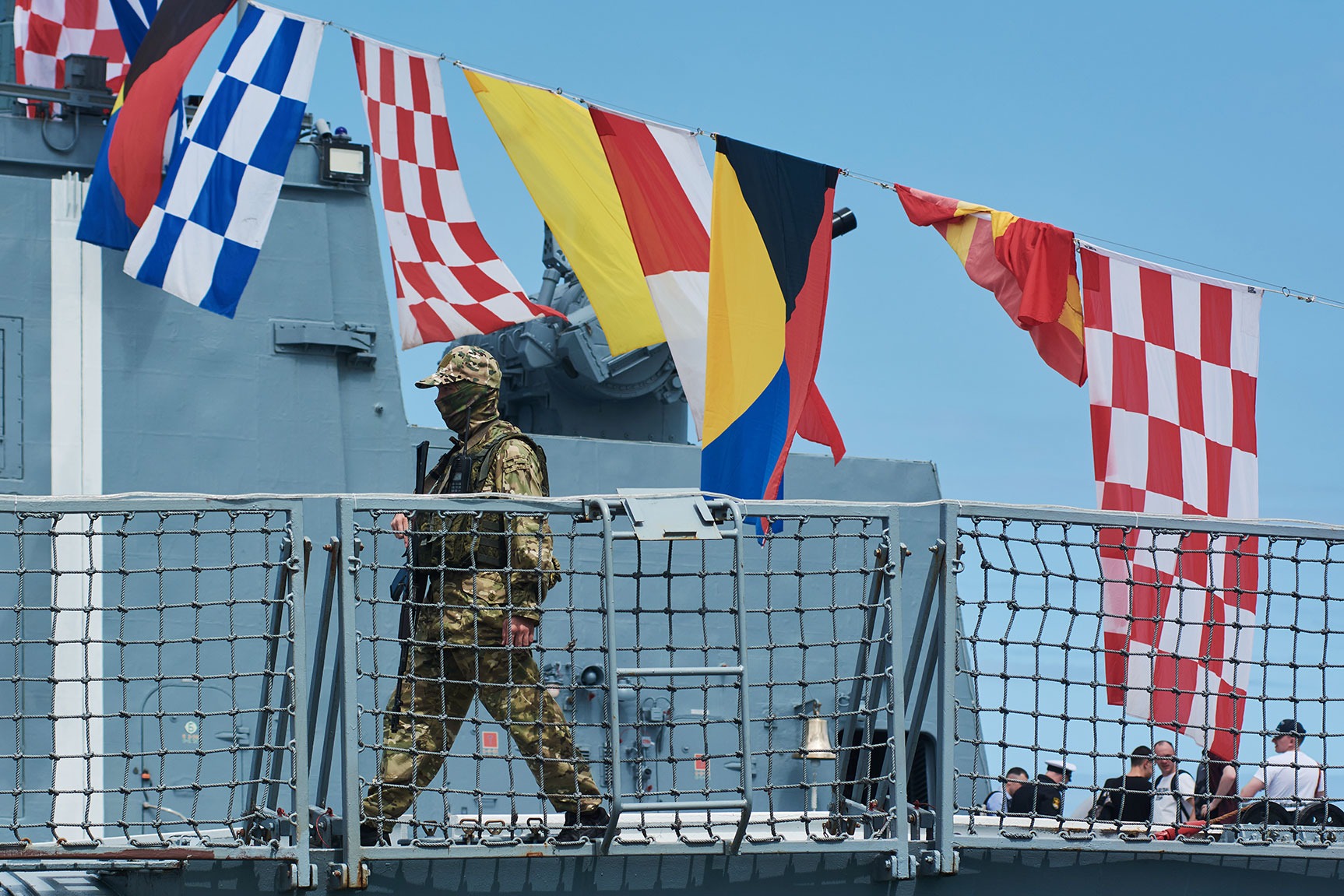
 A soldier patrols onboard the Russian frigate Admiral Gorshkov in Richards Bay on Wednesday, 22 February 2023, before the internationally controversial MOSI II naval drills between Russia, South Africa and China. (Photo: Waldo Swiegers / Bloomberg via Getty Images)
 South Africa will host a joint naval exercise with other countries of the BRICS-Plus group next month, the SA National Defence Force (SANDF) has confirmed.
It said that China would lead the “Joint, inter-agency, inter-departmental, Multinational Exercise to be hosted in South African waters” from 9 to 16 January 2026.
/file/dailymaverick/wp-content/uploads/2025/09/peterfab-MOSI-III-postponed.jpg "Russian navy ships, among them the frigate Admiral Gorshkov, which participated in Exercise Mosi II in 2023. (Photo: Olga Maltseva / AFP)")
Reports had earlier indicated that this would be the third iteration of the series of Mosi naval exercises comprising the South African, Russian and Chinese navies. Mosi I was held in 2019 and Mosi II in 2023.
But the SANDF statement on Tuesday referred to the upcoming exercise as “Exercise Will for Peace 2026”.
It did not specifically mention which other countries would participate, other than saying it would “bring together navies from BRICS-Plus countries for an intensive programme of joint maritime safety operations, interoperability drills and maritime protection serials”.
/file/dailymaverick/wp-content/uploads/2023/02/GettyImages-1247381478.jpg "A soldier stands guard onboard the Chinese frigate Rizhao 598 in Richards Bay on 22 February 2023, ahead of naval drills between Russia, South Africa and China. The exercises were criticised by some of South Africa’s biggest trade partners, including the US and European Union, who questioned the timing of the exercises, which took place a year after Russia launched its invasion of Ukraine. (Photo: Waldo Swiegers / Bloomberg via Getty Images)")
It said the participating nations had agreed on the exercise theme: “Joint actions to ensure the safety of shipping and maritime economic activities”. This theme reflected the collective commitment of all participating navies to safeguard maritime trade routes, enhance shared operational procedures and deepen cooperation in support of peaceful maritime security initiatives.
Iranian flotillas set sail
The Tehran Times of 22 December quoted Rear Admiral Shahram Irani, the commander of Naval Force of the Iranian Army, as saying the 103rd and 104th flotillas of the navy had already set sail for South Africa.
The 103rd flotilla would participate in the BRICS military exercise while the 104th would escort commercial shipping.
Daily Maverick asked SANDF spokesperson Siphiwe Dlamini which navies would participate. He said he had not yet received confirmation of that – China was leading the exercise and would have extended the invitations.
BRICS-Plus comprises Brazil, China, Russia, India, South Africa, Iran, Egypt, Ethiopia, Indonesia and the United Arab Emirates. Saudi Arabia has also been invited to join, but has not formally confirmed its membership.
Media reports have indicated that Indonesia and Ethiopia would also participate in next month’s exercise, though possibly only as observers.
Mosi II annoyed Western countries mainly because of the participation of Russia, and especially because it took place on the first anniversary of Russia’s invasion of Ukraine in February 2022.
Read more: ‘Insensitive’ SANDF to plough ahead with joint maritime exercise with Russia and China
Iran’s participation in the exercise, if confirmed, is likely to make Exercise Will for Peace 2026 even more controversial since Iran is regarded as a sponsor of the radical Hamas and Hezbollah militias fighting Israel. Iran has been involved in a military standoff with the US, which earlier this year bombed Iran’s nuclear facilities.
‘BRICS’ billing queried
Military analysts have also questioned the billing of this as a BRICS exercise, as BRICS does not have a defence operation agreement. Brazil and India did not participate in Mosi I or II and seem unlikely to participate in Exercise for Peace 2026 either.
Darren Olivier, military expert and a director at African Defence Review, said, “It’s a BRICS exercise in name only. There’s no mechanism within BRICS to plan, organise or execute a military exercise.
“Calling it a ‘BRICS’ exercise makes about as much sense as having a ‘G7’ or ‘G20’ exercise. South Africa may be attempting to make the exercise appear to be more legitimate by casting it as a BRICS exercise, but this has not been organised by BRICS.”
He said the focus should remain on the countries taking part, and in that sense, this exercise was just like exercises Mosi I and II, except that now Iran seemed likely to be taking an active part alongside Russia and China.
‘Not smart geopolitics’
“This is not smart geopolitics from South Africa, which should be looking to avoid being seen to be too closely linked with Iran, Russia and China militarily, but to rather have a broader set of partners.
“That should include doubling down and reinforcing its existing military agreements and exercises with India and Brazil, including the Ibsamar maritime exercise, which is both far more useful than Exercise Mosi for South Africa and with two fellow BRICS members.”
Olivier said it was notable that neither India nor Brazil appeared to be joining Exercise Will for Peace 2026 despite it ostensibly being a BRICS exercise.
“The question has to be asked whether South Africa is risking harming its relations with India and Brazil in holding it. ”
In April this year, the Defence Department said in a statement that what was then still called Exercise Mosi and was scheduled for November 2025 would be postponed to avoid clashing with the G20 summit being held in Johannesburg at that time.
It justified the holding of the exercise with Russia and China by saying, “South Africa’s participation in military exercises of this nature with various countries is part of the furtherance of sound multilateral and bilateral relations. As it has in the past, South Africa continues to hold joint military exercises with a broad range of countries. In the last few years, the SANDF has conducted joint and multinational military exercises with countries such as Brazil, China, France, Germany, Russia and the United States.”
‘Hyped-up basic manoeuvres’
Independent military expert Hemoed Heitman said he doubted that Exercise Will for Peace 2026 would be “more than a hyped up ‘passage’ exercise with little real naval elements.” By a “passage” exercise, he meant that the navies would probably practice only basic manoeuvres like anti-piracy or rescue missions, but no combat drills or complex manoeuvres.
“I have not heard of any other BRICS navy taking part,” he said, apart from South Africa, Russia, China and Iran.
/file/attachments/orphans/AV_00050770_333308.jpg "Military expert Helmoed Heitman. (Photo: Gallo Images / Financial Mail / Robert Tshabalala)")
According to some media reports, though, new BRICS members Ethiopia and Indonesia are also due to take part, though perhaps just as observers. Heitman said landlocked Ethiopia had no real navy apart from a couple of patrol boats on Lake Tana and might just send a few observers.
“The Indonesians could send a ship and certainly have a range of capabilities from which we could learn, including some landing ships.” But he said China and Indonesia were both wary of each other because of their disputes in the South China Sea, and so would probably not want to exercise together.
“From our point of view, it is always good to get insight into other navies, even if it is just to learn how not to do things. The Russians could tell us about counter-drone thinking if they are willing. The Chinese certainly have interesting ships, and the Iranians have done some innovative thinking in the naval sphere, but not much of it relevant to our seas.”
‘Major misstep’
“Economically and strategically, it is a major misstep for us, once again alienating our key trading partners (with which we have a positive balance of trade) and investors in favour of countries – Russia and Iran – which are irrelevant to us economically and strategically.”
Heitman said China was a major export client, but that was almost all raw materials, so SA had a very negative balance of trade with it.
All three countries were viewed with a real degree of suspicion – or even as future enemies – by their neighbours, he said.
“Very little upside, lots of scary downside,” he concluded.
Democratic Alliance defence spokesperson Chris Hattingh said hosting this joint naval exercise with Iran and Russia “makes it increasingly difficult for the government to maintain that South Africa is genuinely pursuing a policy of non-alignment”.
“Hosting the military forces of Iran and Russia is not neutral. These are sanctioned states involved in active conflicts and serious human rights abuses,” he added, predicting this “quiet military cooperation” would end “in open alignment”.
/file/attachments/orphans/0000138696_896093.jpg "Democratic Alliance defence spokesperson Chris Hattingh. (Photo: Gallo Images / Foto24 / Mario van de Wall)</p>
<p>")
“This concern is heightened by recent public statements from Iran’s president describing his country as being in a state of war with the United States and Western powers, making South Africa’s decision to host Iranian naval forces deeply concerning.”
Hattingh said that meanwhile, South African defence relationships with democratic countries were weakening. “Joint military exercises with the United States have been cancelled, US participation in the Africa Aerospace and Defence exhibition failed, and diplomatic tensions are increasing. These outcomes are the predictable result of confused foreign policy and poor political judgement.”
He said the DA would insist on full transparency and parliamentary oversight of all military exercises involving sanctioned states, “and hold President Ramaphosa accountable to restore proper civilian control over defence policy.”
A foreign relations observer predicted that the Trump administration would be likely to punish South Africa for conducting this exercise with Russia, Iran and China. DM