




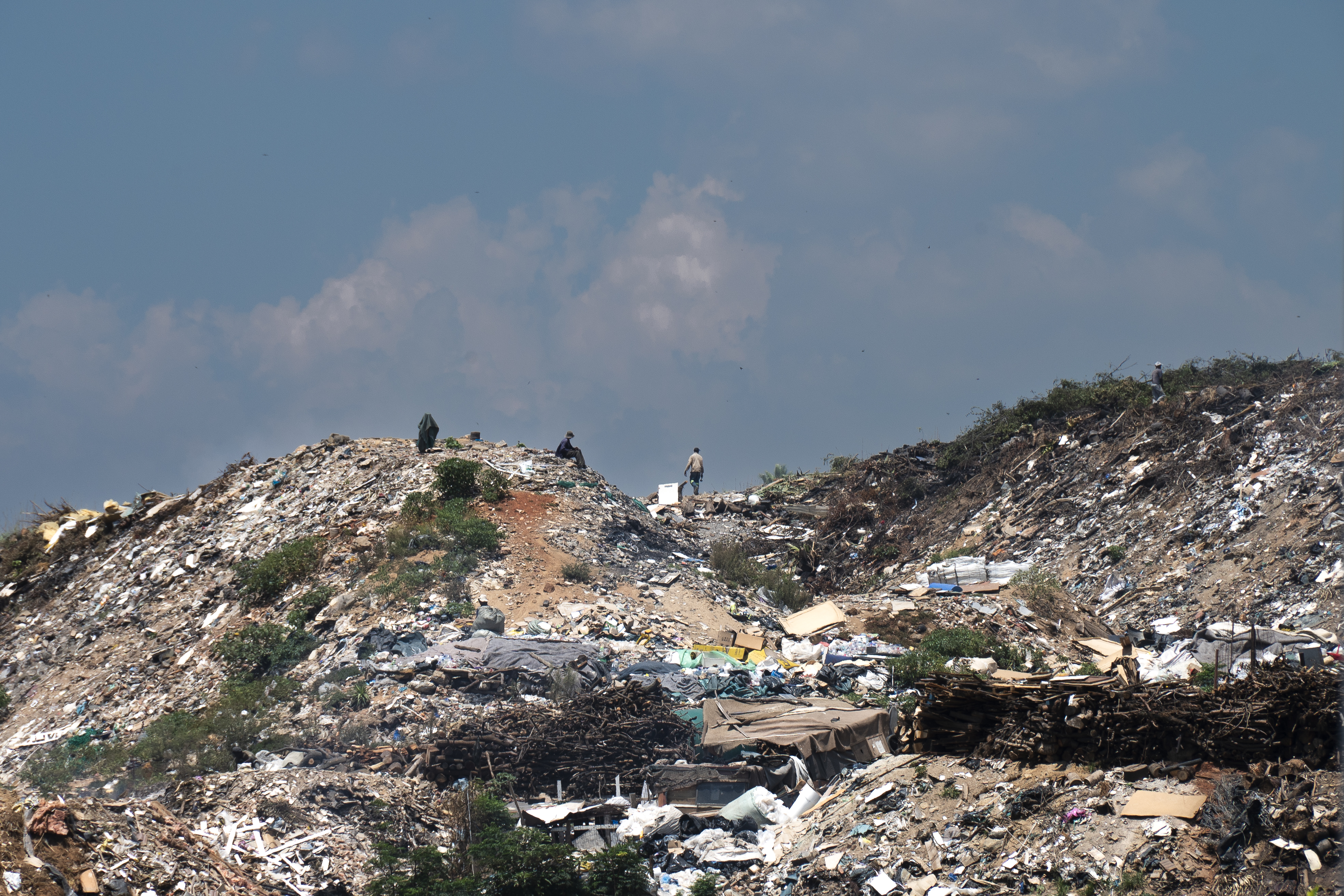
 The main dump on the decommissioned Kya Sands site, as seen from Kya Sands Road. (Photo: Supplied)
 /file/dailymaverick/wp-content/uploads/2025/10/label-Op-Ed.jpg)
In the heart of northern Johannesburg, a quiet catastrophe has smouldered for more than 10 years. What was once the decommissioned Kya Sands Waste Disposal site has been reborn as a sprawling network of illegal dumps – run not by the City, but by organised crime syndicates known locally as the “Waste-Lords”.
Since 2014, at least 10 such sites have re-emerged in the area. Every day, hundreds of trucks unload household, construction, toxic, electronic and even medical waste. Operators charge up to R800 per load, earning millions annually. The trade is open and brazen – a shadow waste economy operating in plain sight, while official oversight has all but collapsed.
The nightly infernos
The air carries more than just a foul smell. Each night, after recyclable materials are stripped out, the remaining waste is set alight with the fires releasing a toxic haze that blankets Kya Sands and surrounding suburbs. The goal is crude but effective – burning clears space for more dumping the next day.
Benzene, ethylbenzene and other hazardous compounds produced by these fires are among the most dangerous pollutants known to science. An estimated 150,000 residents live directly downwind of the affected sites – and for them, clean air has become a luxury.
/file/attachments/2986/Msawawainformalsettlementillegaldumpinprogress_576480_98f2628c9b00b41a37462d45d40f0784.jpg "Illegal dumping in Msawawa informal settlement, Kya Sands. (Photo: Supplied)")
/file/attachments/2986/KyaSandDecomissionedWasteDisposalsite-viewfromCedarCreekEstate_502066_9f0a33edc294ffe0493fadab8a0bfdfd.jpg "Kya Sands decommissioned waste disposal site viewed from Cedar Creek Estate. (Photo: Supplied)")
/file/attachments/2986/ElsecarRoadKyaSandillegaldump-aerialview1_652890_846f413f19c78681a5855e8f66d24100.jpg "An illegal dumping site on Elsecar Road, Kya Sands. (Photo: Supplied)")
Toxic air knows no boundaries
This crisis does not discriminate. It affects residents across economic divides – from informal settlements to established suburbs – blanketing entire communities in the same toxic air. Children walking to school, families exercising outdoors, and the elderly in their homes all breathe the same smoke.
As Mary Kawonga, Associate Professor in the Department of Community Health at Wits School of Public Health, explains: “Open waste burning is reported to be a common practice in South Africa, particularly in settings where proper waste management systems are lacking or poor.
“Open waste burning contributes to air pollution (poor air quality). When waste is burnt, contaminants that are released into the air are inhaled, and in this way they cause health problems. The types of pollutants released into the air depend on the nature of the waste being burnt – they may include particulate matter (PM2.5 and PM10), gases and other toxic compounds, all of which are hazardous to health.
“Short term exposures to these pollutants may result in acute (short-lived) health effects such as cough, difficulty breathing, and nose and eye irritations, and acute infections of the nose and throat. However, long-term exposure to high levels of these pollutants results in severe health conditions including chronic lung diseases, exacerbation of asthma symptoms, heart disease, cancers and a higher risk of premature death.
“Particulate matter 2.5 (PM 2.5) is particularly hazardous because these are fine particles that are easily inhaled and can get deep into the lungs and then into the blood stream. An analysis of global data in 2016 estimated that as many as 270,000 deaths annually across the globe are attributed to PM2.5 from waste burning.”
Read more: Gauteng’s air quality monitoring choking with most stations offline in SA’s most polluted province
Despite years of complaints and petitions, official responses have been limited to site visits, plans and press statements that amount to municipal greenwashing – gestures designed to project action without delivering results.
/file/attachments/2986/DecomissionedKyaSandWasteDisposalSite-nightburning_795487_045811b84579b245b0fd8ebfee191b5c.jpeg "Night burning at the decomissioned Kya Sands Waste Disposal Site. (Photo: Supplied)")
/file/attachments/2986/MsawawaDumpSmouldering-fromCedarCreekEstate_340752_8de2cd1d1adbeb44e400fc38ee0358f9.jpg "The Msawawa dump seen from Cedar Creek Estate. (Photo: Supplied)")
Promises, plans and paralysis
Authorities, including Pikitup, the City of Johannesburg, the Gauteng Department of Agriculture and Rural Development, Johannesburg Metro Police Department and SA Police Service have all been briefed on the problem. In 2021, officials conducted inspections. In 2022, they presented a “strategic plan”. Yet, nothing changed. The fires still burn nightly; the dumping continues unchecked.
In August 2024, the Kya Sands Burning Wasteland Community Forum secured a high court order compelling the City to conduct comprehensive air-quality testing. The City missed its deadlines. Further legal action is now under way against 12 government entities. Independent tests confirm what residents already know: the air they breathe is unsafe.
/file/attachments/2986/DecomissionedKyaSandDumpfromKyaSandRoad_766827_3004855c9564d27d1469b409c37cdcae.jpg "Illegal dumping in progress on Elsecar Road, Kya Sands. (Photo: Supplied)")
/file/attachments/2986/KyaSandDecomissionedWasteDisposalsite-stillactive-aerialview_739665_f30dcb7dd5081c70982080bb04c5e1e7.jpeg "The Kya Sands decommissioned waste disposal site is still active with illegal dumping and burning. (Photo: Supplied)")
The economics of neglect
The illegal waste industry thrives because it is profitable – and because no one is stopping it. Each truckload represents easy money for operators and avoided costs for those who should be disposing of waste legally.
The result is a cruel economy of neglect: the “Waste-Lords” profit while communities pay with their health, their environment and their safety.
A roadmap for change
The community’s demands are clear:
- Coordinated action: A joint task force spanning all levels of government, with court oversight and transparent reporting.
- Immediate remediation: Closure and rehabilitation of all illegal dump sites, enforcement of environmental laws, and restoration of the rule of law.
- Sustainable planning: Development of legal, well-managed waste facilities to serve the area and prevent recurrence.
Accountability must replace greenwashing
The fight for Kya Sands is not just a local battle – it is a national test of environmental justice. It exposes how environmental collapse happens: not through one act of malice, but through years of denial, deflection and delay.
South Africa’s environmental policies promise sustainability. But without enforcement, they amount to little more than policy greenwashing – a theatre of intent masking a failure of governance.
The residents of Kya Sands, Fourways, Bloubosrand and beyond have waited long enough. The courts have spoken. The science is clear. The community has mobilised. Now the government must act – before Johannesburg’s toxic skyline becomes a permanent monument to neglect. DM
Keith Elliott is a Broadacres resident and one of thousands directly affected by toxic smoke from illegal dumping and burning in the Kya Sands area. He is the volunteer director at the Kya Sand Burning Wasteland Community Forum NPC (KSBWCF).