




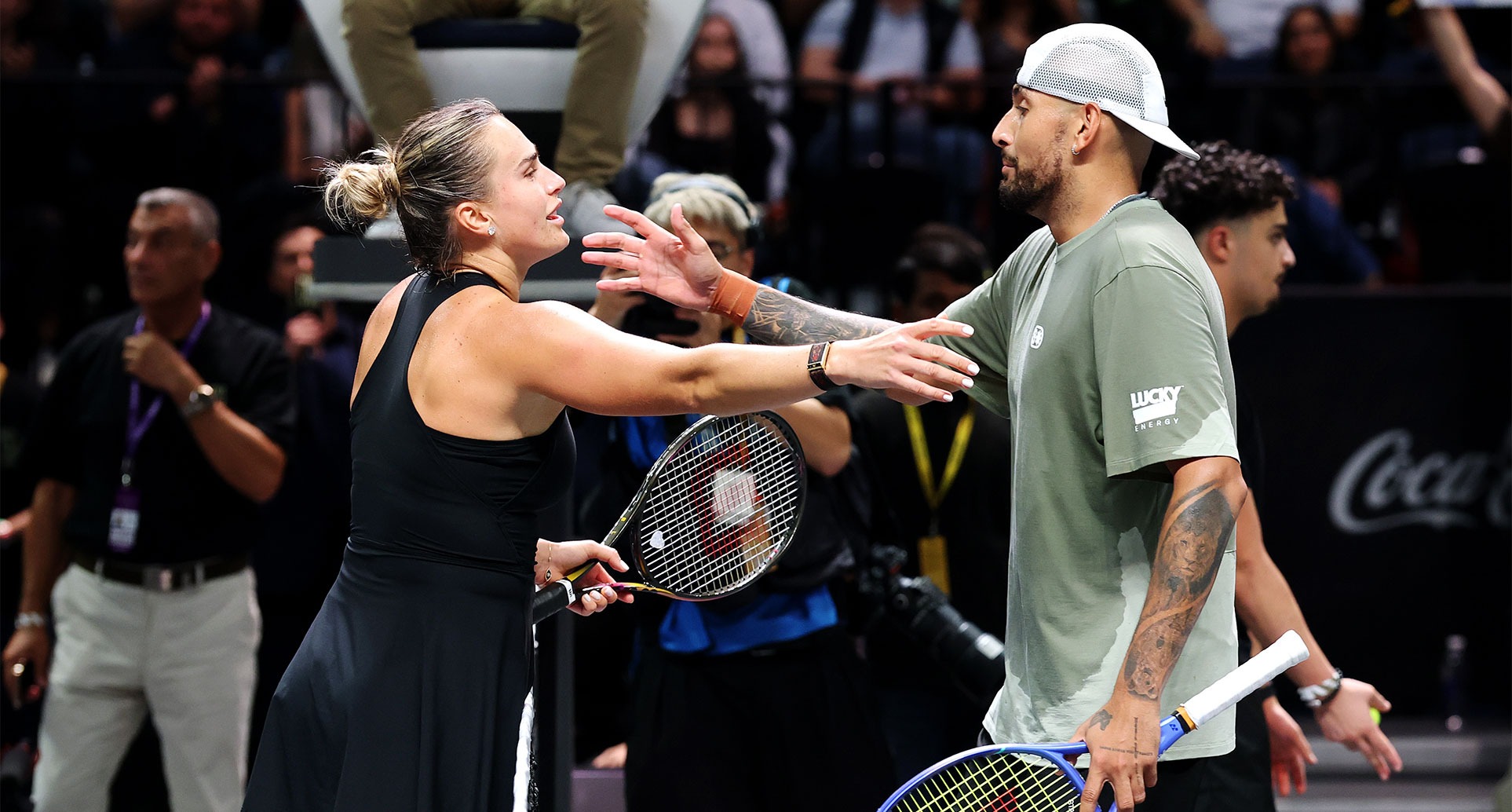
 Aryna Sabalenka of Belarus (left) and Nick Kyrgios of Australia embrace at the net after the ‘Battle of the Sexes’ exhibition match in Dubai, United Arab Emirates, on 28 December 2025. (EPA / Christopher Pike / Pool)
 “And a big thank you to aryna sabalenka for setting women’s tennis back 52 years! hope it was worth the cash and the publicity”.
This tweet racked up more than a million views: proof that outrage is still the most reliable accelerant on the internet, but also because it tapped into a discomfort that many people were circling without quite naming.
The exhibition “Battle of the Sexes” tennis match played in Dubai on 28 December between Aryna Sabalenka and Nick Kyrgios was packaged as a bit of glossy fun: cheeky, ahistorical, unserious. Just a festive season show.
And yet it landed in a political moment where nothing about sex, sport and bodies is neutral any more.
Sabalenka’s concessions controversial in themselves
To make the contest palatable, organisers stacked the deck with concessions to Sabalenka. She was given a smaller court. She was allowed a faster serve clock. Both players were granted just one serve – which was intended to assist the female player, but ended up helping the male player. Kyrgios won 6-3, 6-3.
These adjustments were presented as sensible equalisation techniques, but they were controversial in themselves, because they implicitly conceded the very premise that the exhibition pretended to mock: that men and women are not physically comparable in elite sport.
/file/attachments/orphans/13608343_286544.jpg "Nick Kyrgios of Australia in action during the exhibition match against Aryna Sabalenka of Belarus. (EPA / Amr Alfiky / Pool)")
If the match was meant to be a light-hearted rebuttal to biological essentialism, it did an oddly thorough job of reinscribing it.
That alone would have been enough to make the spectacle awkward.
But the organisers chose to dress it up in the borrowed language of one of the most politically loaded sporting events of the 20th century: the 1973 “Battle of the Sexes” match between Billie Jean King and Bobby Riggs. That comparison is where the Dubai exhibition really begins to creak.
Despite the bells and whistles surrounding that 1973 match, and the fact that King entered the court carried in the manner of Cleopatra, King herself never saw her match with Riggs as just a novelty act.
Looking back, she said: “I thought it would set us back 50 years if I didn’t win that match. It would ruin the women’s tour and affect all women’s self-esteem.”
King knew that it mattered that she won: not because she needed to prove that women could beat men in tennis in general, but because the wider feminist stakes were enormous.
In 1973, women in many parts of the world still lived without basic civic and economic rights. There were countries where women had only recently gained the vote – Switzerland, for instance, granted women the right to vote at the federal level only in 1971 – and others where that right was still contested or constrained.
In the United States, women could not reliably open a bank account or access credit in their own name without a male co-signer until the mid-1970s. Pay inequality was overt and structural: women earned substantially less than men for the same work, with little legal recourse. The modern women’s sports economy barely existed.
When King walked on to the court against Riggs, she was carrying far more than a tennis racquet.
That seriousness translated into audience attention. The 1973 match was watched by tens of millions of Americans and remains one of the most-viewed tennis broadcasts in US television history.
By contrast, the Dubai exhibition struggled to sell out a stadium of around 6,000 seats even after shutting off whole tiers of seats.
/file/attachments/orphans/13608498_234737.jpg "From left, Aryna Sabalenka of Belarus, her goddaughter Nicole, and Nick Kyrgios of Australia after the ‘Battle of the Sexes’ exhibition match in Dubai, United Arab Emirates, on 28 December 2025. (EPA / Amr Alfiky / Pool)")
Terrain has shifted uncomfortably
Even the mythology of the original match is more complicated than its slogan suggests. Martina Navratilova later argued that the primary reason Riggs lost to King was not some grand levelling of the sexes, but age: Riggs was 55, King was 29.
The 1973 Battle of the Sexes was not a crude test of male versus female bodies, but a contest staged inside a specific social reality which was invested with meaning because women’s equality itself was so precarious.
Fast-forward to 2025, and the terrain has shifted in unsettling ways.
There is, undeniably, a global backlash against women’s rights: with reproductive autonomy under renewed attack, gender-based violence endemic and economic inequality still entrenched.
But the most volatile, “live” debate in sport right now is not about cisgender women versus men. It is about trans participation in women’s sporting categories. That argument – often conducted with more heat than care – is, to a certain point, legitimately preoccupied with physical advantage, with power, with the limits of inclusion.
Into that context drops a heavily promoted exhibition match that all but guarantees one takeaway: men are stronger than women.
However playful the packaging, it will be hauled out, again and again, as supposed evidence in arguments it was never ostensibly designed to address.
/file/attachments/orphans/13608398_406901.jpg "Aryna Sabalenka of Belarus in action during the ‘Battle of the Sexes’ exhibition match against Nick Kyrgios of Australia, in Dubai, United Arab Emirates, on 28 December 2025. (EPA / Amr Alfiky / Pool)")
Light entertainment is not neutral
It doesn’t help that everything about this modern rematch felt stage-managed to the point of unreality. Kyrgios’s world ranking of 671 was waved around as if it meant something – a man ranked 671 in the world can beat the women’s number one! – when it is simply a function of his absence from the professional tour. He is a former Wimbledon finalist, an elite player whose talent is not in question. Presenting 30-year-old Kyrgios as a Bobby Riggs-style washout is ludicrous.
The fact that Sabalenka and Kyrgios share the same agency only underlined how little of this was about sporting curiosity and how much about commercial choreography. That impression was sealed when the agency claimed, with a straight face, that the only prize on offer was “pride”. This elided the obvious: both players were no doubt paid substantial appearance fees.
The problem, then, is not that Sabalenka agreed to play, or that Kyrgios showed up, or even that fans bought tickets.
It is that the event borrowed the moral capital of a past struggle without grappling with the present one. King’s match mattered because it was anchored in a world where women’s equality was visibly unfinished, and because King herself was willing to bear the weight of that symbolism. The Dubai exhibition floated free of that responsibility, even as it trafficked in its imagery.
In a different political moment, this might all have been harmless fun. In this one, it simply is not.
When questions about sex, gender and fairness in sport are already weaponised, staging a faux “Battle of the Sexes” as light entertainment is not neutral, and could never be. DM