





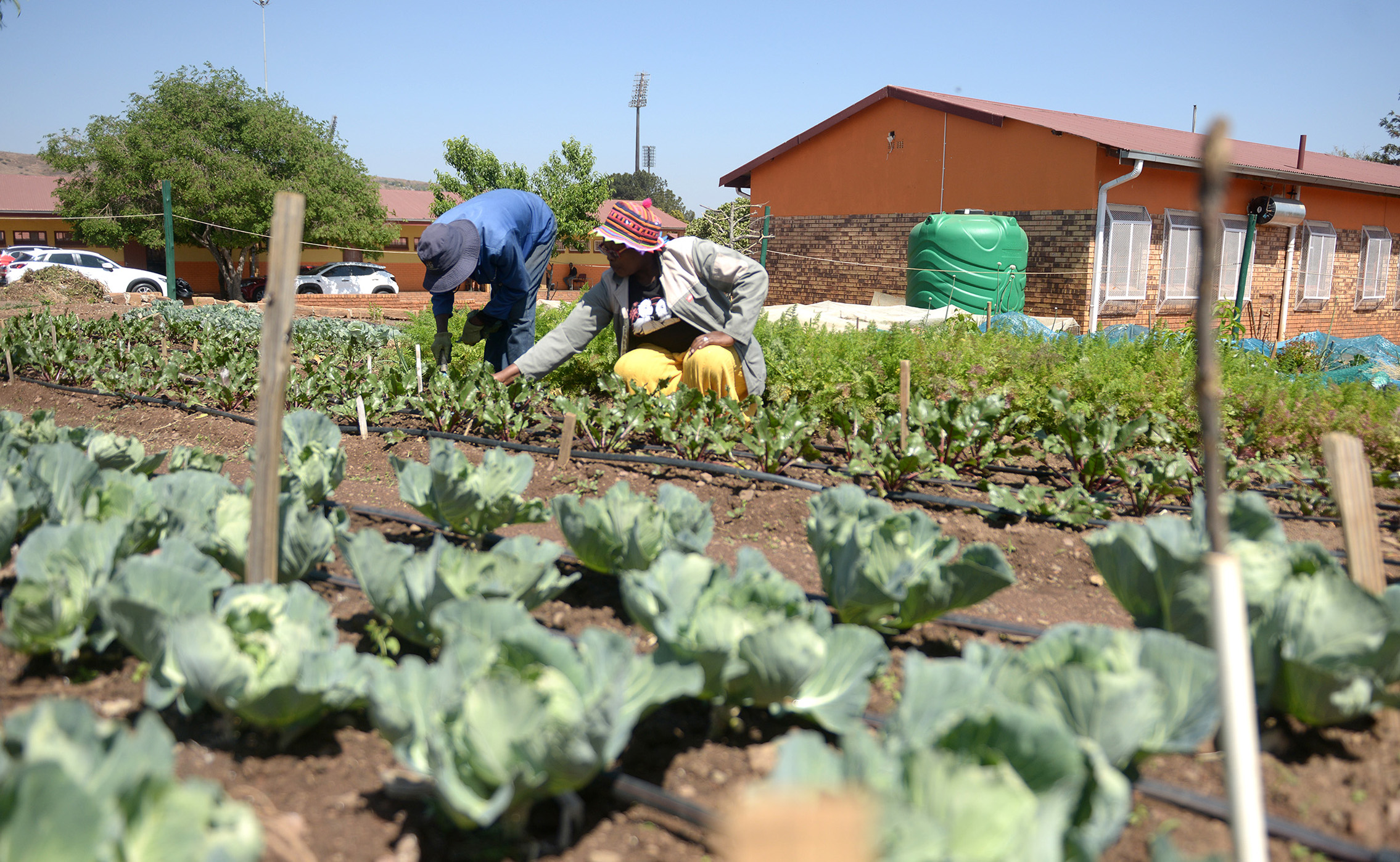
 General assistant Gift Hlatshwayo and project manager Mapenane Kgatitsoe from Siyakhana Growth and Development at Matseke Primary School in Atteridgeville. (Photo: Thosh Studio)
 In the second week of December, primary and high schools closed for the year. So what happens to school gardens when they close over the festive period until January?
KwaZulu-Natal
Umgibe Farming Organics and Training Institute founder Nonhlanhla Joye, known as Ma Joye, has had an impact on more than 500 school gardens in KwaZulu-Natal under the Ithuba Seedpreneurs School Garden initiative, which began in 2018.
Seedpreneurs has a system of ambassadors and champions who are responsible for the gardens, Joye explained to Daily Maverick.
Thabane Ngubani, the founder of Ithuba Agribusiness, was the first Seedpreneur, and ambassador, and helped to train the schools and pupils.
The Seedpreneurs train the younger children, “passing the baton” and coordinating who will be in charge the following year, once older children have graduated.
“We plan everything from January to the end of October and then November. December there is nothing growing, so there’s no need for anyone to go to school. Then in January we start again,” she said.
/file/dailymaverick/wp-content/uploads/2025/08/1000083898.jpg "Nonhlanhla Joye, known as Ma Joye, founder of the Umgibe Farming Organics and Training Institute. (Photo: Naledi Sikhakhane)")
At the schools, they have market days selling produce; huge cabbages and great bunches of spinach are plucked and washed and sold at the stalls. The produce often gets sold back to the schools for nutritious meals.
Between the last week of September and October they have the school garden competition, the “Ithuba Awards”, which recognises the school gardens with the most sales, and how many people the gardens managed to feed in the areas.
2025 Ithuba Awards
Early-childhood development schools:
- Isibonelo Creche;
- Sesikhulile Creche; and
- Owehlukile Creche.
Primary schools:
- Nhlabane Primary School;
- Ethakasani Primary School; and
- Mzuvukile Primary School.
High schools:
- Gratton School;
- Groutville High School; and
- Birds Wood Secondary School.
“We start from kindergarten. They’ve got their own category from three years. Because what we are trying to do is to have a generation of Seedpreneurs that are groomed at an early age to understand accountability and responsibility,” Ma Joye said.
Companies in Richards Bay have sponsored water tanks and tools necessary for the gardens. They are often not fenced, so the next drive in the programme is to secure sponsors to enclose the gardens.
“These kids – we cannot build the future for them, no matter how much we love them – but we can build the youth for the future,” Ma Joye adds.
Tshwane
Mapenane Kgatitsoe, the project manager at the Siyakhana Growth and Development NPO, is responsible for school nutrition guidance in Tshwane.
Groundsmen come to the schools on select days during the holidays to not only tend to the gardens, but the whole school, in preparation for the new year, Kgatitsoe said.
At Kgabo Primary School, the principal ensures the groundsmen are fed and compensated during the holidays, and during normal school months they are fed from the kitchen.
/file/dailymaverick/wp-content/uploads/2025/08/1000084505.jpg "Students of the Umgibe Farming Organics and Training Institute. (Photo: Supplied)")
“In some schools nothing is happening in December and they come back to a weedy garden, and they start afresh. In our schools the groundsmen will be responsible for the upkeep of the school, and the garden is not part of the curriculum, so it’s not given much of a priority.”
When schools reopen, preparing the garden beds begins at the end of February, after the bulk of the other maintenance work, cleaning and organising around the school is finished. Planting begins in March or April, already into winter.
“The possibility is that people can go for the whole half of the year with no produce.”
School holidays during Easter and then mid-year holidays interrupt the planting and weeding.
At some schools, during December, there will often be leafy greens and fruiting crops like tomatoes and pepper, she explained. One school sends crops to an old age home. They also sell the crops to the local residents, which allows people easier access to vegetables like spinach.
“So that’s how the gardens have been run. Some schools are selling to the communities. They sell to the teachers, they give to the needy learners. And in some cases we find that the parents are just coming to help, and when the parents come to help, we give them what we have in the garden.”
/file/dailymaverick/wp-content/uploads/2023/09/Garden7577.jpg "Pupils with garden produce at Matseke Primary School in Atteridgeville. (Photo: Thosh Studio)")
Siyakhana Growth and Development and the University of Johannesburg’s Centre for Ecological Intelligence have been working together. They handed over the gardens officially in July 2024, as the funds from Exxaro towards the gardens were expended.
Siyakhana Growth and Development has not cut ties with the gardens, but can only exchange ideas and check on their progress.
The Department of Education began workshops to involve the principals of schools in the operations of the school gardens. The department is doing this under the “Leading Education for Sustainable Futures” programme, since they found that principals’ involvement was vital to the success of the gardens, and the gardens can be a third learning space for pupils.
/file/dailymaverick/wp-content/uploads/2023/09/Garden7560.jpg "Pupils with garden produce at Matseke Primary School in Atteridgeville. (Photo: Thosh Studio)")
Kgatitsoe said that after handing over the school gardens Philena Primary has thrived, getting gardening tools from the government and sponsors including Pick n Pay, and because of this support the garden has expanded.
“People can notice that something is happening, and they are in support. So we are still trying to get full support and buy-in from the department for them to understand that the gardens are just not only for food, but they can go a long way in terms of developing people’s life differently from all levels.” DM