




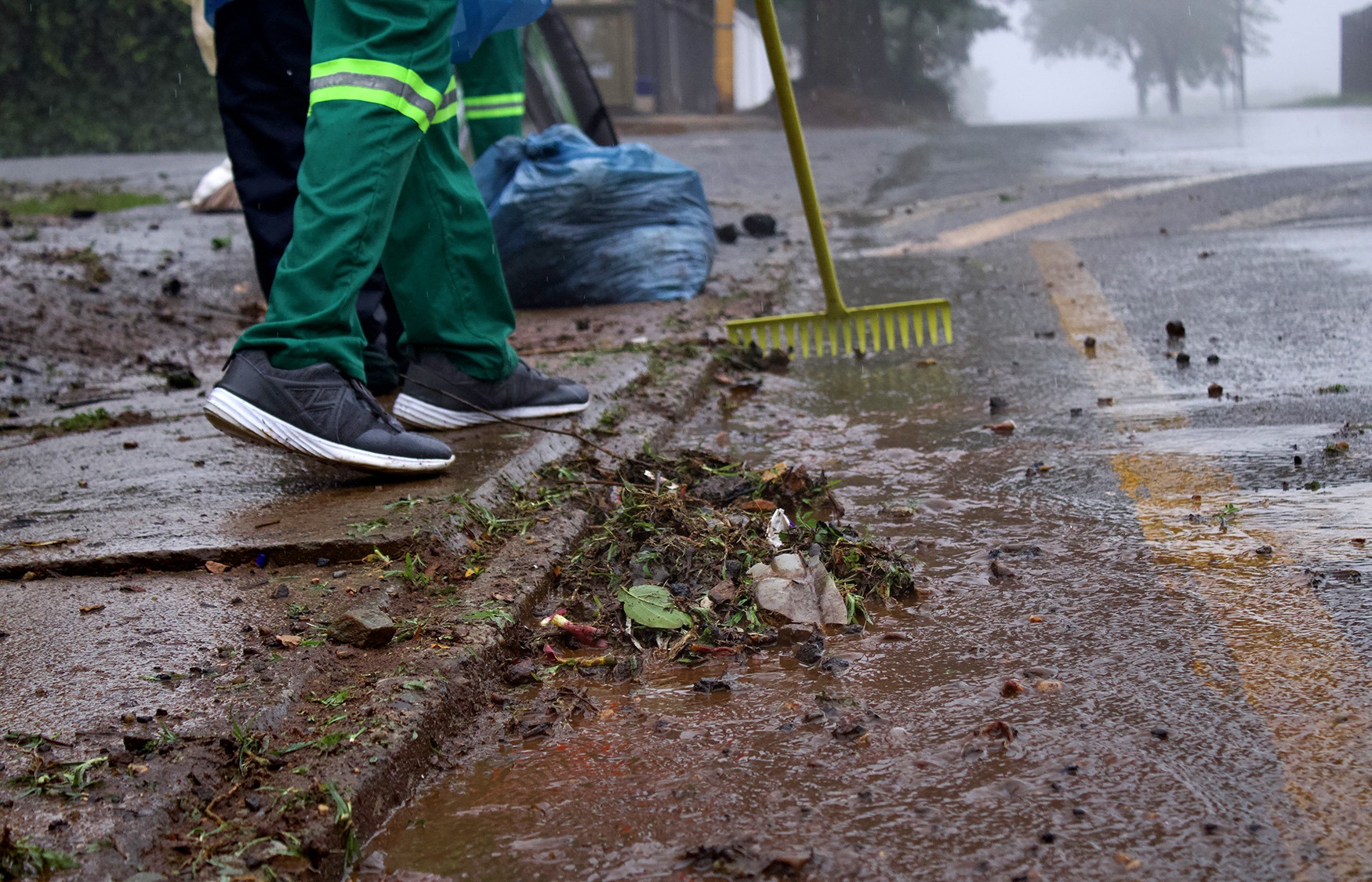
 Litter was picked up, stormwater drains unblocked, and branches and weeds cleared in Brixton, Johannesburg, on 13 December by waste reclaimers. (Photo: Lillian Roberts)
 About 70 waste reclaimers from the African Reclaimers Organisation (ARO) came to Brixton, Johannesburg, on 13 December to clean up the streets alongside residents in the rain.
The Brixton Community Forum (BCF) and the ARO began a collaboration in 2018, sparked by a shared concern about waste, environmental justice and community resilience, explained Sophia Welz, from the BCF.
“What inspired this ... is that the waste that was supposed to be properly diverted, after the [Marie Louise] landfill [in Soweto] was closed ... is going to the community right next door. So an illegal dump is actually being created by the city,” said the ARO’s Luyanda Hlatshwayo.
The ARO encourages individuals to separate tin, paper, glass, plastic and food scraps before disposal. This enables reclaimers to effectively manage waste.
/file/attachments/orphans/Metallikealuminiumisthemostvaluableforreclaimerswhilepaperandcardboardissecondandplasticisthird_985749.jpeg "Metal like aluminium is the most valuable for reclaimers, while paper and cardboard is second, and plastic is third. (Photo: Lillian Roberts)")
“So collectively, if we’re working together, we can find the solution. Then government will come after if they want to,” said Hlatshwayo. “Your bin has 80% of recyclables and about 80% of compost. The rest is going to be construction waste. If we manage it from source, then we don’t really need landfills.
“Hopefully, we can get the city to come on board — the city, as in the people, not the government. The government will come later. We need to do it as a people from the ground.”
On 13 December, 500 bags of waste were collected in Brixton, six stormwater drains were cleaned, one open manhole was fixed, and major dumping sites opposite the primary school and the cemetery were cleaned by the reclaimers.
/file/attachments/orphans/LuyandaHlatshwayospeakstothereclaimersabouttheplantocleanupBrixtononSaturdayDecember13_509772.jpeg "Luyanda Hlatshwayo speaks to the reclaimers about the plan to clean up Brixton on Saturday, December 13. (Photo: Lillian Roberts)")
‘I am my own boss’
Betty Letchuli (50), a lifelong Krugersdorp resident, has been a reclaimer for almost 15 years.
“What I can tell people is that our government is poor. We don’t have jobs. So instead of sitting at home crying to the government, [we create our own job, that of reclaiming]. It’s not something bad. People call us names because we are the reclaimers. At the end of the day, we are not asking anything from anyone because we are making our own money. We are our own bosses,” said Letchuli.
/file/attachments/orphans/BettyLetchuliisproudofherworkandtheincomeshemakestoprovideforherchildrenaswellastheenvironmentalimpactithas_443811.jpeg "Betty Letchuli is proud of her work and the income she makes to provide for her children, as well as the environmental impact it has. (Photo: Lillian Roberts)")
“Here in the reclaiming area, we are [making] a lot of money, just like the person who goes to the factory at work, and now I’m my own boss. I wake up at my own time. I knock off at my own time. I work as I want. So it’s a very good thing. Now, other people, they’re appreciating us, because they are talking to us on the climate.
“Our country will be clean if we can all stand up ... and be the reclaimers. Let’s claim our future.”
‘Today I am happy’
Maria Sibiya (34) from Soul City informal settlement in Krugersdorp has been a reclaimer at a dumping site since she was 19 years old. Her mother was also a reclaimer.
/file/attachments/orphans/MariaSibiyaareclaimersinceshewas19isgratefulforthesupportoftheAfricanReclaimersOrganisation2_786533.jpeg "Maria Sibiya, a reclaimer since she was 19, is grateful for the support of the African Reclaimers Organisation. (Photo: Lillian Roberts)")
Before she began work as a reclaimer, Sibiya said, “Everyone at my place was laughing at me, saying, ‘This one, this is nyaope.’ I was feeling so bad because there was no job. But today I am happy, because I found ARO, and ARO is supporting us. Even my kids are going to school, eating every day. I’m not suffering.
“I [say] to everyone, if you look at us, you must look at us, very well. Don’t judge us.”
‘Nobody is working’
The Marie Louise landfill stopped accepting waste at the beginning of September.
At the beginning of December, the ARO delivered food parcels to the reclaimers who lost their jobs as a result of the landfill closure.
Sibangane Sibanda (45) has been a reclaimer for 26 years and used to work out of the Marie Louise landfill.
/file/attachments/orphans/SibanganeSibandaareclaimersincehewasayoungmanisnowlookingforanyworkastheMarieLouiselandfillhasbeenshut_924596.jpeg "Sibangane Sibanda, a reclaimer since he was a young man, is now looking for any work as the Marie Louise landfill has been shut. (Photo: Lillian Roberts)")
“[Now], nobody’s working. No one’s working. Up from the morning, going to the gate. The gate is closed. No waste, only clean soil. They’re covering the landfill now,” said Sibanda.
It’s the only job he knows.
Without work, he is unable to visit his family over the Christmas period.
‘Residents are also affected’
“When the closure of the landfill happened, not only did it affect the reclaimers, but it’s also affecting the residents,” said Hlatshwayo.
“There’s late collections. And there is illegal dumping ... not from residents, not from reclaimers, but the city that has failed to properly plan for the closure of landfills, because now, where is all the waste that used to go to the landfill going?”
Close to half of the people who attended the clean-up on 13 December lost their jobs when the landfill closed. ARO is engaging with residents to do a separation at source programme in other communities and to link the reclaimers to those communities so they can work again.
/file/attachments/orphans/AV_00031917_347477.jpg "Waste reclaimers at the Marie Louise landfill site on 18 December 2008. (Photo: Antonio Muchave / Gallo Images / Sowetan)")
“These are some of the solutions that we bring,” said Hlatshwayo. “But most of all is finding ways of how we collectively solve the problems of waste from the ground. We are tired of complaining. They say the city doesn’t do anything. Complaining doesn’t work; we would rather do it ourselves, and they will come on board when they want to.”
However, it does make sense for the city to spearhead the programme, he acknowledged, because it has the resources.
The ARO has a system of direct logistical support. A reclaimer can collect 150 to 200 kilograms of recyclable waste, and with the community engagement to separate at source, reclaimers are now collecting double what they used to.
If their load is difficult to transport, the ARO arranges for a truck to collect it, deliver it and sort through it. The organisation also helps the reclaimers to sell what they have reclaimed. All five of the ARO’s drivers were once reclaimers.
/file/attachments/orphans/Reclaimerspackorganicwasteintothebackofabakkieoneloadoutofthe500bagsandbranchesclearedfromHighStreetCollinsroadCarolinestreetResidentsalsopickedupwasteinalleysandoutsidethei_695777.jpeg "Reclaimers pack organic waste into the back of a bakkie in Brixton on 13 December. (Photo: Lillian Roberts)")
/file/attachments/orphans/ReclaimersgetinthebakkietogotackleanotherpartofBrixtonadayofcleaningupthestreetsintherain_901033.jpeg "Reclaimers get in the bakkie to go tackle another part of Brixton on 13 December. (Photo: Lillian Roberts)")
“The MOU [memorandum of understanding] that we’re hoping to sign with the city and Pikitup is based on ... the people that are already working, the relationships that we’ve already created and making sure that we support the people that are collecting, and empower them to be able to do their job,” said Hlatshwayo.
He said three other landfills were due to close within the next eight months. Given that one landfill closure puts more than 100 reclaimers out of work, hundreds of skilled waste collectors will lose their source of income.
“Someone really needs to hold [the city] accountable,” said Hlatshwayo. “This is a problem for cleaners for now, but it’s going to be a problem for everyone. That’s why we thought it’s important to start organising.”
Only about 10% of urban households in SA separate their waste, with most recyclable items ending up in a landfill.
Reclaimers salvage those items from rubbish bins and the landfills. Because of them, South Africa has recycling rates comparable to those of many European countries for metals and plastics. DM