




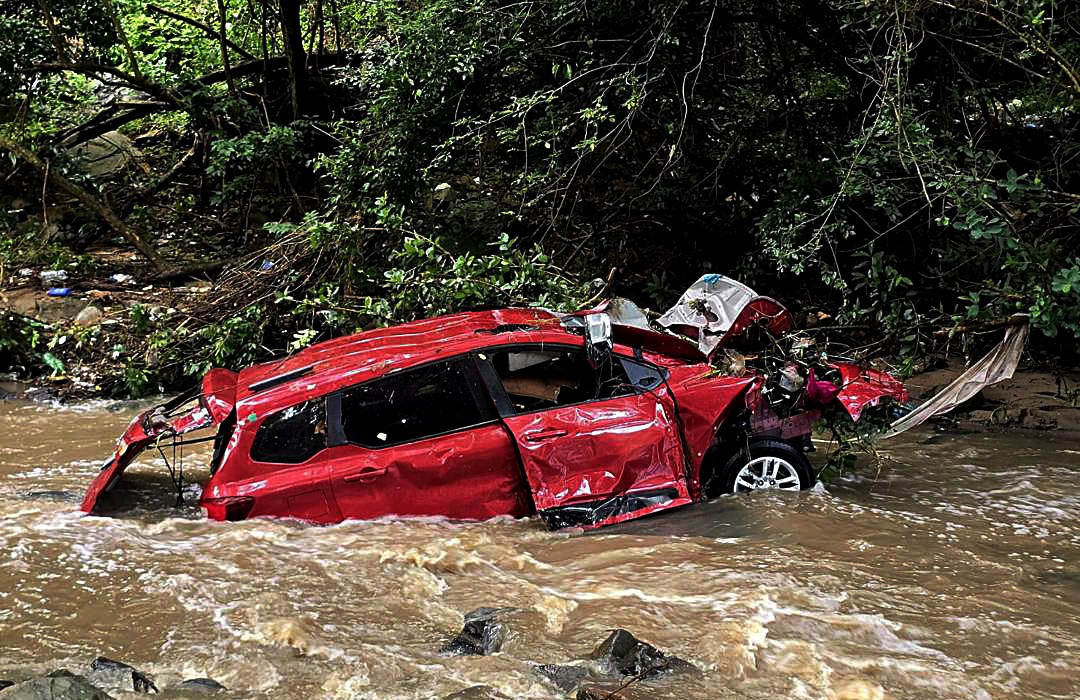
 Two bodies have been recovered after a vehicle the two men were travelling in along with others was swept away by floodwaters. (Photo: Supplied; ALS paramedics)
 Five people have died following severe weather across South Africa, as relief organisations begin their work.
By Tuesday morning, the number of people who died as a result of the severe storms in KwaZulu-Natal had risen to four, according to Ndabezinhle Sibiya, spokesperson for transport and human settlements MEC Siboniso Duma.
“In total, four people perished as a result of the prolonged rainfall.”
The victims were a 63-year-old woman who died after a mudslide caused her house to collapse on her, and three people who had gone missing when their car was swept away in Amanzimtoti.
“The MEC has requested motorists to exercise caution,” Sibiya said, adding that Duma pleaded with motorists that if there were severe weather warnings from the South African Weather Service they should postpone plans.
On the weather forecast, according to the weather service’s travellers forecast for Tuesday, there is still a warning in place for severe thunderstorms, which could lead to localised flooding of susceptible roads, settlements and low-lying bridges, excessive lightning, strong, damaging winds. Large amounts of hail is expected over the Eastern Cape- except along the south coast and interior as well as in the western parts of KwaZulu-Natal.
In Gauteng, one person has reportedly died in Olievenhoutbosch.
Over the past three days there have been several inclement weather events across the country: from heatwave-like conditions in the western parts of the country, to flash floods and heavy rain in the east. The most heavily affected provinces include KwaZulu-Natal and the Eastern Cape.
On Monday, weather warnings were still in place for the rest of that day, as well as Tuesday.
“Cloudy and cool conditions are expected to persist over the eastern parts of the country, with isolated to scattered showers and thundershowers, but will be widespread over the northeastern regions of the country (Gauteng, Limpopo and Mpumalanga)” said Lehlohonolo Thobela, a meteorologist and weather forecaster at the South African Weather Service.
“Severe thunderstorms are expected over the central and eastern parts of the country for today (Monday) and tomorrow (Tuesday).”
Relief efforts kick in
“Gift of the Givers teams are still on the ground, distributing humanitarian aid after the devastating storms that hit the Eastern Cape last week,” said the organisation’s Ali Sablay.
The affected area included East London, Bisho and Qonce (formerly King William’s Town).
“The hardest hit area was King William’s Town. Our teams on the ground have assisted over 200 families that suffered severe devastation in terms of their roofs collapsing, and in some homes completely, completely destroyed,” Sablay said.
/file/attachments/orphans/PHOTO-2025-12-22-12-53-44_786083.jpg "Relief efforts are under way across the country following disruptive weather, including in Middledrift, Eastern Cape. Organisations such as Gift of the Givers have already started helping residents. (Photo: Supplied / Gift of the Givers)")
/file/attachments/orphans/604358818_18552823129006870_4314733334142184924_n_470082.jpg "Relief and assistance efforts under way in Middledrift in the Eastern Cape. (Photo: Supplied / Gift of the Givers)")
“Our teams assisted them with food hampers, blankets, personal hygiene care item packs and water, and it’s gonna be a bleak Christmas for these people... the houses suffered extensive damage,” Sablay said.
In Middledrift, “the most devastating floods that occurred, the storms, 200 homes completely and partially destroyed, our teams rendered assistance there”.
The teams had also helped in Lady Grey, where more than 170 families had been severely affected by flooding.
“Our teams have assisted the community of Diepsloot, which was hit hardest. There were many informal structures completely, completely flooded. Our teams were on the ground to assist them. Our teams were busy in Mpumalanga as well, where they had freak storms.”
Gauteng death
A man believed to be in his early thirties was discovered dead next to a flowing river in Olievenhoutbosch Extension 19 on Sunday (21 December), as severe thunderstorms battered Tshwane, unleashing widespread flooding across the capital.
Tshwane Emergency Management Services (EMS) spokesperson Tebogo Maake said: “At approximately 8am on Sunday, 21 December, the City of Tshwane Emergency Services Department: Fire and Rescue Services received a distress call reporting a drowning in Olievenhoutbosch Extension 19, along Mathotse Street next to Oripile Primary School.”
Firefighters from the nearby Heuweloord Fire Station were dispatched immediately to the scene. Upon arrival, they found the lifeless body of the male lying beside the swollen river. Members of the Community Emergency Response Team quickly assessed the individual and confirmed there were no signs of life.
“The City of Tshwane Emergency Services extends its condolences to the family and friends of the deceased. No further information can be shared at this stage, as the matter remains under police investigation,” Maake said.
Weekend storm devastation
The drowning occurred against a backdrop of intense thunderstorms that struck Tshwane over the weekend, causing localised flooding across a number of areas.
Maake said that due to the current rainy weather, the City of Tshwane Emergency Services has been responding to various flooding-related incidents across the city.
Response teams, including Disaster Management, had been active in clearing obstructed routes, removing mud, managing traffic and helping affected households.
Key affected areas include:
- Centurion;
- Temba;
- Hammanskraal;
- Olievenhoutbosch; and
- The N14 Highway, where a landslide was reported.
“Residents are urged to remain vigilant and are strongly advised not to attempt crossing flowing or stagnant water, particularly where water levels reach knee height or higher, as this poses a serious drowning risk,” Maake added.
The weather service has also issued a Yellow Level 4 warning for severe thunderstorms, forecasting widespread rainfall that could exacerbate flooding hazards. Maake said the City of Tshwane had identified high-risk flooding areas across all regions.
In Tshwane, authorities remained on high alert and continued to monitor known flooding hotspots.
In KwaZulu-Natal, Duma said: “Our Road Traffic Inspectorate worked flat-out with the traffic department in Ray Nkonyeni Local Municipality to clear affected roads and ensure accessibility.”
/file/attachments/orphans/G8tzqWuXwAAM2Qc_519580.jpeg "A road at Manaba Beach in Margate, southern KwaZulu-Natal, following heavy rain. (Photo: Traffic 24 KZN / X)<br>")
Flood safety guide
Floods strike swiftly in South Africa, transforming familiar streets into treacherous waters that claim lives, homes and livelihoods in the rainy season. However, with smart preparation and calm action, you can protect yourself, your family and your property.
Before a flood
- Assemble an emergency kit: first aid supplies with medications, non-perishables, bottled water, dry clothing, a torch, battery-powered radio, spare batteries, candles, matches in a waterproof container, emergency whistle and cash in small notes;
- Save all key numbers on every family member’s phone and keep a printed list. Teach children your contact details and basic flood awareness such as avoiding water;
- Secure your home: clear gutters and drains, fix leaks in pipes or walls, elevate appliances and valuables above expected flood levels, seal basements or low openings with plastic sheeting and sandbags (or soil-filled bags), tie down outdoor items like bins or garden furniture, and bring pets and livestock indoors;
- Contact your insurer to confirm natural disaster coverage, store important documents (ID, policies, medical records) in waterproof bags, and identify evacuation routes to higher ground or community shelters; and
- Stay informed: monitor the weather service, radio, TV or official apps. Disregard unverified WhatsApp or social media alerts to avoid panic.
During a flood
- Evacuate immediately if ordered: head to higher ground, avoiding low-lying areas, rivers, dams or bridges. Take pets, kit and medications;
- Avoid all floodwater: even 15cm deep can sweep away adults or vehicles; do not walk, swim, drive or play in it. Currents hide debris, sewage, oil, chemicals and live wires from fallen powerlines;
- For motorists: reduce speed, increase following distance due to poor visibility, avoid flooded roads or low-water bridges (if water flows strongly or the ground is invisible, turn back). If trapped, abandon the vehicle for higher ground, climb onto the roof if water rises inside, and signal for help;
- If indoors: switch off electricity at the main distribution board (not individual plugs near water), move to the highest level (avoid closed attics), and contact emergency services with your exact location;
- Seek shelter wisely: avoid large trees, open fields (lightning risk), under bridges or riverbanks. In storms, crouch low if no building is available; and
- Vulnerable groups: assist the elderly, disabled and children first. People in informal settlements should follow municipal alerts closely.
After a flood
- Do not re-enter until authorities declare it safe: avoid floodwater (contaminated with sewage, bacteria, or electricity). Wear sturdy boots, gloves and masks when cleaning;
- Electrical and water safety: wait for a qualified electrician to inspect wiring before using appliances. Do not drink, cook with or bathe in tap water until the municipality tests and clears it. Boil vigorously if needed;
- Health precautions: watch for infections from cuts, diarrhoea from contaminated water, or mould. Seek medical help for symptoms, and vaccinate against tetanus if injured;
- Property recovery: document damage with photos for insurance claims (contact your provider immediately), remove wet items to dry, disinfect surfaces and discard soaked porous materials such as carpets;
- Structural checks: inspect foundations, walls and roofs for cracks or weakening. Avoid gas appliances until leaks are ruled out;
- Emotional support: floods can cause trauma – access free counselling via provincial health lines or NGOs like Lifeline (0861 322 322); and
- Report issues: notify your municipality about blocked drains or ongoing risks to prevent future floods.
In times of crisis it’s easy to panic. Save these emergency numbers on your phone:
| Service | Number | Notes | |
| National Emergencies | 112 | Whether it’s a medical issue, fire or even a crime, calling 112 will allow an operator to patch you through to the relevant department. | |
| Ambulance | 10177 | This number can be used in a medical emergency. If you need to report a fire, this is your go-to number as well. | |
| Police | 10111 | This is a 24-hour crime reporting call centre which deals with complaints by the public. | |
| City of Tshwane emergency contacts | 107 OR | 012 358 6300/6400 | Residents are encouraged to report emergencies to the Emergency Control Centre |
Remember to remain calm when making an emergency call, and speak clearly while giving the following information:
- Your name and address;
- Your telephone number, if requested; and
- The nearest street corner to where the incident occurred.
/file/attachments/orphans/604359366_18552823159006870_950451796137419833_n_507860.jpg "Relief efforts have begun across the country. (Photo: Supplied / Gift of the Givers)")
Festive weather outlook
The South African Weather Service expects partly cloudy and warm-to-cool conditions across much of the country during the Christmas and New Year period, with isolated to scattered showers and thundershowers anticipated mainly over the central and eastern parts.
“Thunderstorm activity is expected to occur primarily in the afternoons, although periods of increased moisture may result in morning showers in some areas. Much of the rainfall during this period will be associated with afternoon and evening thundershowers, which may at times be accompanied by heavy downpours, lightning and gusty winds,” senior forecaster Jacqueline Modika told the media in Pretoria on Thursday (18 December).
The latest seasonal climate outlook for the 2025/26 summer season indicates a transition toward a weak La Niña state, which is expected to influence rainfall and temperature patterns across South Africa.
Read more: Weather to remain wet into autumn for most of SA’s summer rainfall regions
Modika said this shift typically brings above-normal summer rainfall to northeastern parts, including Gauteng, Limpopo, Mpumalanga, KwaZulu-Natal and parts of North West and the Free State. Climate models predict heightened chances of above-normal rainfall in the central and eastern regions, especially northeastern summer rainfall zones, with these wetter conditions persisting into mid- to late summer.
Minimum temperatures are likely to exceed normal levels nationwide, while maximums in northeastern areas stay below average due to persistent cloud cover and showers. In contrast, southwestern regions face above-normal daytime highs amid drier, clearer skies.
Residents are encouraged to:
- Seek shelter when thunderstorms approach;
- Move vehicles under cover where possible;
- Avoid driving through flooded roads;
- Report fallen trees, flooding or damage to municipal authorities;
- Avoid crossing flooded bridges;
- Stay informed by following official weather service updates;
- Take necessary precautions during thunderstorms; and
- Consider changing weather conditions when making festive travel plans. DM