




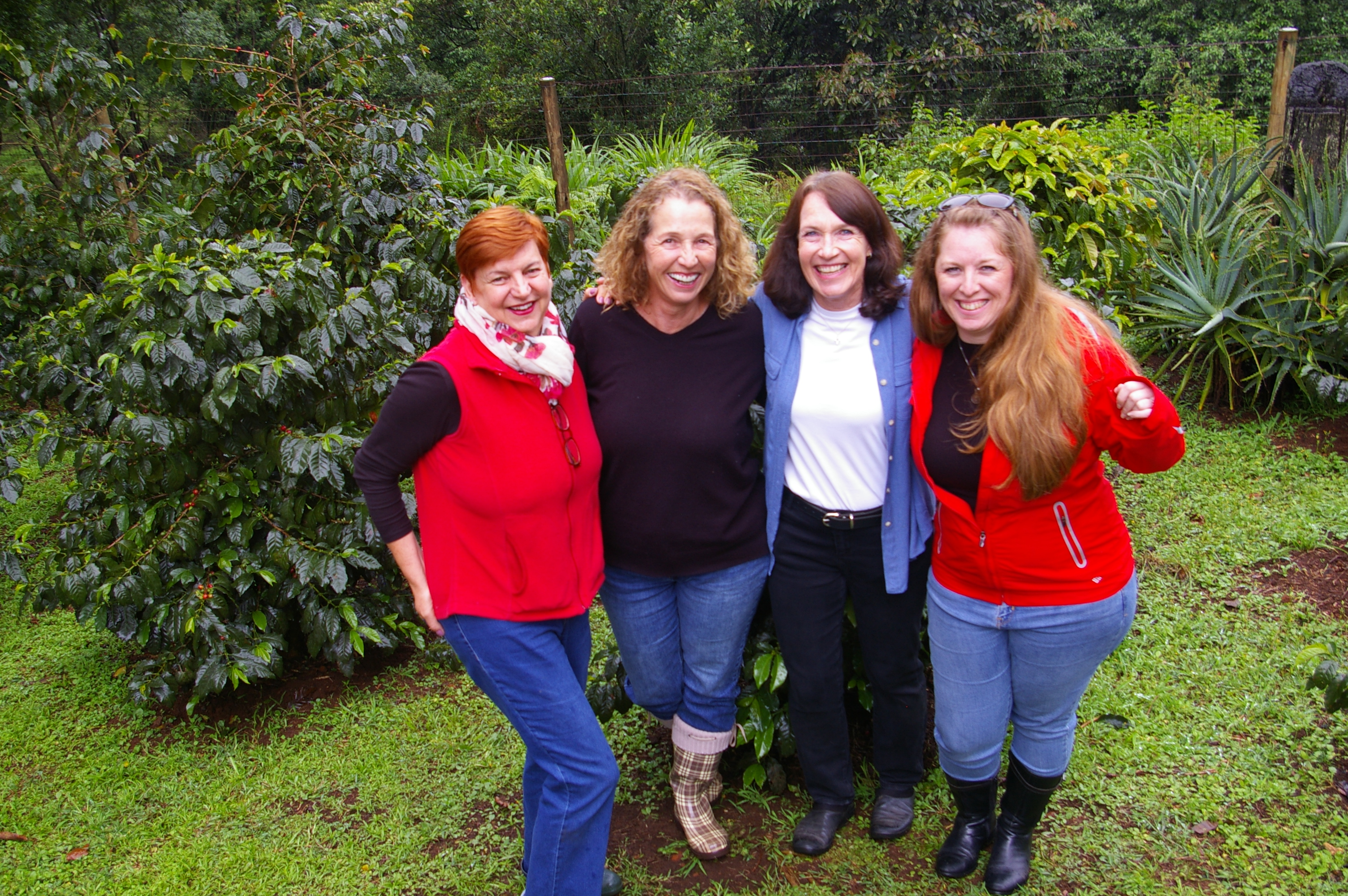
 From left: Members of the Winterskloof coffee collective are Melanie Rood, Marita Thornhill, Nikki Sinclair and Miranda Wilson. (Photo: Supplied)
 Five years ago, Melanie Rood planted three coffee trees to fill an empty space in her garden with sweeping views of the Winterskloof valley, northwest of Pietermaritzburg, KwaZulu-Natal.
This week, she proudly showed off a grove of 200 trees, all in robust health, and idly wondered how a roast from the misty mounts of Winterskloof would stack up against other brews on a global stage.
With her were Marita Thornhill, Nikki Sinclair and Miranda Wilson, all members of Winterskloof’s “coffee confederacy”, a loose brigade of growers ranging from hobbyists to producers with more than 500 trees under cultivation.
Wilson and Thornhill, both with environmental science backgrounds, were quick to point out that sharing knowledge and collaborating would be the first steps towards any sort of consensus and collective action in terms of coffee production in the area.
“There’s certainly an upsurge in interest and questions about coffee, especially as it has a chequered history of being planted here,” said Sinclair.
It’s too early to tell if the casual interest in coffee is quietly increasing property values, at least for those with a sizeable grove of trees.
Fate smiled on recent Western Cape semigrants Daniel and Laura Hutchinson, who only realised after buying their property that it came with 500 coffee trees. “It was a steep learning curve, not least telling apart a bewildering mix of arabica cultivars,” said Laura.
Another bonus was that the previous owner kept meticulous records of plantings and the fertiliser regimes for several cultivars planted between 2018 and 2022. This hand-scribbled record is an outlier in the historically laissez-faire attitude towards coffee in the area, however. And separating anecdotes from evidence is a surprisingly complicated undertaking. The total number of trees and their yields are a mystery. Estimates of tree numbers range wildly, from 1,500 to 3,000 and, occasionally, even higher. An estimate about output would be a wild guess.
The picture is clouded in several layers, from haphazard plantings reportedly up to 35 years ago, spurts of novelty plantings since, and a recent spike in new plantings in Winterskloof, as well as elsewhere in Pietermaritzburg and areas southwest of the city.
“We keep on hearing of people who have a coffee tree or two in their gardens, who all have a story to tell,” said Rood. “We’d love to make contact and see how we all may benefit.”
Growers’ motivation
Rood’s story of becoming a grower is a poignant tribute to her mentor, Myles Sinclair, who introduced her to the world of coffee. He had started with a single bean he found in Tanzania and nurtured to full growth at home.
Sinclair’s mantle has since fallen on his widow, Nikki, who has ensured the creation of many generations of offspring from the original “Myles tree”.
/file/attachments/2985/mylesstreeprogeny_906299.jpg "A ‘Myles tree’ seedling nurtured in memory of coffee mentor Myles Sinclair. (Photo: Supplied)")
Other growers’ stories tell of a passion for coffee, as well as its growth and monetary potential.
Having cut her teeth on 22 trees, Thornhill is adding a further 80. Wilson, a data scientist by profession, had a clear investment vision once the pioneering “proof-of-concept” planting got the thumbs-up. “The initial 50 are doing so well that we’re planning a further 200,” she said.
Collectively going forward, Winterskloof’s share is a rivulet in the rising tide of beans from large, single estates in Limpopo, Mpumalanga and elsewhere in KwaZulu-Natal coming on the market. Citimba Estates near Louis Trichardt in Limpopo, which produces Levubu Soutpansberg coffees, is expanding its 6ha of trees to about 100ha.
FootHills coffee farm in White River, Mpumalanga, is adding to its 13,000 trees, and Mfolozi Swart, between Vryheid and Ulundi, is on a mission to build its coffee as a proudly Zululand brand, much as Beaver Creek in Port Edward on the South Coast has done.
An opportunity lies in filling the yawning gap between the minute share of domestically grown coffee and its overall retail sales value, which reached R7.7-billion in 2023. For size, domestic growers on about 200ha supplied about 120 tonnes of beans, which is between 0.2% and 0.4% of all the coffee consumed in the country each year. About 22.7-million South Africans drink some form of coffee daily.
The homegrown contribution is growing, in real terms and relatively, for five reasons:
- The inexorable rise of international prices – up 36% in 14 months – is forcing local consumers to consider alternatives to coffee imports;
- The percolating effect of a handful of pioneers popularising local coffee;
- A connoisseur-driven appreciation for African coffee;
- Mounting concern over ethical and environmental practices; and
- A bulwark of support services by established growers.
The scenario will continue to evolve once the trickle of beans turns into a roar and marketing and retail support are scaled accordingly.
Whereas single estates are likely to embed and further develop their brands over the next four to five years, the likes of the Winterskloof collective face a spectrum of options, anything from plugging away at the status quo to forging a marketable identity around the unique region-of-origin characteristics.
For that to happen, a lot more beans need to flow from Winterskloof. For now, the focus is on sharing knowledge and getting their hands dirty with some gritty “on-the-job” training.
/file/attachments/2985/Redberrysamples_692219.jpg "Samples of Melanie Rood’s coffee processed under the RedBerry Coffee Collective. (Photo: Supplied)")
All agree (especially those from the RedBerry Coffee Collective) that the mentoring provided by Dylan Cumming of Beaver Creek, which helps small-scale growers to process their beans, has been a game-changer. So too is the surge in knowledge and experience gained from experimentation, even trying different cultivars under varying growth conditions.
Already, Laura is reporting a marked yield rise from trees in dappled shade, as opposed to from those in full sunshine or full shade. “I would never have thought that learning about coffee would open agroforestry options,” she said. “That’s the most exciting thing. You just never know.” DM
This story first appeared in our weekly DM168 newspaper, available countrywide for R35.
/file/attachments/2985/DM-12122025-001_849341.jpg)