



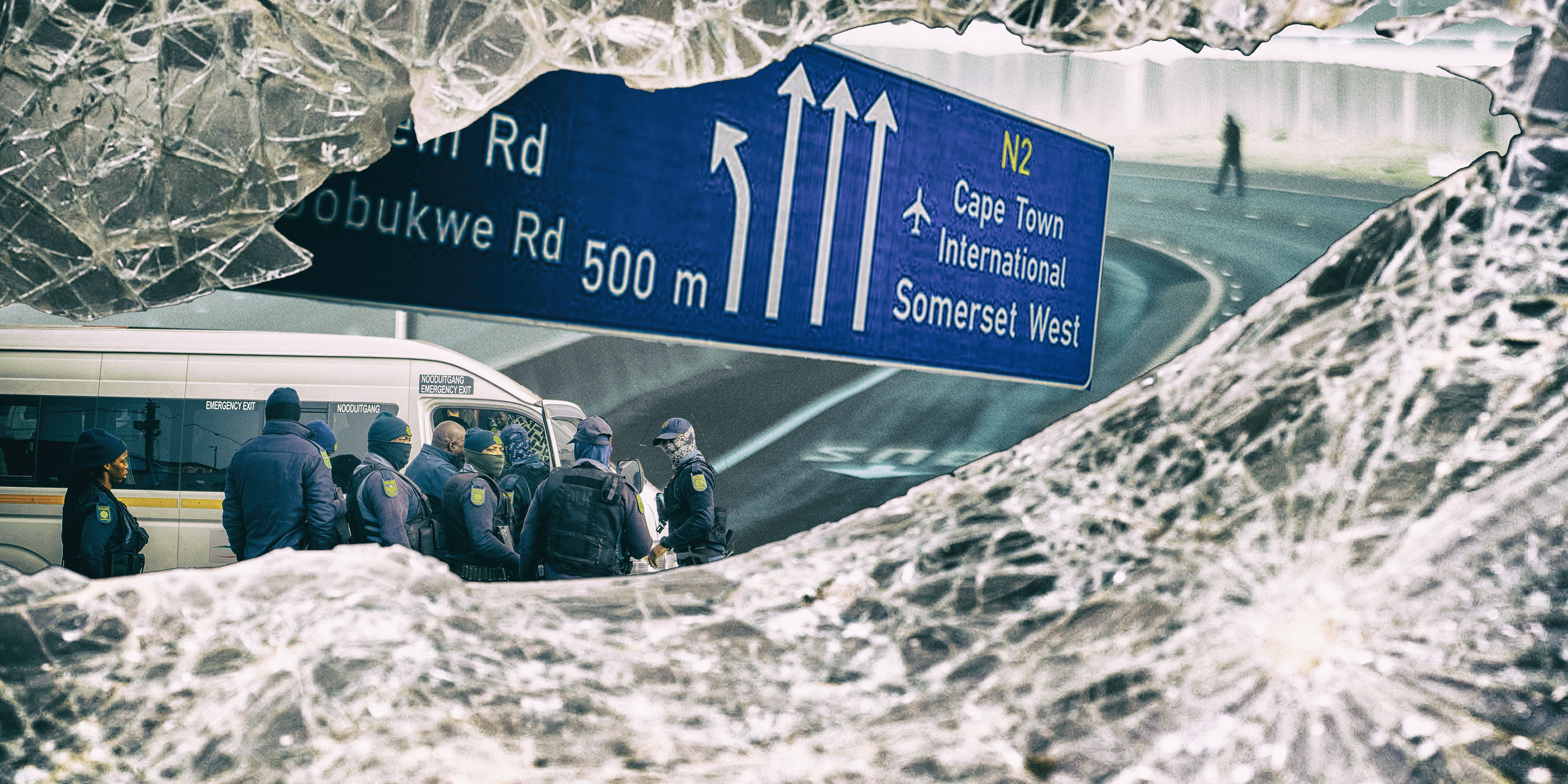
 Illustrative image: Smashed car window. (Photo: Valdrin Xhemaj / EPA) | Law enforcement in Nyanga. (Photo: Jaco Marais / Gallo Images / Die Burger) | N2 signage (Photo: Supplied) | The N2 inbound to Cape Town. (Photo: Jaco Marais / Gallo Images / Die Burger)
 The City of Cape Town’s plan to build a R180-million wall along a section of the N2 highway near Cape Town International Airport has drawn opposition, with critics citing a lack of consultation and arguing that the city should rather fund more programmes to address the root causes of crime.
The city plans to build the wall in the next financial year, following several stone-attacks on motorists by stone-throwing robbers on the N2 near the airport.
Linda Kabeni, a resident of Gugulethu, which is situated alongside the N2 where the proposed wall will be built, said there had been no consultation between the city and residents, community-based organisations or other key stakeholders about the wall.
“What has happened is that we heard from the news media that the city is planning to build a wall,” said Kabeni.
“If the city wants to build a wall, there must be a public participation process. You don’t dictate terms. You engage the community and bring us to the table. We may have a different approach — even a different proposal — to what is currently being put forward.”
Daily Maverick sent the City of Cape Town detailed questions about the proposed wall, including on the claimed lack of public participation. The city’s media office replied, “The city is planning for a security wall along the N2 around the airport to be erected. This will come at a significant cost estimated at around R180-million, but the city is committed to ensuring it is done.
“The city is currently preparing its capital budget for the next Medium-Term Revenue and Expenditure Framework. More details will be available by the time of the budget tabling in March.”
A deadly stretch of road
The stretch of the N2 freeway near the Cape Town International Airport is known as the “Hell Run” because of the number of stone-throwing attacks on motorists.
Read more: Visitors warned to be alert on Cape Town’s N2 ‘Hell Run’
One high-profile incident occurred on 19 August when DA MPs Ian Cameron, Nicholas Gotsell and Lisa Schickerling were attacked with bricks while travelling to the airport after an oversight visit to the Philippi branch of the SA Police Service.
Read more: Quick arrests in attack on politicians shines spotlight on N2 airport area crime
After the attack, the City of Cape Town mayoral committee member for security and safety, JP Smith, said the city had tabled a draft budget allocating R20-million for additional metro police officers to bolster patrols in crime hotspots.
/file/dailymaverick/wp-content/uploads/2025/02/ED_202304-1.jpg "JP Smith, City of Cape Town mayoral committee member for safety and security. (Photo: Brenton Geach / Gallo Images)")
In October, Mayor Geordin Hill-Lewis, alongside Smith, deployed 40 new metro police officers on the N2, in the airport and Borcherds Quarry precincts. The officers were part of a 700-strong police roll-out across Cape Town.
Daily Maverick has reported on several incidents related to stone-throwing on the N2 and connecting roads:
- Inkatha Freedom Party MP Liezl van der Merwe, a frequent N2 commuter, claims criminal syndicates are using children to rob motorists near the airport. In 2024, she was robbed at a traffic light near Borcherds Quarry Road by a boy who forced his hands through her slightly open window and grabbed her cellphone.
- At about 8pm on 26 July, a tyre on Amanda Manentsa’s car burst on the R300. Fifteen minutes later, a colleague found the 41-year-old slumped behind the steering wheel with a bullet hole in the driver’s window; she had been shot in the neck.
- In March 2023, Leonie van der Westhuizen, who was en route to Cape Town International Airport, died after a large stone thrown by a robber shattered her car window and struck her head, triggering a heart attack;
/file/dailymaverick/wp-content/uploads/2023/04/WhatsApp-Image-2023-04-15-at-7.52.47-PM.jpeg "Gert van der Westhuizen speaks at a memorial service for his wife Leonie. (Photo courtesy of the Van der Westhuizen family)")
- In July 2023, a 21-year-old student from Inscape in Stellenbosch, Lucilla Vlok, had her jaw fractured when a stone was thrown through her car window while she was driving on the N2 to the airport;
- In October 2023, a Los Angeles couple, Jason and Kate Zoladz, were en route to Cape Town International Airport via Philippi when a brick was thrown through their car’s windscreen, forcing them to stop. Four men then robbed them at gunpoint; and
- Walter Fischel (55) from Connecticut in the US was shot in the face and robbed in November 2023, after landing at the airport and being directed by a navigation service through Nyanga to Simon’s Town.
Sanral ‘not engaged’
The South African National Roads Agency (Sanral) spokesperson, Lwando Mahlasela, said, “Sanral has not been engaged by the City of Cape Town on the proposed wall. It is not clear whose jurisdiction the N2 wall being referred to will be built in.”
Mahlasela said the stretch of the N2 from Cape Town International Airport to the Raapenberg Interchange (N2/M5) fell under the Western Cape Department of Infrastructure, while the section from the Raapenberg Interchange to the city centre came under the City of Cape Town’s jurisdiction.
He said Sanral had no authority over this portion of the N2 between the airport and the city centre; its jurisdiction begins just before the Swartklip Interchange (N2/R300) and extends eastwards.
He said Sanral regarded barrier walls as critical road-safety interventions, which helped control access — including pedestrian access — on high-mobility roads such as the N2.
Walls and fencing, he said, also channelled pedestrians to designated safe access and crossing points.
On smash-and-grab incidents and broader safety concerns, he said Sanral acted as the implementing agent for the Western Cape Freeway Management System (FMS).
The FMS covers major Cape Town freeways, using more than 280 CCTV cameras that are monitored 24/7. FMS personnel work closely with law enforcement officials to respond to incidents at hotspots.
Carjacking capital
Concrete barriers separating the N2 lanes from Somerset West to Cape Town improve road safety by preventing cross-median collisions, but are ineffective against the smash-and-grab attacks and ambushes that plague motorists along the route.
The most recent police crime statistics reveal that serious violent crime persists in Nyanga, Gugulethu, Philippi, and Khayelitsha — communities alongside the N2 where the proposed wall will be built.
Nyanga again emerged as South Africa’s carjacking capital, recording 67 cases from July to September, marginally down from 74 in the same period last year. Lingelethu West in Khayelitsha followed closely, with 65 carjackings compared to 73 in the same period in 2024.
These areas also feature prominently on the list of South Africa’s police stations that recorded the highest rates of reported murders from July to September. Gugulethu ranked fifth nationally with 56 murders, virtually unchanged from last year, while Philippi East was sixth despite a decline from 73 to 53 cases. Harare saw a sharp escalation, with murders surging from 37 to 51, pushing it to eighth place. Although Nyanga and Khayelitsha recorded declines, with 48 and 43 murders, respectively, both stations remain firmly entrenched as murder hotspots.
/file/attachments/orphans/Top30murderstations_949865.jpg "(Source: SAPS)")
/file/attachments/orphans/Top30carjackingstations_379982.jpg "(Source: SAPS)")
‘Catastrophic failure’
Tauriq Jenkins, convener of Save Our Sacred Lands, said the planned wall was a “gross misallocation of public funds”.
The money, he argued, should rather be spent on alleviating the conditions of communities still trapped by apartheid-era spatial planning on either side of the highway.
“Instead,” said Jenkins, “we are presented with yet another so-called investment designed to shun and invisibilise the city’s catastrophic failure to restore dignity to poor, working-class black communities.
“It pays homage to [US President Donald] Trump and his Mexican wall, and smacks of xenophobic, racist, and ‘crime’ messaging ripe for an election campaign. In 1657, Jan van Riebeeck put up his pega-pega [wild almond] fence along the Liesbeek, which prompted apartheid spatial division.
“Much like highways in occupied Palestine, such walls are designed to push indigenous bodies out of sight, conceal crimes against humanity, and manufacture an illusion of ‘lovely’, ‘uninterrupted’ driving leisure for motorists.”
/file/dailymaverick/wp-content/uploads/2022/11/11140206.jpg "The proposed N2 wall ‘pays homage to [US President Donald] Trump and his Mexican wall’, says Tauriq Jenkins. (Photo: Joebeth Terriquez / EPA-EFE)")
Two worlds, one province
The idea of a wall along the N2 is not new. Chris Nissen of the South African Human Rights Commission placed the current controversy within a longer, troubling history, recalling the 1990s when the late Kobus Meiring, then administrator of the Cape province, oversaw the construction of concrete barriers along sections of the N2 to isolate the highway from informal settlements.
The move drew criticism from the opposition ANC, said Nissen.
“Instead of building bridges, the wall sought to hide people moving between Nyanga and Crossroads across the N2,” he said.
The Nyanga East airport off-ramp, he added, had long been plagued by smash-and-grab incidents.
He said visible policing was far more effective than spending vast sums on physical barriers.
“Spending R180-million on a wall is deeply misplaced. The focus should be on people, not walls. Spend money on proper housing, on education, on building neighbourhood watches and creating a visible human safety presence that engages communities — telling people what is acceptable and what is not,” he said.
/file/attachments/orphans/WhatsApp-Image-2025-12-10-at-1051_784576.jpg "The focus should be on people, not walls, says Chris Nissen. (Photo: Lwandile Ngaxa / GCIS)")
“Tourists must be protected, yes — but they should not be prioritised above the lives and safety of ordinary South Africans,” he said, adding that tourists were often struck by the stark inequalities they saw when driving on the N2 from Cape Town International.
“They look at the shacks and say, ‘wow’. Even when I’m abroad, people tell me Cape Town is beautiful — but when they land, they immediately see the two worlds we live in. So public money is being used to mask the reality of two worlds.”
Nissen said that while the protection of tourists was welcome, vast sums cannot be spent without addressing the root causes of violence — poverty, unemployment and the housing backlog.
/file/dailymaverick/wp-content/uploads/Sune-what-safetyplanTW-option-1.jpg "Public money is being used to mask the reality of two worlds, says Chris Nissen. (Photo: Jose Cendon / Bloomberg via Getty Images)")
Consolidating the divide
Sanele Nkompela, a Khayelitsha resident and former member of the Khayelitsha Business Forum (KBF), described the planned wall as a stark symbol of class division.
“There is no doubt this entrenches the reality of two Cape Towns,” he said. “One for people of a lower social class and another for those who are well off. In a nutshell, it is a project that seeks to consolidate that divide.”
He said the money could rather be spent on dismantling informal structures and building permanent, job-creating housing, offering a more sustainable solution to the housing backlog, which would reduce unemployment and crime.
Nkompela warned that isolating surrounding areas could deter investment, which, he said, the city had overlooked by failing to consult with affected communities.
“These are the issues that would emerge through consultation — beyond benefiting contractors — including community input, jobs, isolation and economic impact, all of which were ignored before the project was approved,” he said. DM