




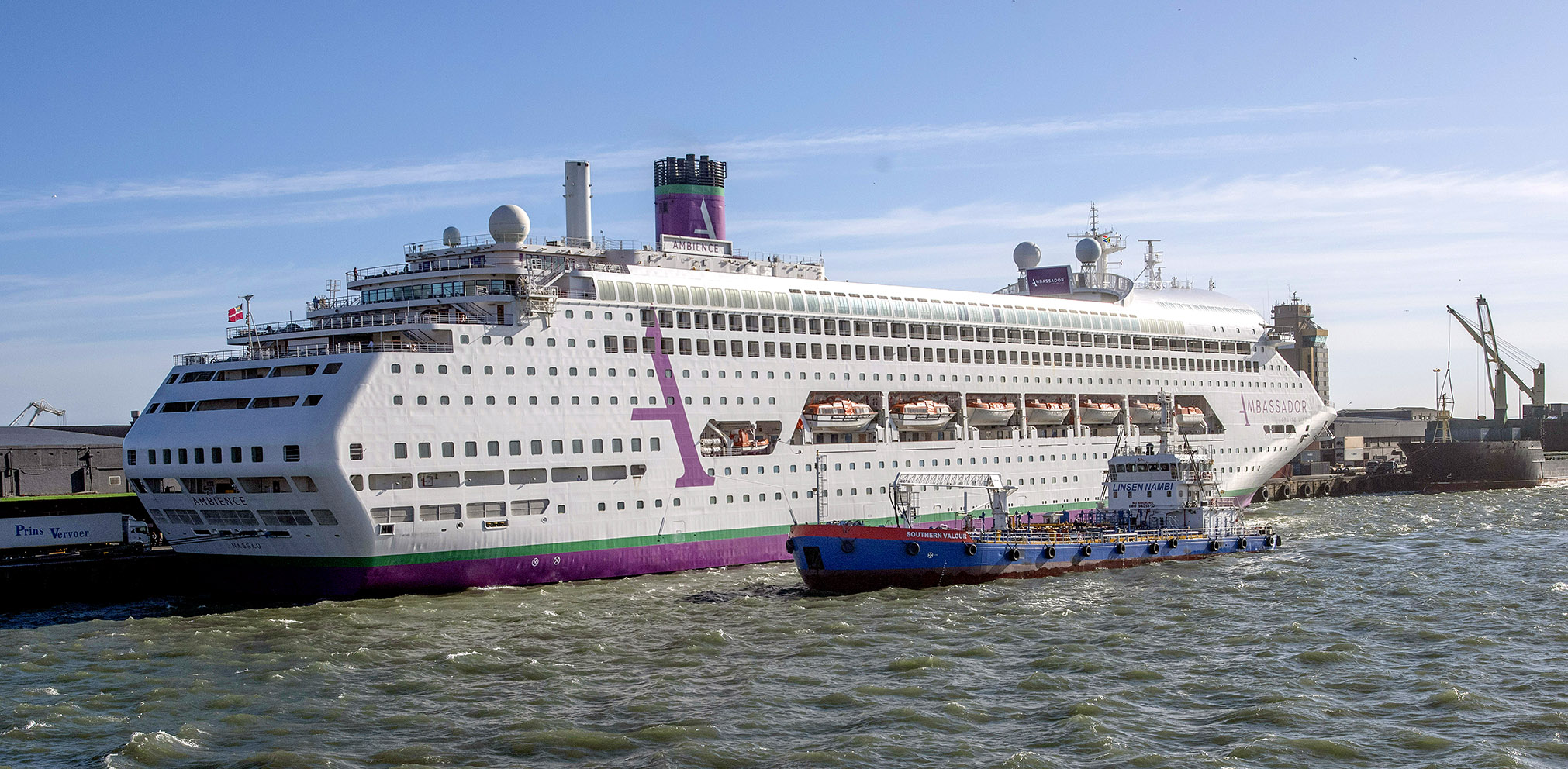
 The Ambience cruise liner in Cape Town Harbour on 5 April 2024. (Photo: Gallo Images / Brenton Geach)
According to the Western Cape Cruise Liner Industry 2024/25 Season report, commissioned by Wesgro, the province’s tourism and investment agency, the 2024/25 cruise season added R1.79-billion to the Western Cape’s GDP-R – the measure of economic output at provincial level – up from R1.32-billion in the previous season. This reflects an 18% rise in vessel arrivals and a 16% increase in passengers, reaching 127,000 between September 2024 and June 2025. Passenger and cruise-line spending totalled R1.99-billion, a 32% nominal increase year-on-year.

International passengers accounted for the lion’s share of the R1.99-billion expenditure during the 2024/25 season. (Source: Western Cape Cruise Liner Industry 2024/25 Season report)
Wesgro’s data also shows a strong surge in international travellers – a 39% increase – which lifted overall spending because visitors from abroad generally spend more than domestic passengers. The report attributes much of the season’s improved performance to this shift in traveller profile.
To calculate the economic effect of cruise tourism, the Wesgro report uses multiplier models, which estimate how money spent on accommodation, food, port fees and similar services spreads into other parts of the economy. Because they are based on assumptions about how money moves through both formal and informal sectors, the report notes that these totals represent estimates rather than precise measurements.
Between September 2024 and June 2025, the Cape Town Cruise Terminal welcomed 83 ship calls, an 18% increase from 67 ships in the previous season. Passenger numbers rose to 127,000, up 16% from 110,000 the previous year.
Long-haul world cruises linking multiple continents accounted for 42 arrivals, reinforcing Cape Town’s reputation as a premier stop on global itineraries. Eleven ships made their maiden voyage to Cape Town. March saw a record 22 ship calls, despite being outside the traditionally popular tourist months, signalling the emergence of a year-round cruise tourism season.
The report states that the 2024/25 season supported 1,234 direct full-time equivalent jobs in the Western Cape. Once indirect and induced effects are included – such as supply-chain activity and secondary spending – the estimate increases to 2,345 jobs provincially, and close to 3,000 nationally.

The retail and hospitality sectors are the primary beneficiaries of cruise tourism employment. (Source: Western Cape Cruise Liner Industry 2024/25 Season report)
Wesgro CEO Wrenelle Stander said the figures show that cruise tourism continues to generate employment and stimulate activity in several industries linked to travel. She noted that tourism-related jobs remain exposed to seasonal patterns, currency swings and global travel demand, all of which can shift quickly.
Central city activity: investment holds despite national pressures
The Town Central City Improvement District’s (CCID) State of Cape Town Central City Report 2024 highlights steady commercial activity in the central business district – the city’s commercial and administrative hub. According to the CCID, property development values reached R9.03-billion in the reporting period, up from R7.29-billion previously. The inner city recorded 3,290 active businesses, a retail occupancy rate of 94%, and 1,323 retail outlets operating in 2024.
The CCID’s Business Confidence Index shows that most retailers reported positive trading conditions during the year.

Retailer confidence in the central city has rebounded to near-record highs despite national economic headwinds. (Source: State of Cape Town Central City Report 2024)
CCID deputy chairperson Grant Elliott described the inner city as a “natural extension of the overall cruise experience”. While the report does not quantify how many cruise passengers spend money in the central city or how their spending affects local retailers, the data points to steady fundamentals supported by tourism flows, private-sector investment and a rise in mixed-use and residential developments. This shift has been partly driven by elevated office vacancy rates across South Africa.
What this means
The Wesgro and CCID reports show growth across both sectors: more scheduled vessel calls for the 2025/26 season, and continued investment and strong retail performance in the inner city. But these forecasts depend on factors that can shift quickly, including global travel trends, exchange-rate volatility and consumer confidence.
In the central city, high retail occupancy and active development point to resilience, though questions remain about affordability, infrastructure capacity and long-term demand for inner-city living and commercial space.
Spillovers beyond Cape Town
The Wesgro report also tracks cruise-related activity in coastal towns outside Cape Town. Mossel Bay, Hermanus and Saldanha Bay received about 32,000 passengers during 26 vessel calls, with an estimated R47.5-million in local spending. The report notes that visitors spent money on tours, transport, retail and hospitality, creating short-term employment and exposure for local small businesses.
However, cruise tourism remains a relatively small part of these towns’ economies, which continue to rely mainly on sectors such as agriculture, fishing and general tourism.
Structural constraints
Although inner-city retail occupancy is high, the CCID report shows that 26% of businesses still view crime and safety as ongoing challenges, despite joint public-private efforts to address them. Broader economic factors also affect the city centre, including inflation, pressure on household finances and uneven foot traffic linked to hybrid work arrangements.
National landscape
Tourism accounts for a modest share of South Africa’s total GDP but remains a useful indicator of external demand. While Cape Town dominates the international cruise market, the Wesgro report notes that Durban remains a key competitor for domestic passengers, largely due to its proximity to South Africa’s major population hubs. This geographic split suggests that the country’s cruise activity is distributed according to market segments rather than concentrated solely in the Western Cape. DM