




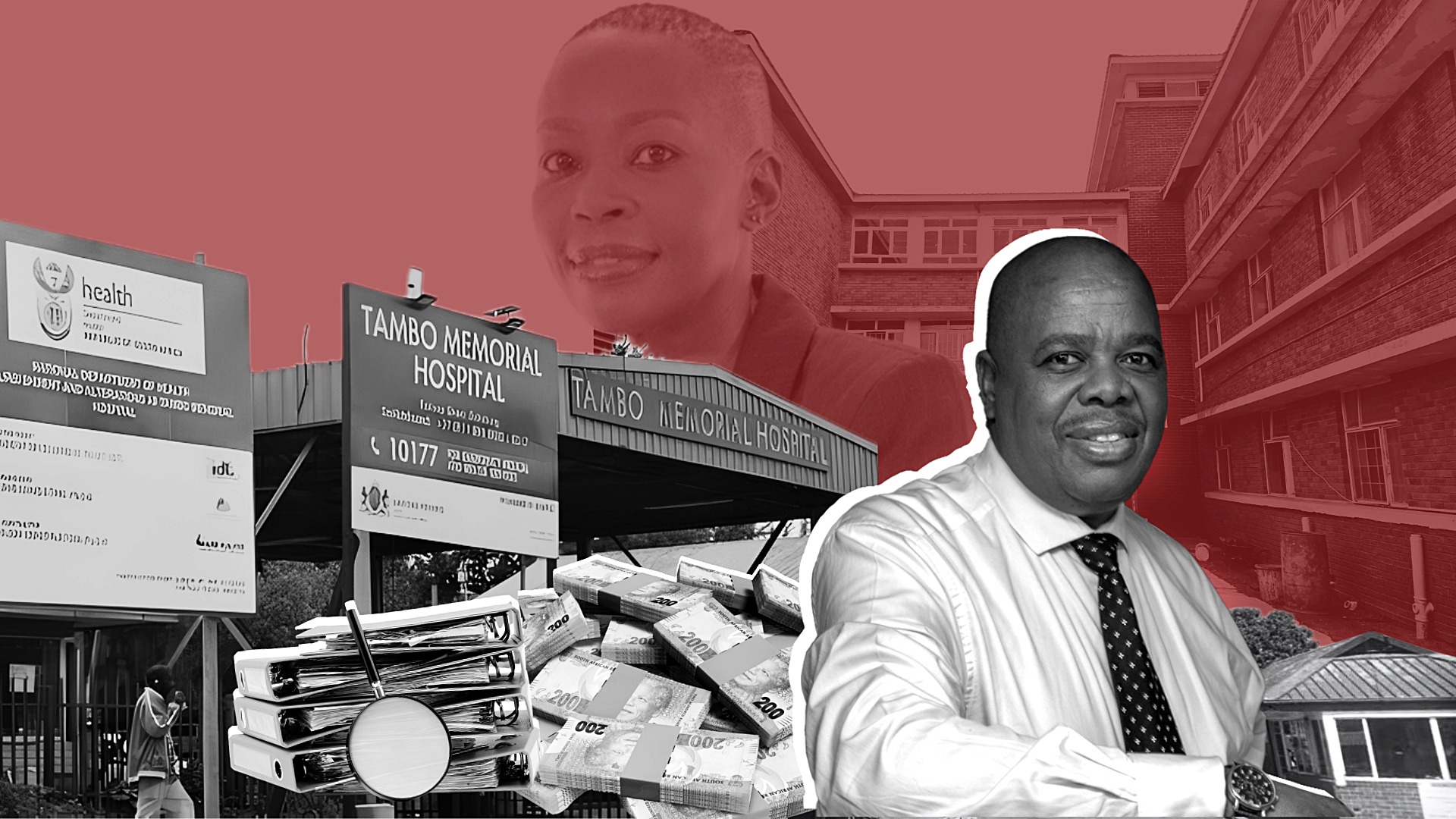
 Illustrative image: Suspended IDT CEO Tebogo Malaka. | NDoH Director-General Sandile Buthelezi. | Witbank Hospital. (Source: Azarrah Karrim / Google Maps)
 The National Department of Health (NDoH) has launched a sweeping “due diligence investigation” into a series of hospital refurbishment projects that have already burnt through millions of rands in what may amount to irregular, fruitless and wasteful expenditure.
The programme — managed by the Independent Development Trust (IDT) and which would have cost more than R1.6-billion — was meant to deliver long-overdue upgrades to key hospitals. Instead, it has been dogged by allegations of fraud, mismanagement and irregularities.
Spearheading the programme is NDoH director general Dr Sandile Buthelezi, who informed the IDT that the memorandum of understanding (MOU) between them had been terminated.
The August 2025 letter declared that the department was “dissatisfied with the progress made and the results of projects that have been undertaken”.
The IDT, however, has hit back in its responses to amaBhungane, alleging that it was the health department that failed to provide necessary oversight, give instructions and transfer money on time.
Yet while the NDoH is now scrutinising the IDT, it has appeared far less willing to confront Buthelezi’s own role — with damning allegations against him in connection with two projects now under scrutiny — as well as his relationship with the now suspended IDT CEO, Tebogo Malaka.
Amid the spat, some critical projects have ground to a halt, with one contractor writing to the minister of health, Dr Aaron Motsoaledi, for intervention in a hospital upgrade that has already been delayed by more than a year.
/file/attachments/orphans/6I1A5417_485979.jpg "Health Minister Dr Aaron Motsoaledi. (Photo: Felix Dlangamandla)")
Timing
The timing of Buthelezi’s correspondence to the acting IDT CEO, Carmen-Joy Abrahams, is questionable. His first letter was sent on 22 August 2025 — 22 days after Malaka’s suspension.
Just three weeks later, he terminated the MOU and announced an investigation.
Until then, warnings about procurement failures and mismanagement had seemingly been allowed to fester with little visible intervention from the NDoH, our reporting suggests.
NDoH spokesperson Foster Mohale disputed this, saying the department had been conducting oversight “to the extent [that] the ability and capability can allow”.
He said the DG “is now acting in line with the responsibilities of all accounting officers. The department did not allow the flourishing of issues, but has been proactive and numerous correspondences have been sent to the IDT since its appointment as an implementing agent … that is why we are taking action.”
On the potential irregular, fruitless and wasteful expenditure, Mohale said if the IDT “execute [sic] their mandate in such a way that the department incurs a finding, this will be revealed in the Auditor-General’s report”.
Buthelezi played a central role in the irregular R836-million oxygen procurement process, allegedly working alongside Malaka to push the deal through despite serious red flags.
Audit firm PwC was appointed to investigate the project and singled Buthelezi out for this very action, even though it was not mandated to probe the NDoH.
But Mohale said that the department “did not hire” Malaka, and its only relationship with the IDT was as an implementing agent.
Malaka was placed on suspension after PwC found she was responsible for a number of procedural and oversight failures.
According to IDT spokesperson Lerato Modisana, Malaka’s hearing is set to continue in the first week of February 2026.
Modisana said that as a result of PwC’s findings, one official had been dismissed, and two others — former spokesperson Phasha Makgolane and the general manager for supply chain management, Dr Molebedi Sisi — had been charged and suspended.
Mohale said the minister of health, Dr Aaron Motsoaledi, had requested that the minister of public works, Dean Macpherson, extend the PwC investigation to include officials in the NDoH, including the director-general, and that they were still waiting on the outcome.
Macpherson confirmed this in a press briefing last Thursday, saying the full report could not yet be released “so as not to compromise criminal action that may result from it”.
/file/dailymaverick/wp-content/uploads/2025/10/Minister-Macpherson-Cape-Town-Central-SAPS-DH-6026-copy.jpg "Minister of Public Works and Infrastructure Dean Macpherson. (Photo: David Harrison)")
Buthelezi is also at the centre of a Hawks investigation into allegations that he solicited a R500,000 bribe from a construction company, Base Major working on the Tambo Memorial Hospital project — to which the IDT later awarded one of the very contracts now under scrutiny.
Hawks spokesperson Brigadier Nomthandazo Mbambo told amaBhungane that “the docket in this matter is still with NPA [National Prosecuting Authority]. No one has been formally charged, as we are still awaiting a decision by the DPP.”
The NPA did not respond to amaBhungane’s numerous requests for an update on the matter.
The NDoH spokesperson told amaBhungane that if Buthelezi were found guilty of soliciting a bribe, “action will be taken”.
Delayed due diligence
In his 22 August 2025 letter to the IDT’s Abrahams, Buthelezi spelt out a litany of problems that, despite being years in the making, seemingly had only now triggered decisive action.
The hospital refurbishment programme began in 2022, and the red flags should have been apparent almost from inception.
Buthelezi noted issues with Stage One planning, non-performing contractors, the absence of some elements of the implementation plan and the failure of some projects to meet the National Treasury’s infrastructure planning guidelines.
Yet, while the IDT is responsible for procurement and project management, NDoH officials are also involved at every step.
The health department has the ultimate responsibility over the programme, and appointments, changes to the scope of the projects, work verification and payments cannot be done without its go-ahead.
/file/attachments/orphans/GRAPHICOFHOSPITALS_389596.jpg "(Graphic: amaBhungane)")
In the letter, Buthelezi detailed instances of contractors being paid for work not done, conflicts of interest and no approved plans in place before work began.
Yet, money continued to flow, risking irregular, fruitless and wasteful expenditure.
He provided instances of conflicts of interest regarding contractors, advance payments for work not completed at Harry Gwala and Tambo Memorial hospitals, the failure of the IDT to provide updates on risks, delays, payments and projections, and underspending of the budget.
“Risk identification practices have fallen short of industry norms, specifically when considering the size of some of these projects and the substantial risks associated with the contracting methods applied,” said Buthelezi.
But according to IDT spokesperson Modisana, “Ultimate financial stewardship and accountability for the programme reside exclusively with the NDoH.”
She said the IDT aimed to prevent irregular, fruitless and wasteful expenditure and had taken steps to protect the state from financial exposure, even when strict Public Finance Management Act (PFMA) compliance slowed operational work.
“The IDT welcomes legitimate oversight but must correct any inaccuracies that risk misrepresenting prudent financial management and statutory compliance as wrongdoing,” she said.
Modisana contended that payments referred to by Buthelezi were “lawful infrastructure payments”, arguing that the IDT had, in fact, withheld payments where the NDoH delayed approvals or failed to transfer funds — measures she described as necessary for PFMA compliance.
The NDoH also incurred significant delays for major projects, particularly due to the department delaying mandatory approvals, Modisana added.
“While the impact on contractors is regrettable, the causation rests entirely with the entity holding exclusive approval and funding authority: the NDoH.”
Probe
In a subsequent letter to Abrahams, Buthelezi confirmed that the department was in the process of procuring a service provider to conduct a due diligence investigation into six hospital projects.
The probe would look into, among other things, whether:
- The IDT adhered to procurement policies;
- Bid committees were properly constituted and bidder disqualifications justified;
- Bidding processes were equitable, transparent and cost-effective;
- Project prices were market-related and reasonable;
- Projects were managed in line with agreements, contracts and industry standards; and
- Expenditure incurred was aligned with actual progress.
“The department accordingly requests your full support and cooperation with the appointed service provider, including granting access to all documentation required to conclude this process in an efficient and timely manner,” Buthelezi wrote.
Mohale told amaBhungane that the audit firm Thabi Consulting would conduct the probe.
‘Situation deteriorating’
Caught in the middle of the spat, however, are contractors reckoning with nonpayment and an angry community.
In November, the situation became so dire for Powerchoice Group — contracted to build an orthopaedic unit at Witbank Hospital — that it wrote to Motsoaledi pleading for intervention.
“It has come to our attention, through members of the Emalahleni community, that certain officials within the NDoH have communicated that a decision has been taken by the office of the director-general to halt payments to the main contractor,” wrote director Andile Somana in a letter shared with amaBhungane by a community stakeholder.
“As a result, the department has reportedly decided not to transfer funds to IDT for the settlement of Powerchoice Group’s approved invoices.”
He added, “Despite our attempts to engage all relevant stakeholders, it has become apparent that the project has been effectively abandoned.”
/file/attachments/orphans/InsidetheorthopaedicunitofWitbankHospital_209623.jpeg "Inside the orthopaedic unit of Witbank Hospital. (Photo: Azarrah Karrim / amaBhungane)")
Powerchoice asked the minister for his assistance to facilitate payments after, it said, the NDoH had not transferred the funds to the IDT.
“The non-payment has caused severe distress among local labourers and subcontractors, many of whom have begun removing valuable equipment from the site to secure their wages,” he said.
The situation on the ground was deteriorating, Somana told the minister, as workers were facing threats from the community and suppliers “who believe we are withholding their payments.
“We therefore make an earnest plea for your immediate intervention to resolve this matter. The escalating frustration of the community and suppliers is becoming both palpable and uncontrollable, and urgent action is required to prevent further unrest and protect public assets.”
At a press briefing held by the company alongside community stakeholders in early November, a representative of Powerchoice told amaBhungane this was due to internal problems “caused by the NDoH not paying the IDT”.
They added that their last payment was received in May, but in July, Buthelezi issued an instruction to the IDT to terminate Powerchoice’s contract “without due process”.
“The current status of the project is really undesirable, the project is 60% complete, but it has started to deteriorate as it has stopped for five months now.”
The construction of the orthopaedic unit involved complex work on three floors, but the project was also beset by changes in design, reinstalling and fixing work and a turnstile of subcontractors appointed and terminated, according to the company.
The project is now overdue by more than a year, with 44% of the total contract value claimed by the contractor.
AmaBhungane visited the site and found the bare bones of unfinished work still far from being completed.
/file/attachments/orphans/WorkhasbeenstalledformonthsatWitbankHospital_307414.jpeg "Work has been stalled for months at Witbank Hospital. (Photo: Azarrah Karrim / amaBhungane)")
/file/attachments/orphans/EnterancetoWitbankHospitalwithunopenedHuaweiboxes_402622.jpeg "Enterance to Witbank Hospital with unopened Huawei boxes. (Photo: Azarrah Karrim / amaBhungane)")
/file/attachments/orphans/UnopenedboxesinsideWitbankHospital_152761.jpeg "Unopened boxes inside Witbank Hospital. (Photo: Azarrah Karrim / amaBhungane)")
Large boxes of transformers and solar batteries — costing about R1.4-million — still sat, unused, on site. Cabling and heating, ventilation, and air conditioning installations were almost complete, the company said, but then stalled months ago.
Powerchoice said it was waiting on payment for about R31-million for work it completed.
Mohale did not respond to amaBhungane’s request for comment on Powerchoice’s complaints, but according to Buthelezi’s letter to Abraham, the company had been performing poorly since the start of the project, and penalties had been partially imposed.
Powerchoice, however, denies this, saying it never received a notice of poor performance. DM