




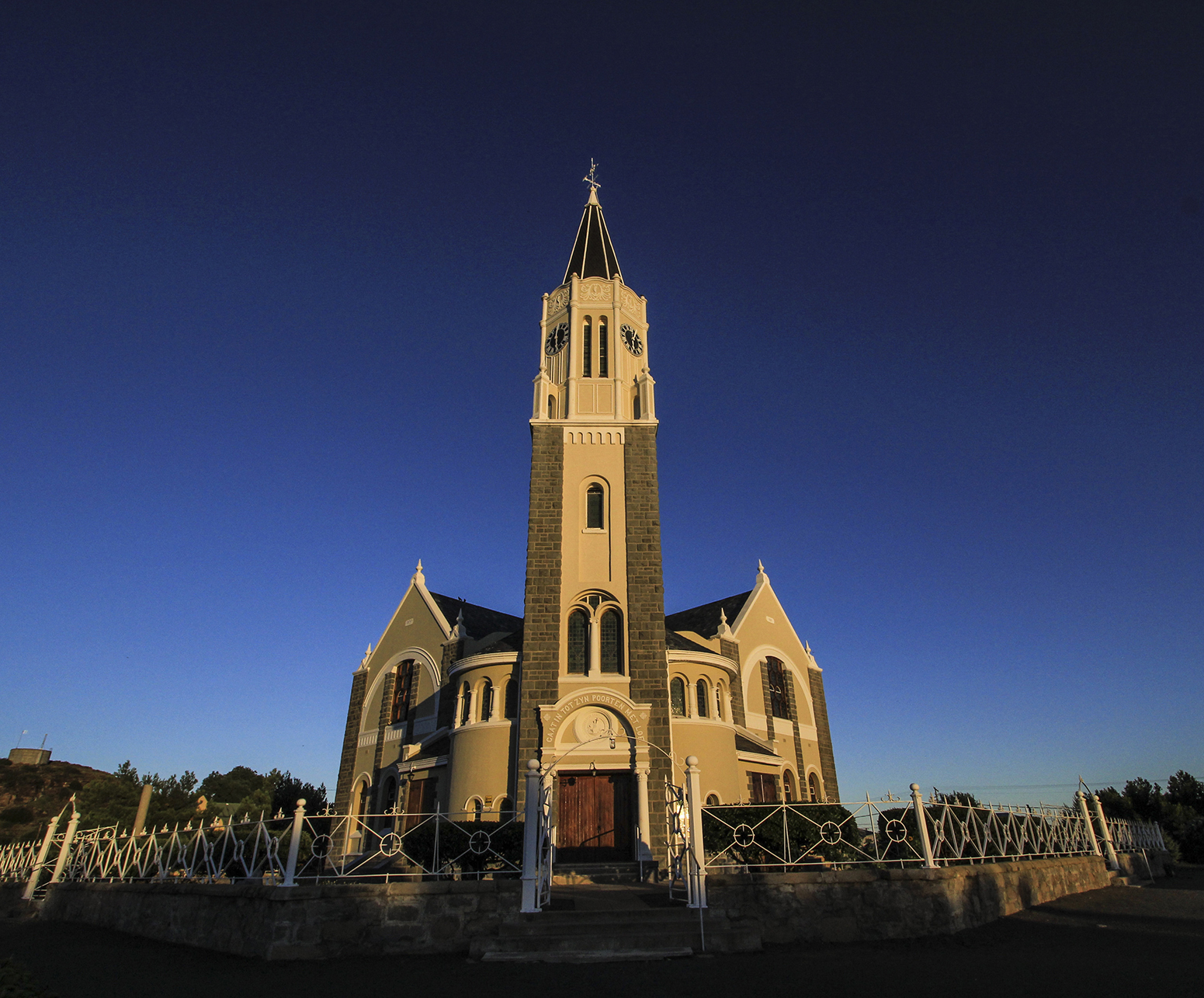
 The Hanover NG Church in dawn glory. (Photo: Chris Marais)
 The Mother Church of Hanover
If you stand at the top of a little hill called Trappieskoppie and look south, you will see the Northern Cape village of Hanover in all its old glory.
In the midst, like a queen bee, stands the NG Mother Church which, when opened in 1907, encouraged the faithful to bring their own chairs to services. Before the era of electricity, the church chandeliers were powered by methane gas sourced from sheep dung.
In its time there has been no shortage of colourful dominees and kosters (vergers) in Hanover. The first dominee had his pastorie (manse) built in a “B-for-Bethlehem” shape. Another dominee called Thomas Francois Burgers tried his own individualist brand of Christianity on the locals but did not impress by his refusal to believe in the literal truth of the Bible.
He was duly expelled from the church and went on to become the South African Republic’s fourth President.
As far as Hanover’s vergers go, the most famous one was Tannie Mollie Kleingeld, who insisted on climbing the stairs to the steeple up to the age of 86. She served for more than 30 years before calling it a day.
What do vergers do? we asked. “Clean the church, mind the garden, set out tables, wind the clocks and ring the bell on Sunday,” said another verger, Mike Burger. And then he went off to do just that.
/file/attachments/orphans/WisebrickworksoutsideRichmondNorthernCape_ChrisMarais_384785.jpg "Wise brickworks outside Richmond, Northern Cape. (Photo: Chris Marais)")
Wisdom in the bricks
You know what they say in Richmond?
“Werk, vrek of trek.” Work, die or move. Now, really, what does that mean? More to the point, and less cosmically complicated, is the fact that, in Richmond, they make bricks in the biblical manner.
A blinkered donkey is harnessed to a central pivot and trudges round and round a hole, where the master brick maker digs up clay and flings it into a cylinder that resembles an Archimedes screw. Two assistants run back and forth with brick moulds, filling them, dumping them and rushing back.
Welcome to the Kiewiedo family business. Kiewiedo the Elder, Daniel, had been a brick maker like his dad. His son Trevor now runs the show, and the company goes by the name of Danielskuil Steenmakery.
They have been known to produce 6,000 bricks a day, and are so in demand that customers pay large deposits on their purchases. What makes some of these bricks so special is that the local art gallery commissioned them to bake speciality items, with each brick bearing a letter of the alphabet.
Back to the working, dying or moving thing.
If you spend time in Richmond, you might spot an ancient American pickup bearing the words Vrek, Werk of Trek. First you die, then you work and then you move. Compared with the brick slogan, is another kettle of philosophical fish altogether.
/file/attachments/orphans/MJSwartphotographedin2008shortlyafterhisretirement_ChrisMarais_974081.jpg "MJ Swart, photographed in 2008, shortly after his retirement. (Photo: Chris Marais)")
Number please – nommer asseblief
MJ Swart, one of the last manual telephone exchange operators of the Karoo, loved his work so much that he literally took it home with him when he retired.
He bought up sections of the Richmond exchange and installed them in the voorkamer of his house, recreating a chunk of the life that kept him glued to the vintage Bakelite headphones for more than 40 years.
MJ even brought home the stretcher that was used by operators on break for catnaps and such. “I was Google before Google was Google,” he once told us. “If someone around here wanted the answer to something quickly, the solution would always end up with ‘Vra Sentrale – ask the Exchange’.
“Even the pigeon fanciers would call up to find out about the wind and the weather just before a big race.”
In its final years of operation, the manual exchange in Richmond was only used to transfer calls to farms in the district. “Those people on the farms are so lus to chat that they would listen in to others talking, up to 10 at a time. And when the conversation became boring, the eavesdroppers would often fall asleep and you could hear them snoring.”
/file/attachments/orphans/IsthereabetterfeelingthanbeingoutontheopenroadinthevastKaroo_ChrisMarais_437992.jpg "Is there a better feeling than being out on the open road in the vast Karoo? (Photo: Chris Marais)")
The open road
How does one speak of the magic of a Karoo road trip?
Is it somewhere between the blue horizon, a sighing windpump, a darting meerkat, a bite of a kudu pie, the swoop of a kestrel on the hunt or a silent day in the middle of nowhere?
Can it be that feeling of at-last freedom, a cheerful word shared with a round lady under a floppy sunhat at a stop-go on the highway or feeding the family dog his breakfast at a lay-by and watching as he meets his first sheep?
Or does that magic lie up on snowy mountain slopes in the dead of winter, when your host has warmed your cottage, stocked your fridge with a mound of lamb chops and his wife has placed something sweet and special on the pillows in the kids’ bedroom?
Is it waking up on a Karoo farm, as the head rooster struts his stuff around the homestead and greets the world, while the shearers dig deep into their breakfast bowls with a long, hard day in the shed before them?
Can the spell of a Karoo road befall a man on a motorbike as he opens up and roars down a lonely dirt track, finding himself suddenly in the presence of nothing but an ancient and majestic landscape sweeping from left to right?
Is it some, or all, of the above? DM
/file/attachments/2984/book-promo_675310_47c9ccf5bbdc7efa7ac10973cfb023d5.jpg "Karoo Space books by Julienne du Toit and Chris Marais.")
For more stories on life in the South African Heartland, get the Karoo Quartet set of books (Karoo Roads I-IV with black and white photographs) for only R960, including taxes and courier costs in South Africa. For more details, contact Julie at julie@karoospace.co.za