




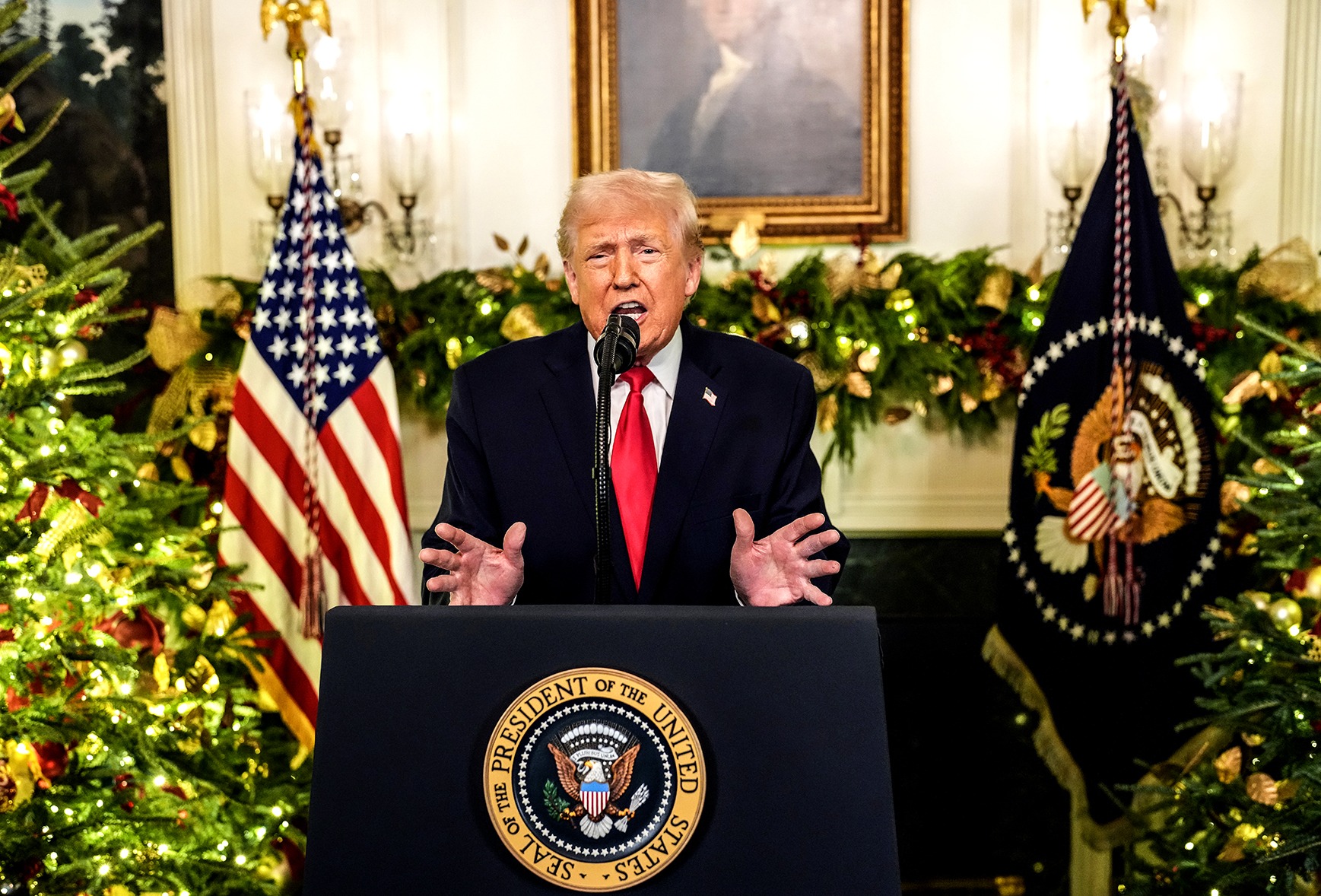
 US President Donald Trump addresses the nation from the White House on 17 December 2025 in Washington, DC. (Photo: Doug Mills / Pool / Getty Images)
 /file/dailymaverick/wp-content/uploads/2025/10/label-analysis-2.jpg)
For you, gentle readers, just as you start to switch off from the world’s troubles and tribulations and make your annual migrations to the beach, the mountains, foreign shores or snow trails, or even in Johannesburg “staycations”, this writer dutifully awoke at 4am on Thursday, 18 December 2025, so he could listen to the broadcast by American President Donald Trump, live from the White House and explain what he had witnessed. This speech had been billed as a kind of American-style “family meeting” a la SA President Cyril Ramaphosa’s speciality, and a report card on Trump’s success in his first 11 months in office this time around.
The expected content, therefore, would have had Trump describing the successes of his administration via his usual extravagant, idiosyncratic tones, boasts, and sui generis turns of phrase. There would also be promises yet to be realised in the remainder of his second term of office, but just over the horizon, just down the way on that yellow brick road.
His speech presumably also offers words of reassurance, support, and encouragement to voters who feel they are being ground down by their country’s economic circumstances – or even the mercurial nature of the president’s policies. This would be important since the polls show Trump is increasingly losing favour with many voters over his economic policies, his foreign adventures, and his aggressive immigration policing, so it was important to speak in a way that would arrest any further draining of support.
But instead, what his audience heard was the political equivalent of a grumpy old codger, standing belligerently on his front porch, waving his cane, yelling at the neighbour’s children to get off his lawn and take their baseballs and bats with them before he comes out and does something they will regret. If this had been a movie I had paid to watch, I would now be demanding my money back at the box office as well as some kind of compensation for the precious minutes of sleep I lost out on by getting up to watch this melange of rants, belligerence, outright lies and prevarications.
After listening to Trump for decades, though, the weirdest part of this presentation, since we have come to expect all of the usual tropes of Trump speeches, was that he delivered it as if the teleprompter had been accidentally set at 2x speed. He delivered his very un-merry holiday seasonal address in an angry pitch, raging against the dying of the light, and absent any nuance or hint of reassurance or warmth – save with a pro forma “Merry Christmas” at the end.
Favourite riffs
Professional Trumpologists and many others have got used to his improv feints, spinning out his favourite riffs in speeches that have lasted as long as 90 minutes. This time, though, given an apparently joint decision by US television networks that they would allot him a quarter hour of their prime time broadcasting space, but no free rein to rant as long as he wished, the president had no space for those Trump-standard rhetorical flourishes and meanders.
As a result, his pace generated an aural image of a man being pursued by a hungry cheetah through the savannah, rather than any effort to rally citizens to join in a great adventure for the future of the republic. But perhaps I was simply responding to my third cup of strong coffee in a desperate effort to stay with his spiel of anger and revenge seeking.
What we got, instead, was a Donald Trump on fast-forward autopilot. The old tropes came tripping out: Joe Biden and the Democrats, they had wrecked our beautiful country but I’m fixing it; we are entering the golden age of America; tariffs will pay for everything; gazillions of foreign investment is already flowing into the country; I’m getting drug costs cut by 600% (a statistical and logical impossibility); prices are falling (even if they are rising, in which case it is all Biden’s fault as the polls continue to point to disfavour of Trump’s economic policies); and the country was dead, dead! DEAD! before I arrived, but now it is hot, hot, HOT, I tell you! HOT!
Listening to the speech, there was something of a blur about it that the Democrats’ inflation disaster had raised mortgage costs and high interest rates, and that illegal immigrants were stealing jobs, soaking up medical help, and taking housing rightfully belonging to real Americans. But now the border is secure, inflation is down, we are poised for an economic boom the likes of which we have never seen before. And don’t forget that we’ll have the Olympics and the World Cup soon, too, brought to these shores by yours truly. God bless you all.
About the only actual nuggets of policy were his promises to give everyone in the uniformed military services a special Trumpian “warrior” bonus of $1,776 (aha! catchy, hey?) for the 250th anniversary of American independence; and the reiteration of a proposal to provide families with $2,000 (about R33,500) directly to pay for their own health insurance policies. This would come instead of extending the subsidy for lower income families who depend on the medical plans supported by the Affordable Care Act (that is, in case listeners have forgotten, Obamacare).
As for the former promise, it remains entirely unclear if the president can unilaterally change the entire military pay structure without congressional appropriations action, whether Congress will find actual ways to fund this new promise, or if this promise will simply drift away into the future unknown like an escaped balloon.
Votes
For the latter, that $2,000 will come nowhere close to being sufficient to keep healthcare costs from spiralling beyond the budgets of many – although, ever the populist, he did rail at those arrogant, greedy insurance companies that extort money from honest working Americans. In truth, there are very few votes to be gathered from among insurance company executives, but millions from among the ranks of the dissatisfied insured.
Notably missing was virtually anything substantial about international affairs, whether it was about the policy of attacking motorboats in the Caribbean Sea, seizing oil tankers and threatening further action against Venezuela, insisting upon imposing a peace on Ukraine largely dictated by Russia, or fundamental arrangements in the Middle East or elsewhere.
I think I may have heard a quick comment about his having settled eight conflicts even before he had finished breakfast, but maybe that was just my super-strength coffee caffeine rush. There was, of course, the ritual obsessing over the success of the magic of tariffs in bringing foreign scofflaw nations to heel over their trade nastiness.
Thus, mostly, the speech was bog-standard, red meat chunks flung to those – about 30+ percent or so of the electorate – who were already dyed in the wool Maga supporters. It is doubtful, however, that anything the president asserted on Wednesday night would sway undecided voters, let alone Democratic Party-supporting ones, to line up behind him after having heard what he had to say.
The polls now say that Americans disapprove of Trump’s handling of the economy by a margin of 21 percentage points, according to a PBS News/NPR/Marist poll released on Wednesday. Fifty-seven percent of Americans do not approve of Trump’s handling of the economy, while 36% do, the lowest the poll has found over both of his terms.
Reactions like these will matter a great deal in 2026 because this year hosts a mid-term election for Congress with all seats for the House of Representatives and a third of the Senate up for grabs. Yes, voters in many seats are so strongly aligned to one party or the other that only a smaller subset of seats are really going to be in play, but in a sharply divided Congress, the electoral results for those seats will be crucial.
Redistricting maps
Meanwhile, a growing number of Republican (and some Democratic) incumbents are choosing to retire, while the efforts of red (i.e. strongly Republican-leaning) state legislatures to carry out unusual redistricting maps for those House seats to strengthen Republican chances are not gathering strong support beyond the effort in Texas. (The California initiative to favour Democrats has similarly found favour with legislators and voters.)
Democrats are coming to the realisation they have two pocket-book issues to hang their campaigns on – the so-called “affordability” issue as overall inflation continues to rise, especially including prices on key consumer goods, and the question of funding aid for the growing impact of healthcare costs on family budgets, absent tangible measures by Congress to rein in such cost rises or offer real offsets in support.
Almost as soon as the speech was history, the pundits and talking heads were weighing in and largely offering a thumbs-down on the speech. The Washington Post reported that former Trump strategist Steve Bannon, on his “War Room” online talk show, reminded his audience that this speech had been seen by prime time network TV viewers, not just the president’s base. As such, Bannon asked rhetorically whether or not this speech had been “too intense” (i.e. too partisan) for a broader broadcast audience?
Meanwhile, fact checkers noted that his claim of having secured investments of $18-trillion in the US is actually double what the White House lists on its own website – and it manages to list some investments that predate Trump’s time in office.
Trump also claimed he had inherited from his predecessor some of “the worst trade deals ever made”. One problem with such a statement is that one of those horrible, inherited trade deals was his own United States-Mexico-Canada Agreement, negotiated during Trump’s own first term.
Thus the president spoke, ranted, roared and pontificated, but without much real impact outside the Maga bubble. But that is where things are these days. DM