




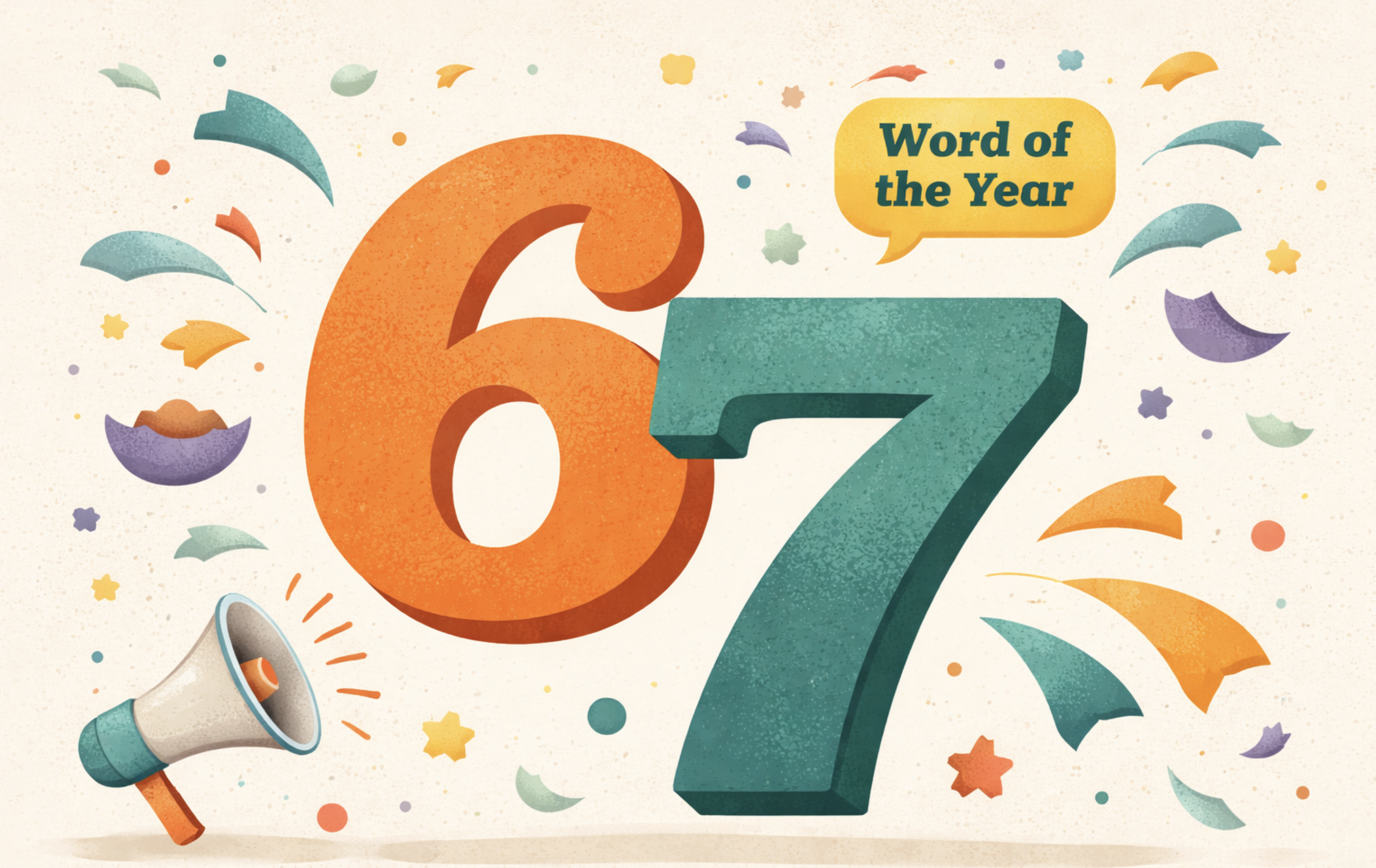
 Rage Bait. Slop. 67 are 2025 Words of the Year. (Illustrative image: Nano Banana/ Gemini)
 In 2025, the world’s leading language authorities did something quietly revealing when selecting their Words of the Year. They did not choose terms associated with innovation, progress or optimism. They selected a handful that describe how the internet behaves now.
Oxford University Press named “rage bait” its Word of the Year, noting a threefold increase in use and a decisive public vote. Merriam-Webster chose “slop”, driven by a surge in lookups tied to low-quality digital and AI-generated content. Dictionary.com selected the numeral “67” (said as “six seven”, not sixty-seven), after interest increased more than sixfold in a single year. Cambridge highlighted “parasocial”, while Collins focused on “vibe coding”. Each decision was made independently, using different editorial processes and data sets, yet together they describe a single cultural condition. They point to an internet shaped less by meaning and more by signalling.
That shift becomes clearer when set against the language of recent years. In 2024, they weren’t exactly uplifting either – the dominant words reflected concern rather than accusation. Oxford selected “brain rot”, capturing anxiety about cognitive overload and the mental effects of consuming endless low-quality content. Merriam-Webster chose “polarisation”, driven by sustained public attempts to understand deepening social and political division. Cambridge highlighted “manifest”, rooted in aspiration and self-optimisation culture, while Dictionary.com selected “demure”, reflecting conversations about identity, presentation and restraint.
In 2023, the mood was lighter and more exploratory. Oxford’s “rizz” celebrated social charisma in youth culture. Cambridge and Dictionary.com both focused on “hallucinate”, as the public grappled with the novelty and unpredictability of early generative AI systems. The emphasis was on naming new phenomena rather than judging their consequences.
By contrast, the 2025 selections mark a turning point. The language no longer circles the effects of the internet on the individual. It names the behaviours the system now produces.
For almost 10 years I have worked directly and in person with Gen Z and Gen Alpha as a social media safety educator. Teaching the generations shaped by these systems while advising organisations building within them offers a dual vantage point. It reveals not only how behaviour is changing, but why. I feel as though I am watching two points of reality collide daily, and it is genuinely fascinating.
I have explored related dynamics in earlier writing, including how social media conditioned us for AI, how content abundance risks hollowing out meaning and why the internet periodically feels as though it is eating itself.
Words of the Year – so what?
Words of the Year are not novelty picks. Dictionaries are conservative institutions. Their selections are based on sustained increases in use, search behaviour and cultural penetration across platforms and media. A term must persist beyond a viral spike and appear across contexts editors consider stable. That filter is what makes the 2025 cluster so striking.
None of the selected words describes aspiration or progress. They describe reactions. “Rage bait” names emotional manipulation. “Slop” names overproduction without care. “67” names participation without meaning. “Parasocial” names intimacy without reciprocity. “Vibe coding” gets a nod because of “AI-assisted everything in everyday life”, the ridiculous accessibility to basic coding and creation, sure to crush a segment of developers in the coming years.
A new inflection point. Another one, yes
This linguistic convergence coincides with a demographic shift reshaping the internet. Gen Z is no longer emerging. Its oldest members will soon be approaching 30 (in 2027). They are now managers, parents, creators and cultural gatekeepers. Their online behaviours are less surprising, having been de-sensitised somewhat over the past decade.
However, Gen Alpha is entering early adolescence as the first generation raised entirely inside algorithmic systems. They did not learn the internet as a tool but inherited it as infrastructure. Touchscreens, recommendation feeds and now AI interfaces are not optional layers. They are the environment, and this overlap matters.
Gen Z learnt how platforms work, and now Gen Alpha (born from 2010 onwards) absorbs their incentives as defaults. What is often labelled as absurdity or decline is better understood as adaptation to systems that reward speed, repetition and emotional clarity over depth.
67: Why meaning collapses while signalling thrives
At the centre of this shift sits a simple economic truth. Digital platforms reward what is measurable. Engagement is easy to track, while understanding is not. Decades of behavioural research show that content triggering high emotional arousal spreads faster than reflective or ambiguous material. Platforms did not invent this tendency, but they industrialised it. Over time, users adapt their language to what survives in these environments, learning early that calm nuance disappears, emotional spikes survive, and outrage travels.
In parallel, the rise of “nothing signals” such as “67” reflects a different psychological adaptation. If you don’t know this trend, kids say the words “six seven” if they hear it when adults say the two numbers. They jump in, interrupt, laugh and smile at each other knowingly. It’s the leading 2025 in-joke of all parental and educator mockery.
For adolescents especially, language is often performative rather than semantic, and so this signals belonging more than meaning – they own something repeatable, recognisable, exclusionary, and irritating to outsiders. The absence of meaning is not a flaw. It is the feature. Inane, yes, but powerful.
Parents often find this behaviour infuriating because they search for content or depth where there is only context. The signal says, “I am part of this loop”. It says nothing else because it does not need to.
Slop: AI and the dilution of value
The emergence of “slop” as a Word of the Year reflects growing public awareness of a mismatch between production and purpose. Generative systems can produce content at scale, but scale alone does not confer value. When authorship is unclear and effort is obscured, audiences struggle to assess credibility or intent. Over time, this leads to a blunt linguistic response. Is “slop” a rejection of technology? A disappointment in humanity’s use of such power? Or a way of naming excess without meaning? You decide.
This dynamic mirrors broader concerns about how AI multiplies content while weakening resonance and originality. When production outpaces intention, audiences push back linguistically and culturally.
Parasocial: Connection in an algorithmic age
Cambridge’s selection of “parasocial” captures another layer of the same phenomenon. One-sided emotional relationships, once associated with celebrities and television personalities, now extend to influencers, streamers and AI chat companions.
These relationships can feel emotionally real while remaining structurally hollow. They offer the sensation of connection without reciprocity. For younger users raised inside feeds, this is not unusual behaviour; by contrast, it’s normative. Platforms simulate intimacy at scale, and language evolves to describe the psychological consequences.
Rage bait: Needs little introduction
I can barely give the term “rage bait” too much airtime, simply because it’s said that a word like this is hailed as a word of the year. You will feel this if you have children, for sure, that some form of celebrity is made of a word that captures content shaped to be intensely provocative to get attention (likes, views, follows, comments) or to get under someone’s skin. What makes it worse is that algorithms favour provocation more than many other forms of content. Musk, Zuckerberg, Altman and others know what they’re doing, make no mistake.
What unites these words
Taken together, the 2025 Words of the Year describe an internet that has shifted from meaning to signalling. This is really the central point I’m trying to make here.
Rage outperforms truth.
Belonging outperforms explanation.
Volume outperforms craft.
Visibility outperforms understanding.
This is not cultural decay, but I think, and people may disagree, it’s just learned optimisation.
Words of the Year are mirrors, not ornaments. And in 2025, the mirror reflected a culture optimised for attention, struggling to preserve meaning.
The open question is whether platforms, media and institutions can reintroduce authorship, friction and intentionality without losing relevance. Because when being seen consistently matters more than being understood, language inevitably follows. And in 2025, it finally told us so. DM
Dean McCoubrey is the co-founder of MySociaLife and Humaine.