




 Gauteng health MEC Nomantu Nkomo-Ralehoko with health workers.
 At the core of the Gauteng Department of Health’s strategy is a robust focus on infrastructure, ensuring that hospitals and clinics are not only functional but also equipped to handle growing demands. In the last financial year, the department successfully completed refurbishment and improvement projects across the province.
/file/attachments/2986/Pictureone_352827_ab7d035130b20a7b19341cce1aa88503.jpg "Nomantu Nkomo-Ralehoko is Gauteng health MEC. <br>")
These initiatives targeted critical areas such as emergency units, operating theatres, maternity wards, clinics, and mental health facilities.
Patient care: “I serve with a smile” & MEC’s help desk
Frontline staff have embraced the MEC’s rallying cry – “I serve with a smile” – turning every interaction into a moment of dignity. The MEC’s Help Desk, launched under Nkomo-Ralehoko, fields patient complaints within 24 hours, resolves 92% on first contact, and has slashed waiting-time grievances by 68%. From bedside manner to discharge planning, the culture shift is tangible: happier patients, prouder staff, and a province that finally feels the care.
/file/attachments/2986/IMG_2438_266934_0a568940e2bd2db832f2a9d8d7c3d44c.jpg "Gauteng health MEC Nomantu Nkomo-Ralehoko with health care worker engaging with a patient.")
The Gauteng Department of Health launched the "I Serve With a Smile" campaign across all hospitals, clinics, and districts in the Gauteng province. Acknowledging that staff behaviour is often affected by occupational stress, long working hours, and personal burdens, the campaign is combined with an internal Employee Wellness Programme.
The Gauteng Department of Health is opening wellness centres in hospitals and districts where staff have access to psychologists and other healthcare professionals to confidentially address mental, emotional, and personal challenges. Furthermore, the Gauteng Department of Health has introduced "Wellness Wednesdays" to encourage physical health. On these days, staff are encouraged to participate in scheduled activities such as aerobics, jogging, walking, and sports to promote the principle that a healthy body supports a healthy mind.
This holistic approach aims to improve the work environment, enhance patient experience and support the overall well-being of the staff.
Revitalizing infrastructure: Building for the future
Under MEC Nkomo-Ralehoko's watchful eye, the Gauteng Department of Health has completed 27 major refurbishment projects in the last financial year, focusing on emergency units, theatres, maternity wards, clinics, and mental health facilities. Standout accomplishments include the extension of the Maternity Ward at Jubilee District Hospital, a new 60-bed mental health ward at Bertha Gxowa Hospital, structural repairs at Chris Hani Baragwanath Academic Hospital, and the full refurbishment of Mamelodi Regional Hospital.
The recent opening of the Sicelo Clinic in Sedibeng marks a milestone in expanding primary care to underserved communities. Ongoing initiatives, such as upgrading Kopanong Hospital to a tertiary facility and the fire recovery program at Charlotte Maxeke Johannesburg Academic Hospital—targeted for completion by January 2026—demonstrate her commitment to long-term resilience. The introduction of a Planned Preventative Maintenance Model has minimized disruptions, with projects like the Johannesburg Forensic Pathology Lab at 98% completion and Khutsong Clinic at 80% underscoring efficient progress.
/file/attachments/2986/Picturethree_211063_afb84a248e2989a8b0ac3e15a700989b.jpg "Chris Hani Baragwanath Academic Hospital.")
Projects completed in one year
- Jubilee District Hospital – Maternity Ward extended
- Bertha Gxowa Hospital – New 60-bed mental health wing
- Chris Hani Baragwanath – Structural repairs completed
- Mamelodi Regional Hospital – Fully refurbished
- Sicelo Clinic (Sedibeng) – Newly opened for full PHC
- Charlotte Maxeke – Fire recovery on track for January 2026
Looking ahead, ongoing projects signal even greater ambition. To prevent future disruptions, the department has implemented a Planned Preventative Maintenance Model across all facilities, addressing plumbing, electrical, and structural issues proactively. The Gauteng Department of Health is also Implementing biometric body tagging using fingerprint technology for real-time patient traceability and enhancing digital mortuary processes for accuracy.
Technological leaps: Equipping hospitals for modern care
Nkomo-Ralehoko has championed the integration of cutting-edge medical equipment, installing new MRI machines at Steve Biko, Dr. George Mukhari, and Charlotte Maxeke Academic Hospitals to bridge diagnostic gaps. Advancements in cancer treatment include Linear Accelerators at Chris Hani Baragwanath and Dr. George Mukhari, set for 2026 completion.
A R100 million recapitalization grant, with R50 million dedicated to laundry machinery, has resolved operational hurdles. Digital innovations flourish with the Health Information System's Clinical Module live at key sites and the Picture Archiving and Communication System rolled out across 18 community health centres and 17 hospitals. Investments of R81.4 million in queue management and record digitization, plus R14 million for LowDox forensic machines and biometric tagging, highlight her focus on efficiency and accuracy.
/file/attachments/2986/Pictureeight_368200_2dc24468b5d6a0217a9a0d08e750ed19.jpg "New Technologically Advanced Medical equipment MRI Scans at Gauteng health facilities.")
The Clinical Module of the Health Information System is now live at Mamelodi Hospital, Charlotte Maxeke Hospital (Cardio Thoracic), and Dr. George Mukhari Hospital (Emergency Unit and 18 wards). The PACS (Picture Archiving and Communication System) has been rolled out in 18 Community Health Centres and 17 hospitals. Major projects currently underway are the Daveyton New Hospital (final design phase), the Sterkfontein Mental Hospital (287 new beds), the Gauteng Department of Heath is busy with a transition of Johan Heyns Hospital which will see the hospital become a District Hospital, and the fire recovery program at Charlotte Maxeke Hospital targeting full restoration by January 2026. The Gauteng Department of Heath’s Key completions are Johannesburg Forensic Pathology Lab is 98% complete and the Khutsong Clinic is 80% complete.
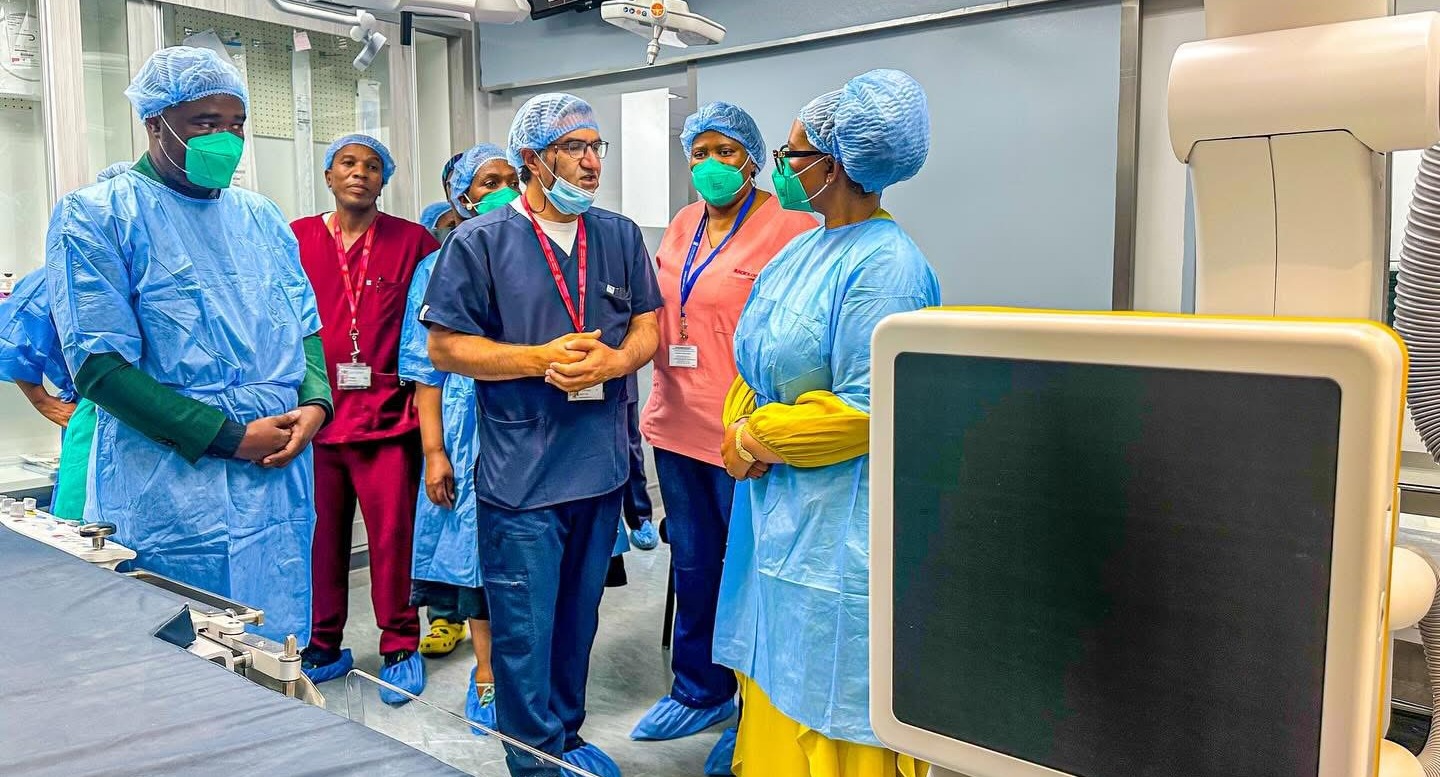
9 December 2025 MEC Nkomo-Ralehoko officially unveiled cutting-edge medical equipment and upgraded infrastructure at Dr George Mukhari Academic Hospital as part of ongoing efforts to modernise healthcare services and build a world-class health system.
/file/attachments/2986/IMG_2464_678000_5a5e099cfe41915d659c2c466d852556.jpg "New Technologically Advanced Medical equipment MRI Scans at Gauteng health facilities.")
The new additions include a heart-lung machine, a refurbished angiography suite, and a state-of-the-art angiogram machine. These advancements will significantly enhance the hospital’s capacity to deliver specialised cardiothoracic and vascular care, improve diagnostic precision, reduce waiting times, and elevate the overall quality of patient care.
In an era where technology drives medical advancements, the GDoH has prioritized equipping facilities with state-of-the-art tools and digital systems significantly closing diagnostic gaps.
Community-centric primary care: Reaching the vulnerable
With a R38.4 billion budget allocation for primary health care, MEC Nkomo-Ralehoko has emphasized maternal and child health. A new 13-bed high-risk maternal unit has been launched, while 14 mobile clinics have screened and vaccinated over 188,000 learners. HPV vaccination coverage stands at 88%, and deworming has reached more than 946,000 children.
Wellness programs in 108 township areas have engaged over 291,000 residents, and the "Corner 2 Corner" initiative has empowered 2.5 million youth with healthy habits. Thirty-seven centres for children with special needs distributed over 90,000 assistive devices last year, including paediatric wheelchairs and hearing aids. The Sihamba Kunye program in Tshwane supports the first 1,000 days of life, embodying her grassroots approach.
/file/attachments/2986/Picturesix_754333_a5d7172ceb8b2fdb5b13e6b4ce8cc826.jpg "Mobile Health Clinics teams up with Bayer South Africa to launch a mobile clinic.")
Primary healthcare remains the bedrock of the GDoH's budget, with R38.4 billion allocated to prioritize maternal and child health. A new 13-bed unit for high-risk maternal cases has been launched, while 14 mobile clinics have supported District School Health Teams, screening and vaccinating over 188,000 learners.
Tackling Cancer, mental health, and GBV
MEC Nkomo-Ralehoko has forged innovative partnerships for cancer care, referring around 500 patients to five private oncology facilities, with over 200 completing treatment. Gauteng's pioneering Treatment Time Guarantees (TTGs) for surgeries set maximum waiting times, a first in South Africa.
Mental health expansions include new facilities at Kopanong and Bertha Gxowa, adding beds to reach 549 total, alongside the Weskoppies Mental Health Museum and Tara Hospital's therapeutic garden. A R484.1 million commitment for 2025/26 will fund mobile clinics.
For Gender-Based Violence (GBV), 27 specialized facilities, including Thuthuzela Care Centres like Sinakekelwe at Thelle Mogoerane Regional Hospital, integrate medical, forensic, psychosocial, and legal services to support survivors and aid prosecutions.
/file/attachments/2986/Pictureseven_535024_0ea4d75b1955bf06924502b5e7f272a3.jpg "Mental Health A Growing Condition In Healthcare For South Africa.")
Combating HIV and TB: On the path to eradication
Progress toward UNAIDS targets is strong, with 95% testing and treatment initiation rates, and viral suppression nearing 80%. Youth infections have dropped to 0.89%, and infant PCR positivity to 0.29%. TB deaths fell to 6.5%, backed by a R5.4 billion allocation aiming to re-engage 326,346 in treatment and test 900,000 for TB.
The allocation supports consolidated HIV, TB, STI, and HPV programs, via a 1.1 million ART Treatment campaign.
Emergency and workforce enhancements: frontline strength
Over 5,000 community first responders have been trained, and the new Gauteng Scheduled Emergency Transport model ensures 87% of emergencies are handled within the golden hour.
Since April 2025, 2,389 appointments have bolstered the workforce, including 940 nursing graduates. The Siveze project has filled over 504 clinical positions and community service personnel, and absorbing 351 trained professionals. The Gauteng Department of Health Successfully placed nursing graduates from the Gauteng College of Nursing and the Siveze project verification campaign strengthened payroll integrity, enabling the filling of clinical positions across key disciplines. 18 CEO positions have been advertised to bolster leadership at strategic hospitals.
/file/attachments/2986/Pictureten_693070_2766d7bd6e199fad6c52e611aa56207d.jpg "Gauteng emergency rescue.")
Financial reforms and supply chain reliability
An 83% compliance with 30-day payments cleared R4.35 billion in debt. Medico-legal liabilities plummeted from R24.7 billion to R6.9 billion through innovative mediations. Essential medicines availability exceeds 95%, with clean audits for the supply depot, the Gauteng Department of Health has enjoyed sound financial management and compliance for the past three years under the MEC Nkomo-Ralehoko’s leadership.
Accruals reduced by 54% – R4.35 billion paid to suppliers within 30 days (83% compliance). Litigation liabilities plummeted from R24.7bn (2019/20) to R6.9bn through mediation and archiving 802 dormant claims.
This was achieved through a pilot mediation project, systematic archiving of 802 dormant claims (valued at R7.2 billion), and a proactive legal defence strategy. Successful mediation settlements totalled R34.2 million in late 2024. This model is now seen as a benchmark for other provinces.
Under MEC Nkomo-Ralehoko’s leadership the Gauteng Health Department is no longer a crisis headline – it’s a success story in motion. From “I serve with a smile” to R4.35bn paid in 30 days, her 18-month sprint has rebuilt trust, infrastructure, and hope. As Gauteng looks ahead, MEC Nkomo-Ralehoko's vision—rooted in equity and innovation—continues to inspire, turning challenges into triumphs for millions. DM
Author: Ntsako Fiona