




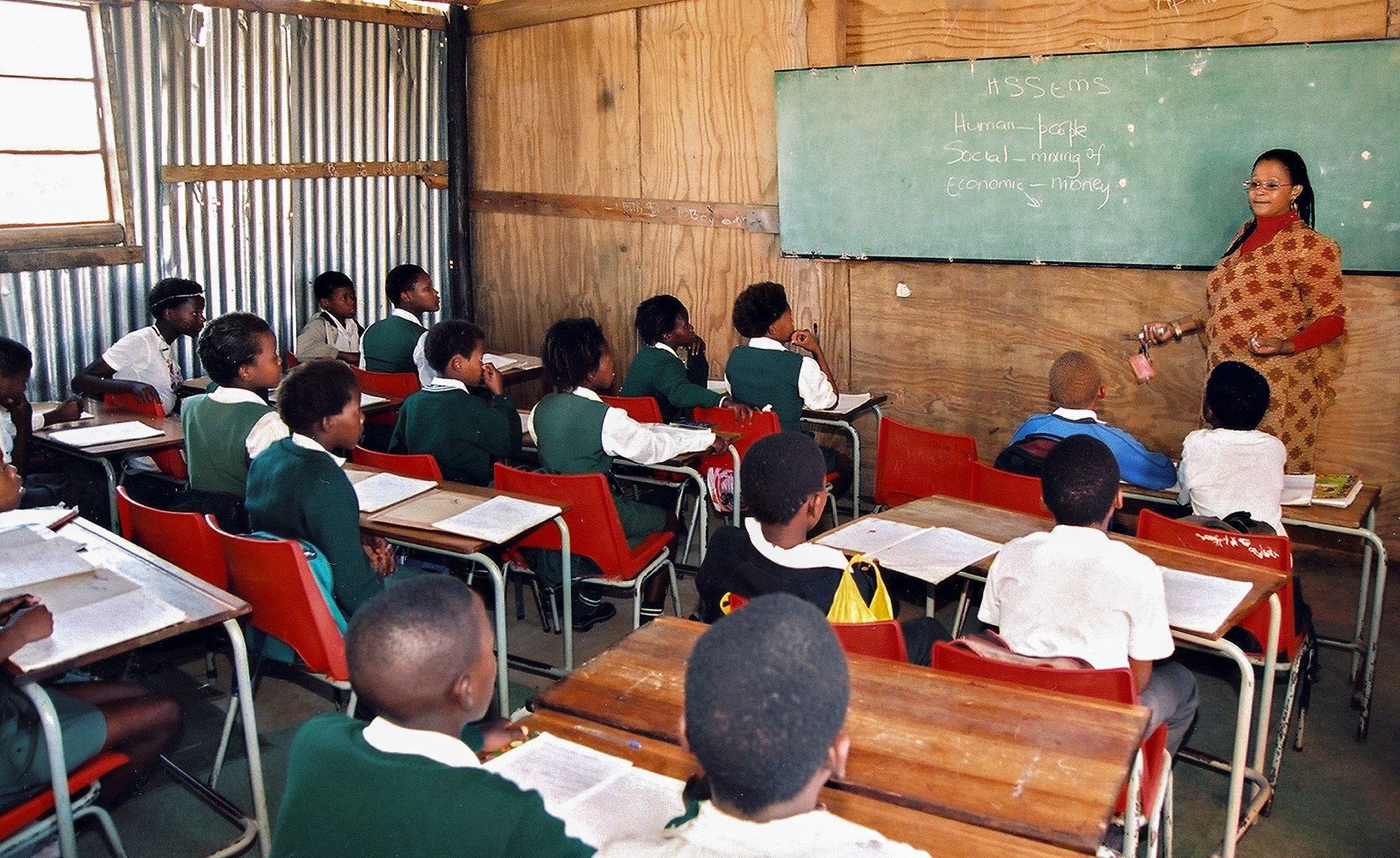
 Grade repetition significantly improves academic performance for struggling learners in South African schools, a new report has found. (Photo: Unknown)
 It is the outcome many parents fear and every economist warns against: a child being held back a year in school. In South Africa, grade repetition is a costly cog in the education machine, absorbing roughly 8% of the entire national education budget annually.
For years, international critics have argued that failing a learner is often demotivating and ineffective. However, a new report by Ros Clayton from Stellenbosch University’s Research on Socio-Economic Policy Group suggests that for South Africa’s struggling learners, repeating a grade might actually be the lifeline they desperately need.
The report dives into the massive “Data Driven Districts” dataset, covering almost all learners across six provinces (Eastern Cape, Gauteng, KwaZulu-Natal, Limpopo, Mpumalanga and North West) between 2017 and 2023.
Clayton used a regression discontinuity design, a sophisticated statistical method that compares learners just below the promotion threshold.
“Weaker learners tend to repeat, they tend to also do worse later, and we don’t know whether that’s due to the repetition or whether that’s due to the factors that cause them to repeat. This method overcomes that problem by looking at learners just below and just above the test promotion thresholds,” she explained.
“In South Africa, learners have to get certain marks in certain subjects to pass — like 50% in Home Language for grades 1 and 4. So we compare a learner who gets 49% and repeats to one who gets 50% and doesn’t repeat.”
Early-grade repetition delivers stark gains
The findings regarding early-grade remediation are stark. Learners who repeated Grade 1 saw their Home Language marks skyrocket by 18.3 percentage points in Grade 2 compared to peers who were promoted. While the advantage naturally settles as the child ages, the academic benefits remain statistically significant all the way through to Grade 4. The data shows that former Grade 1 repeaters retained a 9.5 percentage point advantage in Grade 3 and a 5.2 percentage point advantage in Grade 4.
The benefits also extend effectively to the Intermediate Phase. Students who repeated Grade 4 were found to be significantly better off than their promoted peers across all three measured subjects (Home Language, Mathematics and First Additional Language)
Specifically, a learner who repeated Grade 4 achieved Home Language scores 11.1 percentage points higher in Grade 5 than a peer who passed. While this immediate jump is smaller than the surge seen in Grade 1, the fade-out rate is much slower. By Grade 6, the advantage remained at 7.5 percentage points, and by Grade 7, the former repeater was still scoring 6.3 percentage points higher than a learner who was not held back.
/file/attachments/orphans/2025-12-1717_15_06-Greenshot_574933.jpg "(Graph: RESEP)")
Maturation powers the repetition dividend
The report identifies maturation as a critical mechanism behind the improved marks, suggesting the benefit stems from biological development as much as extra instruction time. Because repeating learners are a full year older when they retake the grade, they benefit from enhanced cognitive and non-cognitive development, such as improved focus and emotional regulation, which allows them to better grasp the curriculum.
The findings suggest that the initial failure often stems from a lack of developmental readiness rather than a lack of ability. Consequently, the report argues that enforcing stricter school-readiness policies, ensuring children are truly ready before entering Grade 1, could deliver these same maturity benefits upfront. This approach would avoid the financial cost and emotional stigma of failing a grade later, provided that delayed entrants still have access to alternative early learning opportunities and nutrition programmes.
Consistency across wealth and geographical lines
In a South African education landscape where interventions often struggle to gain traction in under-resourced environments, Clayton’s research found that the repetition dividend is consistent across all five school quintiles.
/file/attachments/orphans/2025-12-1717_22_28-Greenshot_816792.jpg "(Graph: RESEP)")
The analysis reveals that when the data are standardised to account for these vast differences in resources, the impact of repeating Grade 1 remains uniform. Whether a learner attends a Quintile 1 school in a rural village or a Quintile 5 school in a wealthy suburb, repeating the grade boosts their Grade 2 Home Language marks by approximately 1 standard deviation. This consistency persists as the child progresses; the advantage remains at roughly 0.6 standard deviations in Grade 3 and 0.3 standard deviations in Grade 4, irrespective of school quintile.
Geographically, the results for Grade 1 were “highly consistent’ across all six provinces studied.
Systemic risks outweigh individual wins
Despite these positive results for the individual child, Clayton offers a stark warning to policymakers not to increase repetition rates.
While holding a child back improves their individual marks, scaling this practice up would be disastrous for the system as a whole. Grade 1 classes in South Africa are already critically overcrowded. Increasing the number of repeaters would inflate these class sizes further, diluting the quality of teaching for everyone.
/file/dailymaverick/wp-content/uploads/first-day-hillcrest.jpg "Papers for grade ones to fill in at the end of their first day at school. (Photo: Karabo Mafolo)")
Clayton argues that without a massive budget injection to hire additional teachers, increasing repetition would overburden the system and likely negate the very learning gains the policy aims to achieve. The report also highlights critical blind spots that policymakers must consider. While marks improve in the medium term, the current administrative data cannot yet determine if repetition leads to higher dropout rates in high school.
Furthermore, there is a severe economic opportunity cost. Repeating a grade delays a young person’s entry into the workforce by a full year. This results in a year of lost future income for the learner and a year of lost productivity for the economy.
Finally, the study’s methodology creates a specific blind spot: it looks at learners who failed “just below” the pass mark. These findings may not apply to the “typical” repeater who fails by a wide margin.
Rather than defaulting to a costly extra year of school, Clayton suggests that policymakers use these results to audit other interventions. If alternative programmeIts, such as structured pedagogy or targeted language support, can deliver similar learning gains without the high price tag of a wasted year, they would represent a far better return on investment.
Until those alternatives are proven to match the repetition dividend, holding learners back remains a flawed, expensive, but undeniably effective tool in the South African classroom. DM