




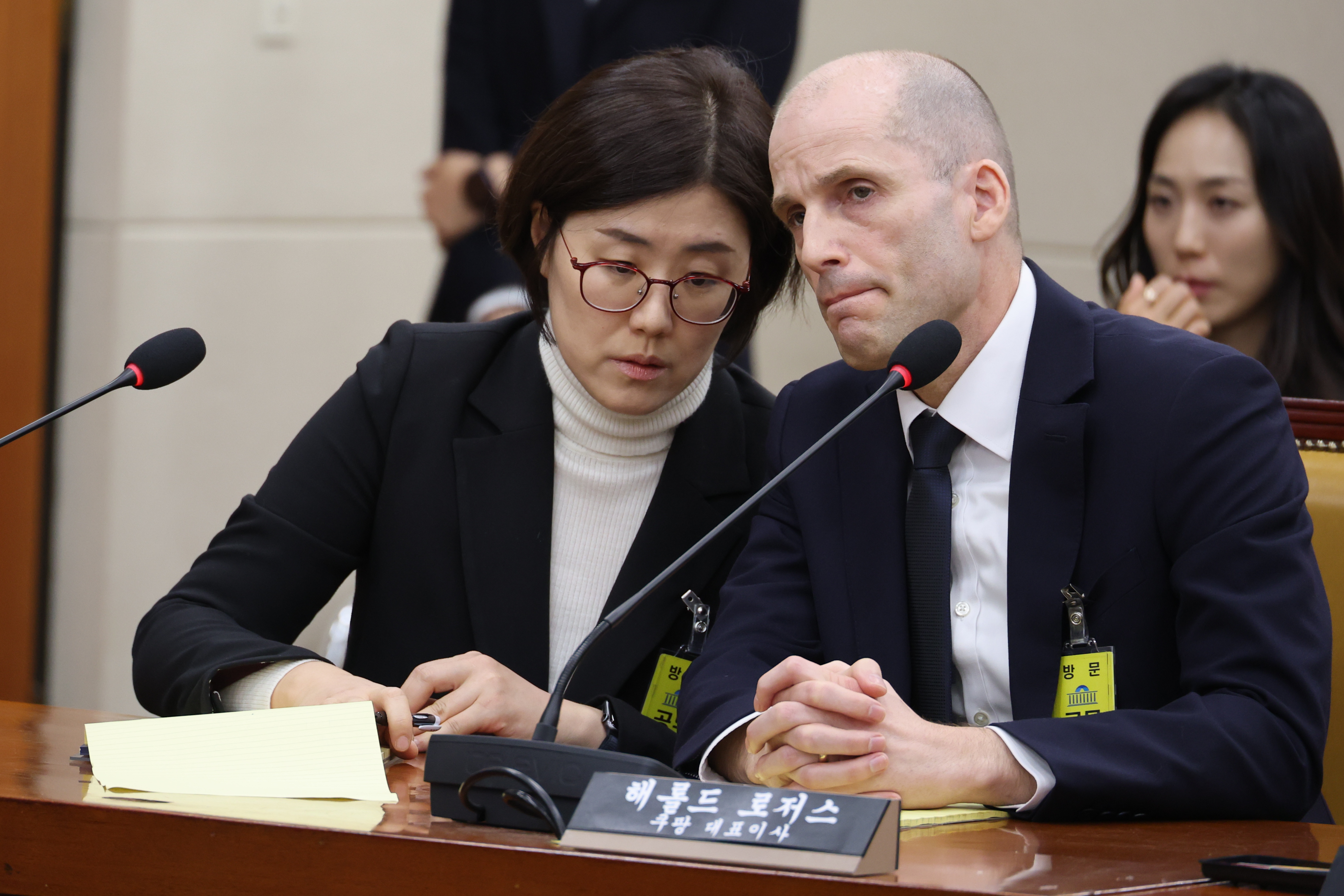
 Harold Rogers (R), interim chief of e-commerce giant Coupang Corp., talks with an interpreter during a plenary session of the science, ICT, broadcasting and communications committee at the National Assembly in Seoul, South Korea, 17 December 2025, to probe into the company's massive personal data breach. EPA/YONHAP SOUTH KOREA OUT
 Coupang Inc CEO and Chairman Bom Kim declined to attend, citing his overseas residence and commitments as head of a global company operating in more than 170 countries.
"Chairman Bom Kim's claim that he cannot attend because he is travelling abroad and is a global CEO is, in my view, an act that truly mocks the public and delivers despair to global investors," said lawmaker Choi Hyung-du.
"Even Meta's Mark Zuckerberg and Amazon's Jeff Bezos - heads of companies larger than Coupang - did not refuse to appear before Congress hearings," he said.
Lawmakers said they will be filing a complaint against Kim, accusing him of breaking a law that compels witnesses to attend hearings and make themselves available for investigations. Under the law, people can be fined or imprisoned for refusing testimony.
YELLING IN PARLIAMENT
Such was their anger that the lawmakers often shouted at Harold Rogers, the interim CEO of Coupang Corp - the company's South Korean unit, who was standing in for Kim. Rogers had to repeatedly request to be allowed to finish his answers.
"I'm in communication with our board of directors, including with our chairman," Rogers said, but added "I am the decision maker in Korea."
The personal data of more than 33 million Coupang customers was leaked in a breach believed to have started on June 24 through overseas servers, though the company did not learn of the problem until November 18.
Shares in New York-listed Coupang, which is roughly 17% owned by Japanese tech investment group SoftBank 9984.T, have slumped 17% since it revealed the breach at its South Korean unit late last month. The South Korean unit accounts for the vast majority of its revenue.
Rogers said that under U.S. SEC rules, the breach did not count as a material breach as the information leaked is not considered highly sensitive. It would not violate U.S. privacy law, he added.
The data included customers' names, home and email addresses, phone numbers as well as their purchase history.
A DOMINANT FIRM
Coupang dominates South Korea's e-commerce market, keeping rivals in check with its competitive prices and various benefits such as same-day delivery, video streaming and food delivery services. It has 24.7 million active users, nearly half of the country's population.
That dominant position is expected to help Coupang weather the negative publicity brought from the breach.
Coupang is "structurally advantaged in the Korean e-commerce market, effectively operating in a market with limited direct competition due to its scale, logistics integration, and consumer lock-in," Nomura analysts said in a note to clients this week.
The company is, however, likely to be hit with a hefty fine.
Under current South Korean law, companies that fail to implement adequate data protection measures can be fined up to 3% of revenue, which would translate to a penalty of more than 1 trillion won ($680 million) for Coupang.
In the wake of the breach, South Korean President Lee Jae Myung has called for increased penalties, and on Wednesday, lawmakers introduced a bill to raise fines to up to 10% of revenue for massive data breaches.
(Reporting by Hyunjoo Jin and Heekyong Yang; Editing by Ed Davies, Miyoung Kim and Edwina Gibbs)