




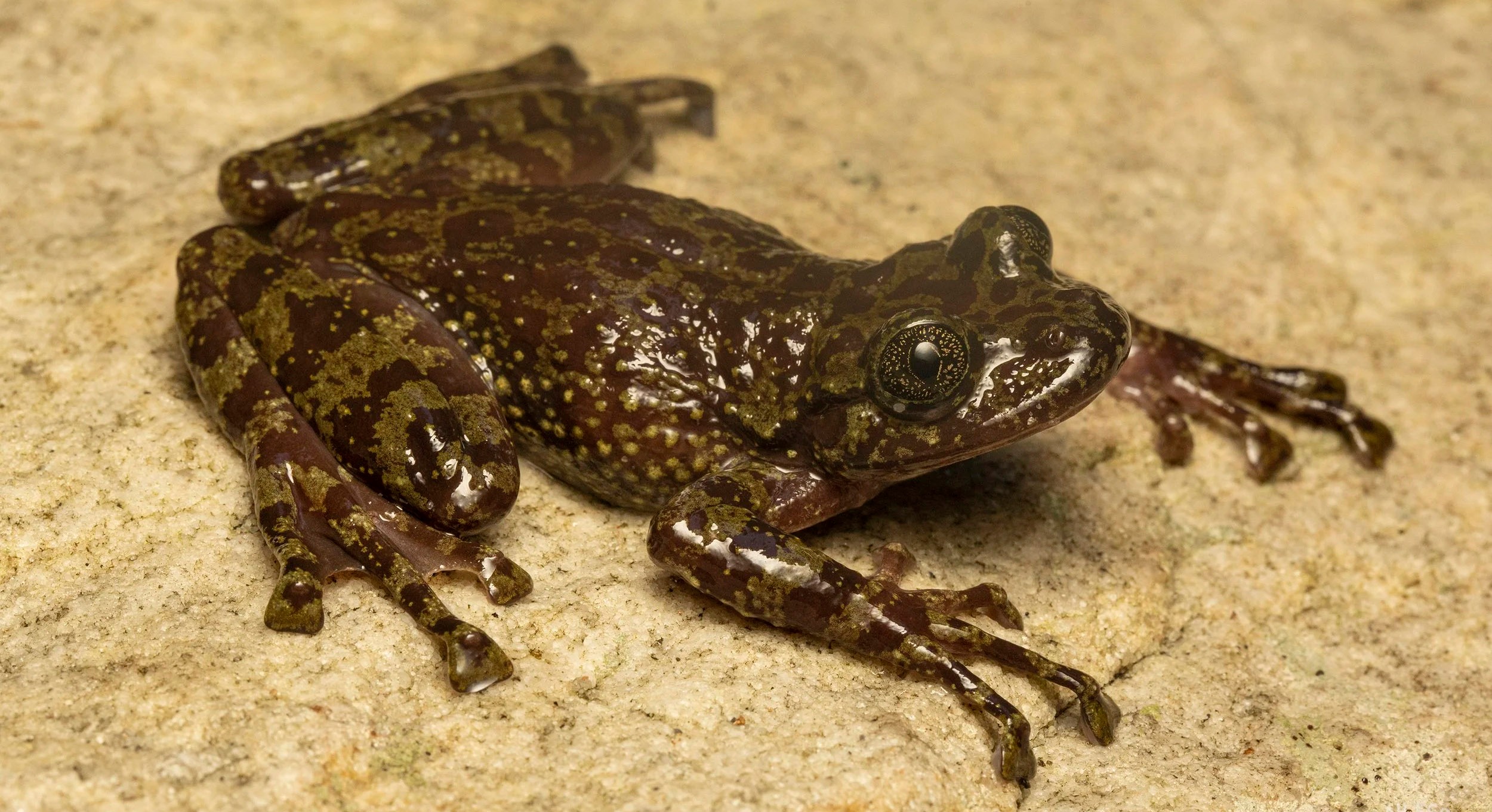
 The Table Mountain ghost frog. (Photo: Gary Kyle Nicolau)
 At the edge of a mountain stream is where conservation ecologist Joshua Weeber spends a lot of his time, scanning the moss-covered rocks for something most people have never heard of – a frog the size of a fingernail. It is not glamorous work, but it is vital.
Weeber works with the Threatened Endemic Species Unit in the Endangered Wildlife Trust (EWT). He is part of a group of researchers and conservationists who are pushing South Africa to think differently about wildlife protection. Rhinos, lions and elephants dominate fundraising drives, but their concern is for the quieter creatures – the amphibians, reptiles, moles and more whose disappearance would unravel the foundations of entire ecosystems.
Their work is slow, difficult and often underfunded. “The majority of amphibian and reptile species in South Africa ... we know very little about their biology and their distribution,” says Weeber.
This lack of spatial information means many cannot be officially listed as threatened, leaving them invisible in spatial plans, environmental assessments and conservation prioritisation.
The species are overlooked, even though they are a part of “fragile food webs”, says Dr Oliver Cowan, a conservation and data scientist at the EWT. If small, unstudied species vanish, “it can have huge ramifications further down the line”.
In recent years, there has been a focus on the conservation of some less charismatic species. This can be seen in the International Union for Conservation of Nature’s (IUCN) 2025 Save Our Species brief, as many of the programmes it researched and worked on focused on lesser-known species.
Canaries in the funder coal mine
Globally, conservation funding has long favoured large, charismatic animals. The imbalance is stark.
“The classic example: rhinos, tigers, lions – enigmatic species – get disproportionately large amounts of funding,” Weeber says. Meanwhile, reptiles and amphibians face neglect and active fear from the public.
Yet these species are “arguably as important to biodiversity as a whole and the way that the environment functions, as some of the larger species”.
Part of the challenge in securing funding is communicating why these small species matter. The metaphor Weeber uses is “canaries in the coal mine of the world”.
Small, endemic, range-restricted species, particularly amphibians, which are sensitive and occupy both aquatic and terrestrial ecosystems, are excellent indicators of environmental change.
“A lot of the work that we do is using these small species as proxies for broader ecosystem health,” Weeber says. If these species are disappearing at a very small scale, that’s indicative of a much bigger issue. The system as a whole is changing, and this is just the first species to go.”
/file/attachments/2985/P16Daniellesmallfive2_871054.jpg "A rough moss frog. Photo: Wikimedia Commons")
Knowing enough to make a ‘difference’
Beyond securing funding, another major challenge is simply knowing enough about these species to protect them. Many are classified as “data deficient” on the IUCN Red List, meaning scientists lack enough information to assess their conservation status correctly.
Cowan says global research shows that data-deficient species are likely disproportionately threatened, meaning most are probably under threat but can’t be protected because researchers don’t know enough about them.
Sometimes, conservation success hinges on something as simple as where people walk. On Table Mountain, for example, the Table Mountain ghost frog faces a key threat: erosion from human foot traffic as tourists cross streams without proper boardwalks or bridges.
This connection between public awareness and conservation outcomes is very important to both Cowan and Weeber. Cowan describes how tools like iNaturalist enable citizen science: anyone can upload photos of species they’ve seen for expert identification, generating valuable distribution data.
The long game
“Sometimes working in conservation feels like you’re arriving at an earthquake site with a dustpan and broom,” says Cowan, quoting a phrase that has stuck with him. “It feels like one person can’t do that much, but if everyone has their dustpans and brooms out, you can make a difference.”
Every species matters, regardless of size, says Weeber. “Look at the little rough frogs, toads and lizards.”
In South Africa’s conservation landscape, success should be measured in saving enigmatic species and frogs the size of fingernails, discovered in mountain seeps where few people venture. And that, Weeber argues, is what we all should realise.
Three tiny defenders worth knowing about
Table Mountain ghost frog (Heleophryne rosei)
Status: Moving from critically endangered to endangered, a disputed change.
Where: Endemic to Table Mountain, breeding in only six to seven perennial streams in the Western Cape.
Unique features: Adults have spatula-shaped discs on their fingers for climbing sheer rock cliffs. Tadpoles take at least 12 months to develop, far longer than most frogs.
Biggest threats: Human foot traffic causing stream erosion, damming and climate change impacts on water sources.
How you can help: Use designated boardwalks and bridges when hiking to avoid trampling through streams. And when a pathway is closed, use the detour route.
Conservation milestone: Intensive monitoring and habitat management have resulted in the species being downlisted from critically endangered to endangered.
Rough moss frog (Arthroleptella rugosa)
Status: Critically endangered.
Where: Klein Swartberg Mountain near Ladismith, Western Cape.
Unique features: About the size of a pinky nail. This species has no free-swimming tadpole stage – they lay eggs in moist moss and vegetation, where tadpoles develop into tiny frogs.
Biggest threats: Invasive pine trees drain water, alter fire regimes and choke out the native habitat.
How you can help: Support invasive alien vegetation clearing programmes and ensure your property has no invasive species.
Conservation milestone: There are Save Our Species-funded clearing operations and controlled burns to restore the frogs’ habitat.
/file/attachments/2984/a_pauw_tm_ghost_frog-1_608467_43bad7ea57656f18f28076c362ac3d10.jpg "Daniélle Schaafsma Lesser known species")
Moonlight mountain toadlet (Capensibufo selenophos)
Status: Endangered (formerly data deficient).
Where: Only four known populations exist in high elevation areas across the Cape Fold Belt in the Western Cape.
Unique features: The species was only recently assessed as endangered after targeted conservation research revealed how restricted and threatened it is.
Biggest threats: A combination of invasive plant species and disrupted fire regimes – both too-frequent fires and complete fire exclusion – destroy their habitat.
How you can help: Landowners can support biodiversity stewardship agreements to protect habitat on their land.
Conservation milestone: The Mount David Nature Reserve has just been declared specifically to protect this species, safeguarding one of its only four known populations, alongside many other threatened species. DM
This story first appeared in our weekly DM168 newspaper, available countrywide for R35.
/file/attachments/2985/DM-05122025-001_646584_373ba8718846ee4aec17b376c955d496.jpg)