




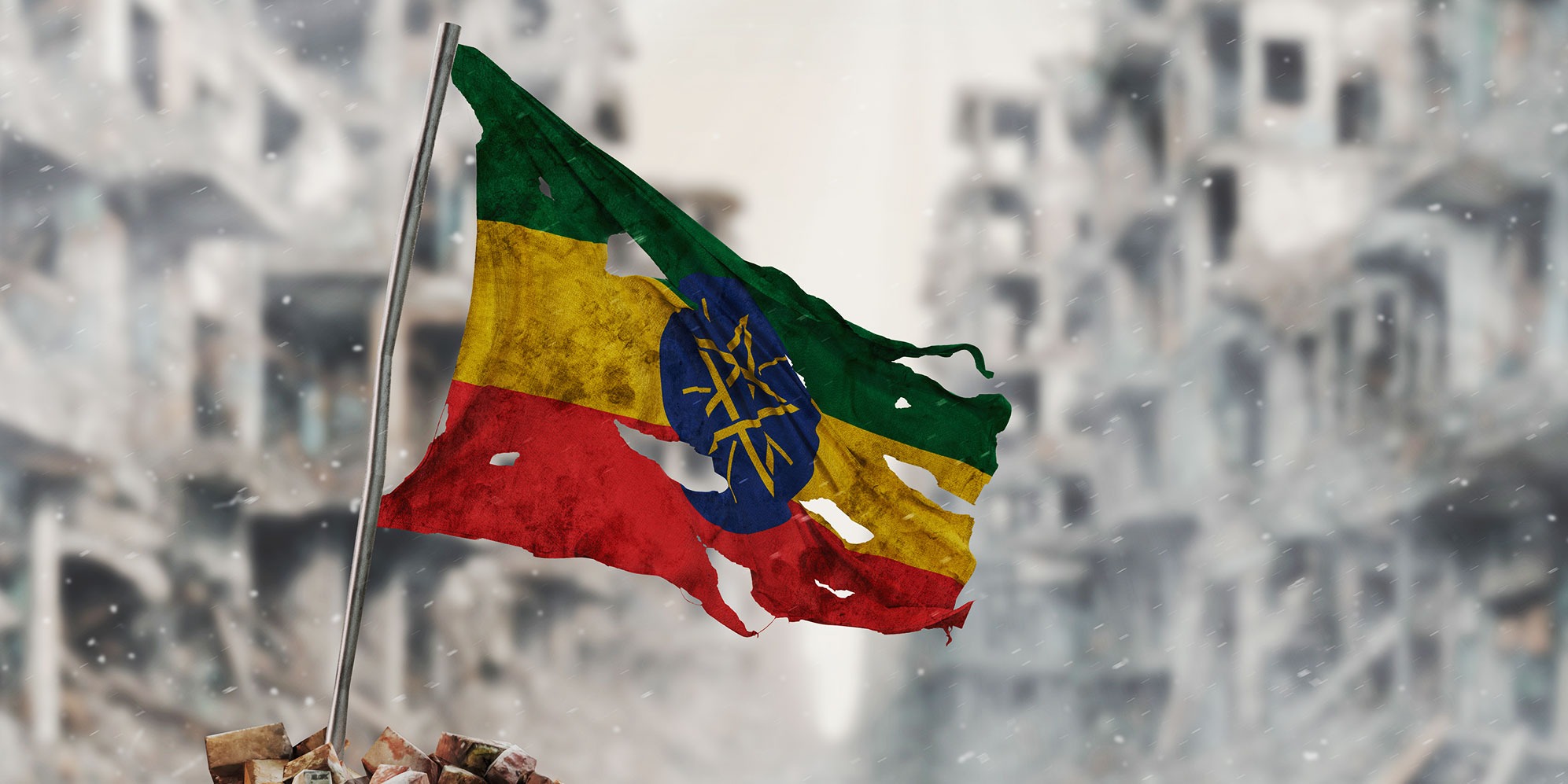
 Lessons from Abyssinia's history resonate today amid rising tensions and disregard for collective security.(Image: Istock)
 /file/dailymaverick/wp-content/uploads/2025/10/label-Op-Ed.jpg)
A grim anniversary passed this year almost unnoticed.
Ninety years ago, in October 1935, Fascist Italy invaded Abyssinia — one of only three African states, alongside Liberia and South Africa, to retain formal sovereignty after the imperial partition of the continent. What followed was not merely a colonial war. It was a decisive test of whether the international system created after World War 1 would defend its own rules when a powerful state violated them.
Abyssinia fought back with courage and endurance. Poorly armed, with almost no air force, its forces resisted for months against a modern European army. Italian aircraft bombed villages and troops at will. Mustard gas was sprayed from the air in flagrant violation of international law. Marcel Junod of the International Committee of the Red Cross later described thousands of men lying everywhere, their bodies burnt, crying out in agony.
When Addis Ababa fell, the violence escalated. Educated young men were rounded up and shot. After an attack on Italians in February 1937, Fascist Blackshirts in Addis were authorised to kill indiscriminately. Men, women and children were stabbed as they fled burning homes. Bodies were dumped into mass graves. At Debra Libanos monastery, 425 monks and deacons were executed.
This was the logical outcome of a system that spoke the language of law while practising the politics of power.
Britain and France — the guarantors of the League of Nations — condemned the invasion, then ensured that sanctions would fail. Oil was exempted. The Suez Canal remained open. Behind closed doors, they negotiated plans to reward Mussolini by carving up Abyssinia and granting him a colonial mandate over much of the country.
Emperor Haile Selassie fled Addis to make an impassioned address to the League of Nations in Geneva in June 1936, where he launched a scathing indictment on the international community. Collective security had been abandoned. Expediency had triumphed over principle. His warning — “It is us today. It will be you tomorrow” — was met with indifference, even ridicule. The destruction of an African state was seen as regrettable, but normal.
The fate of Abyssinia showed Nazi Germany and Imperial Japan that treaties would not be enforced if enforcement risked war; that democracies feared conflict more than dishonour; and that expansion could proceed step by step. Within months, China, Austria, Czechoslovakia and Poland were invaded, one by one. World War 2 did not begin in Africa — but its inevitability was established there.
Credibility test
That lesson matters now because we are again living through a credibility test of the international system — and once again, a great power has elevated an ideology around its racial identity, and black people are being made to feel they count less than others.
The liberal international order that emerged after 1945, shaped by the Atlantic Charter and the UN Charter, promised something radically different from the world of Abyssinia. It rejected spheres of influence and imperial carve-ups. It rested on a demanding premise: borders would not be changed by force, and aggression would be met with collective resistance. That order, imperfect and unevenly applied, nonetheless opened the door to African decolonisation and statehood.
Today, that premise is in retreat.
US President Donald Trump’s worldview makes this explicit. In his framing, international order rests on the rule of the “larger, richer, stronger.” Power — not law — determines outcomes. The world is divided into spheres of influence managed by great powers through deals, threats and transactions. Smaller states do not have rights; they have utility.
This is not a return to Cold War competition. As the political scientist Stacie Goddard has observed, Trump is not trying to defeat China or Russia. He seeks collusion, not competition — a modern “concert of powers” in which strongmen cooperate to manage the world above the heads of weaker states. Order is imposed, not negotiated; stability purchased, not guaranteed.
For Africa, this should sound chillingly familiar. It is the logic of Abyssinia updated for the 21st century: peace through partition, stability through extraction, diplomacy through coercion. The language has changed; the hierarchy has not.
Nowhere was this clearer than when Trump boasted, during what was meant to be the signing of a peace accord between the presidents of Rwanda and Democratic Republic of the Congo, that the United States was “getting … a lot of the mineral rights from the Congo”. The message was unmistakable: African conflict is not a humanitarian or security concern; it is an opportunity to secure resources, a pit to plunder from.
/file/dailymaverick/wp-content/uploads/2025/08/13153930.jpg "President Donald Trump with US, DRC and Rwandan officials following the signing of a peace agreement on 27 June. (Photo: Yuri Gripas / EPA)")
Impunity travels
And so collective security continues to erode. Gaza, Sudan and eastern DRC burn with little more than rhetorical outrage from the international community. These are treated as peripheral crises, unfortunate but containable. Yet Africa’s history teaches that impunity travels. What is tolerated in the periphery becomes precedent at the centre.
Ukraine is today’s global credibility test, just as Abyssinia was in 1935. The question is not only whether Ukraine survives, but whether conquest is normalised — whether borders can be changed by force and later ratified by fatigue, negotiation or surrender. Africans should care deeply about the answer, because we have seen this movie before.
Europe has begun to draw the lesson, too. In the face of Trump’s contemptuous treatment of his former allies, the transatlantic alliance is fraying. Germany is rearming on a scale unseen since World War 2. Poland speaks openly of hosting nuclear weapons. When collective security weakens, states re-enter a world of self-help, arms races and permanent insecurity.
Africa, lacking nuclear deterrents and shielded alliances, would be among the first to suffer.
The problem is lawlessness. As China’s foreign minister Wang Yi warned recently: “Imagine if every country prioritised itself above all else and placed blind faith in power and status — this world would regress to the law of the jungle, where smaller and weaker nations would bear the brunt of instability, and the international order and rules-based system would face severe disruption.”
The choice is not between US hegemony and Chinese dominance. It is between a world governed by rules — however imperfectly — and a world governed by deals among the strong.
Africa has lived in the latter world before. It was called Empire.
The first real Allied victory of World War 2 came not in Europe, but in Africa: the liberation of Addis Ababa in 1941 by largely African troops — South Africans, Nigerians, Ghanaians, Kenyans, Sudanese, Congolese and Ethiopian patriots — under British command. Out of that contradiction — a colonial empire fighting a fascist empire on behalf of the principle of self-determination — emerged the Atlantic Charter and, eventually, the global rejection of imperialism.
That history carries an obligation.
Haile Selassie warned what would happen if a strong nation could destroy a weak people with impunity. The world ignored him then. Africa should not ignore the warning now — especially when the language of “deals,” “spheres” and “might” has returned so openly to global politics, and when a headline in The New York Times’ opinion section on 16 December warns that Trump is putting us on the path to World War 3.
The lesson of Abyssinia is not that international order always fails. It is that when it does, Africa is rarely the last to feel it — but almost always the first. DM
Phillip van Niekerk is the managing partner of Calabar Consulting, a risk consulting company specialising in Africa. The views expressed are his own. He also publishes Africa Unscrambled on Substack.