




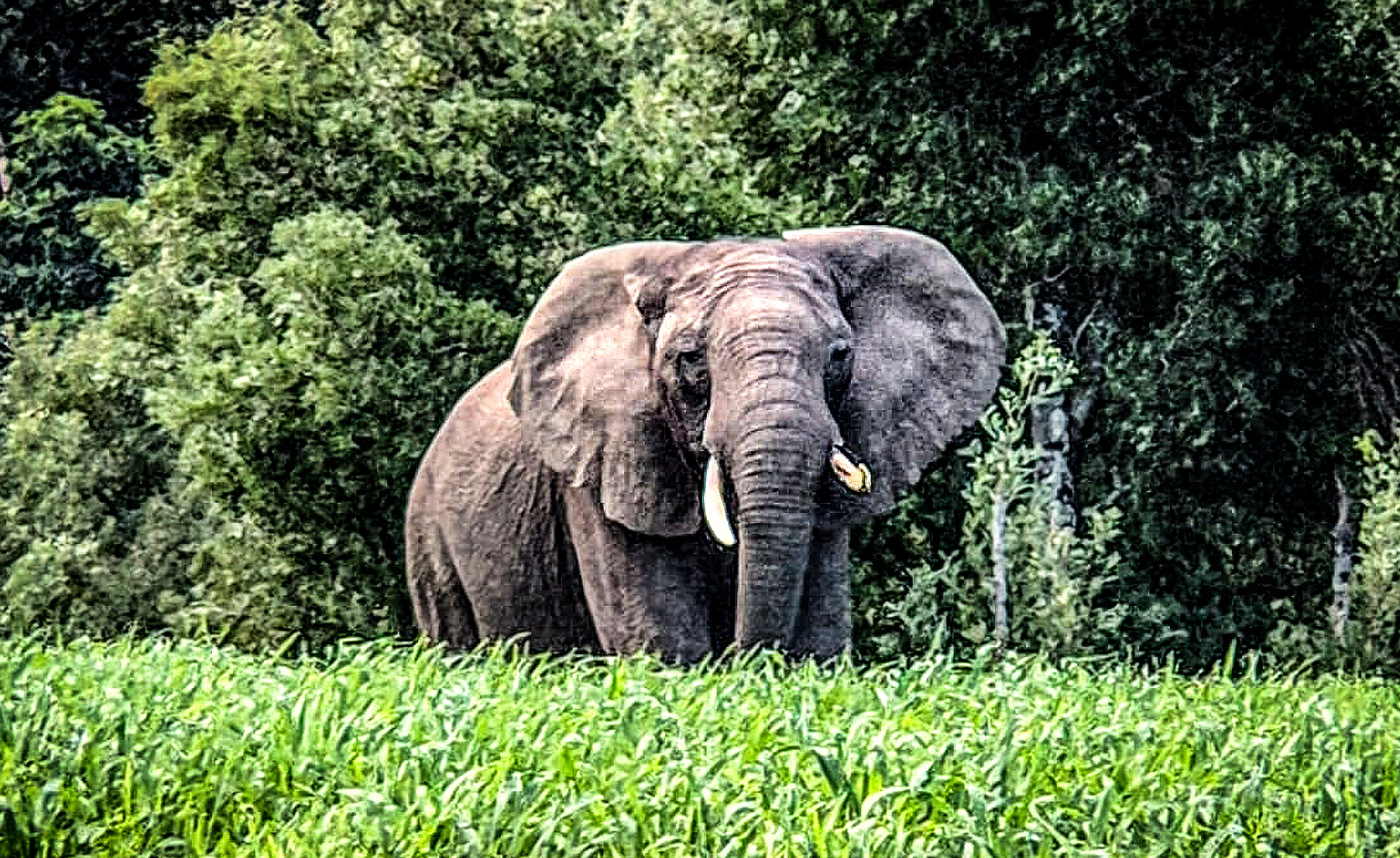
 Knysna’s last elephant, Strangefoot, who roams Knysna’s forest alone. (Photo: SANParks)
 Deep in the moss-slicked silence of the Knysna Forest is a single trail of huge footprints. They belong to Strangefoot – the last living member of what was once the world’s southernmost free-roaming elephant population.
She moves alone through the forest’s filtered green light, a living relic and a reminder of how quickly a landscape can lose its memory.
For years, conservationists, scientists and members of the public have asked a simple question: Does Strangefoot need companionship? And if so, why haven’t we acted?
It’s a question that has animated public meetings, stirred petitions and inspired one of the most comprehensive privately funded rewilding proposals the region has ever seen. And although that project has now formally been withdrawn, the story behind it remains one of passion, possibility and profound loss – but also one that continues to inspire.
A forest shaped by elephants
Elephants have been shaping Knysna’s dense Afrotemperate forests for millennia. They’re keystone species – engineers that open pathways, disperse seeds and maintain ecological structure. Without them, an ecosystem begins to shift.
A previous attempt to introduce three orphaned elephants failed. They came from a flat coastal area, were already traumatised and had no experience of browsing in a forest. They risked starvation and were relocated. That liaison was doomed, because Strangefoot had a young calf (who died in 2000) of her own to look after and would probably have chased the orphans away.
Without Strangefoot, the last remaining ecological thread to that long lineage may finally snap.
For Herd Instinct – a coalition of elephant specialists and wildlife advocates – the ethical argument is just as powerful as the ecological one. Elephants are deeply social, emotionally complex beings.
To allow Strangefoot to live out decades of isolation is, in their view, incompatible with any modern understanding of welfare or responsible conservation.
And they are not alone in this belief. Independent surveys conducted by market survey specialist Alan Powell found overwhelming public support for reintroducing a small group of companions to the forest. Friends of the Knysna Elephant measured it at 81% across demographic groups – an extraordinary consensus in a region where environmental decisions are often contested.
A family of three
The original rewilding proposal was both ambitious and pragmatic. Herd Instinct, with the Knysna Elephant Park making suitable elephants available, had identified three ideal, acclimatised elephants for release – individuals already familiar with the region’s vegetation, climate and social complexity. They were ready. The team was assembled. The funding – R5-million in private capital – was secured.
This project would be carried out at no cost to SANParks, and included a fully phased, scientifically rigorous integration plan: a SANParks-approved boma, veterinary assessments, daily guided acclimatisation, satellite tracking, cortisol-based stress monitoring and a gradual approach that allowed Strangefoot to interact entirely on her own terms.
“It is designed as a carefully managed pilot project, open to oversight, open to adaptation, and open to honest collaboration,” wrote Jarrett Joubert, conservationist and co-founder of Herd Instinct in his cover letter to SANParks.
Every line of the proposal echoed a core theme: Let us do this together.
A window that closed
But conservation does not operate in scientific time. It operates in bureaucratic time.
Years passed. Meetings were promised but seldom materialised. Correspondence thinned. No new ecological studies were published. No SANParks surveys were released. Documentation obtained via the Promotion of Access to Information Act revealed no evidence of active assessments on Strangefoot’s welfare or forest impacts.
Meanwhile, the elephants identified for rewilding could not wait indefinitely. They were eventually rewilded elsewhere – and they thrived.
Still committed, Herd Instinct amended the proposal this year, identified two new suitable elephants – a 36-year-old matriarch and her 12-year-old adolescent calf – and offered, once again, to carry the full operational cost at no burden to the state.
But by October 2025, after nearly three years of silence and stalled engagement, the organisation withdrew its offer entirely.
“The window has closed,” its withdrawal letter read. “The elephants have moved on and, so too, has the opportunity for SANParks to have played a defining role in one of South Africa’s most meaningful conservation efforts.”
Read more: Filmmaker captures breathtaking images of Knysna forest’s elusive elephant cow
Heartbreak and hope
To some, this is simply a story of bureaucratic inertia.
To others, it is a story of heartbreak – a project that could have changed the trajectory of a forest, a species and a single, ageing elephant whose only companions are her memories.
But Strangefoot’s story resonates because it is also a story about public will – and about the power of individuals and communities to keep pushing for a different future.
The residents of the Garden Route made themselves clear: they wanted elephants restored. They wanted their forest to feel whole again. They wanted the region to correct a historic wrong – the systematic killing of elephants through hunting and persecution, a violence that extinguished the herd long before conservation authorities existed.
“This population was not lost to nature,” Herd Instinct wrote. “To ignore this history is to share in its guilt. Complacency is no different from the hand that pulled the trigger.”
Yet even in their most pointed words, the tone is not one of bitterness, but of moral urgency – a plea to choose action over rhetoric.
What we stand to gain
Despite its withdrawal, the proposal left behind a roadmap – not just for Knysna, but for all small, isolated elephant populations across Africa. It demonstrated:
- That rewilding is possible, even with elephants raised in semi-captive conditions, when managed ethically and scientifically;
- That public support is overwhelming, cutting across demographics, municipalities and land-use interests;
- That collaboration between private and public sectors can work, and can do so at a fraction of what government-run projects typically cost;
- That even a lone elephant can be given a chance at social connection, dignity, and restored purpose; and
- Perhaps most importantly, that citizens, scientists and conservationists will not stop advocating for Strangefoot, even when institutional systems stall.
What happens now?
Strangefoot still moves through the forest.
She still follows the same ancient paths.
She still leaves her quiet imprint on the forest floor.
She still listens for voices that never answer.
Her presence is both a triumph – of survival against impossible odds – and a call to action.
Yes, the R5-million proposal is gone. The rewilding team has been redeployed. The donor elephants are thriving in a new habitat. But the conversation is alive, louder than ever, fuelled by years of public engagement, documentary evidence and a deepening sense of urgency.
In the words of Herd Instinct: “History will judge our choices.” And perhaps that is where the hope lies. Because history is not yet finished being written.
Strangefoot still walks the Knysna Forest. And as long as she walks, her story – and the possibility of renewal – continues to echo through every moss-softened corridor of green. DM