




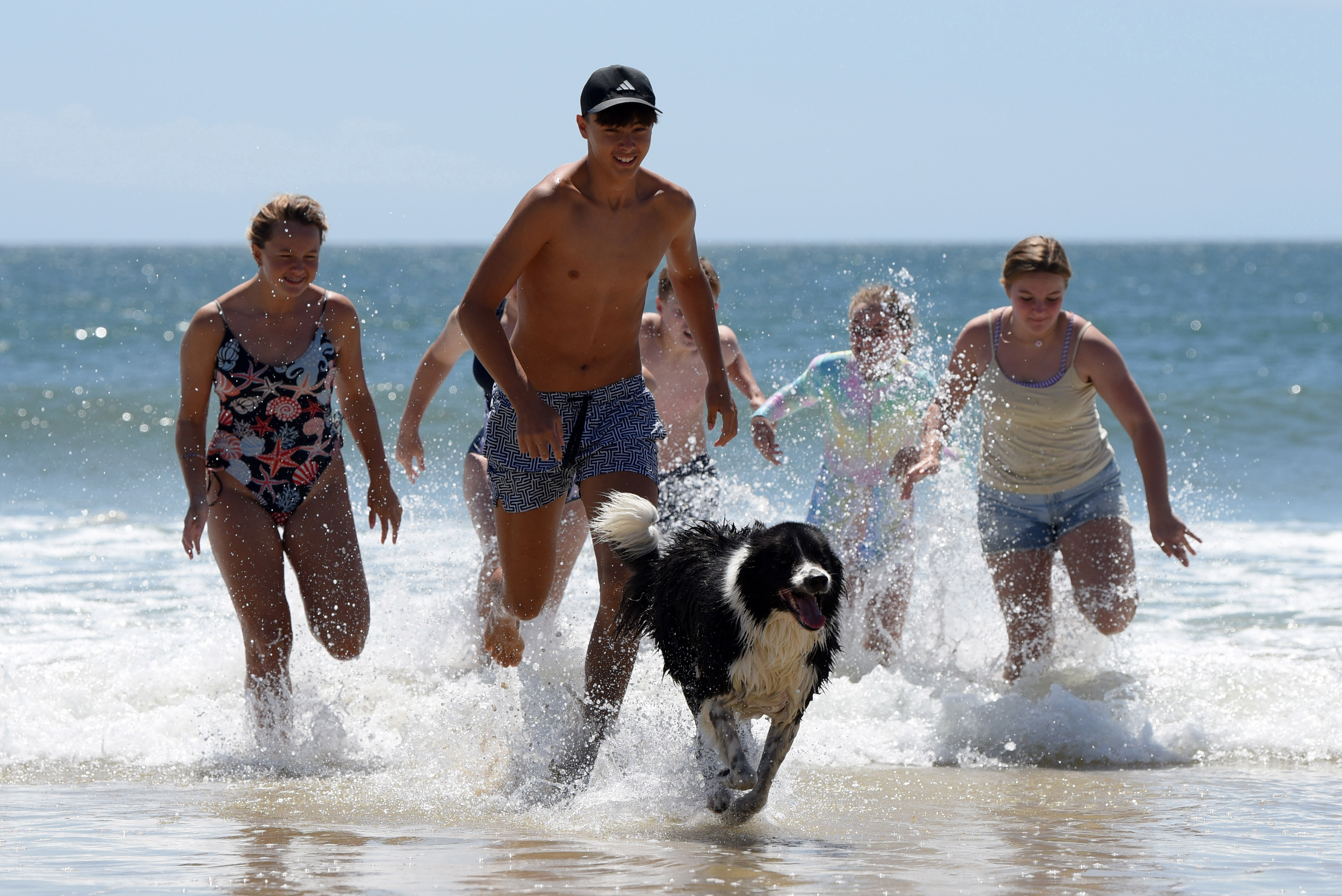
 Cayden Kingsley chases Oreo out of the surf of Kings Beach in Gqeberha (Photo: Deon Ferreria)
 As the summer months bring blue skies and soaring temperatures across the Northern and Western Cape, locals and tourists alike are flocking to the many picturesque beaches the coastline has to offer.
Municipalities are taking steps to ensure public safety during the festive season, including water quality testing and the deployment of lifeguards at recreational sites. Daily Maverick took a closer look at the state of beaches going into the holidays.
Western Cape
City of Cape Town beaches
/file/attachments/2985/CPT_Cliftonbeach_flag_935146_d82920353bed91f64ef95e0447032461.jpg "Clifton 4th, one of the City of Cape Town’s eight Blue Flag beaches. (Photo: Supplied)")
The Wildlife and Environment Society of South Africa (Wessa) awarded 27 beaches in the Western Cape full Blue Flag status for 2025/26.
Eight of these beaches fall in the City of Cape Town: Bikini Beach, Camps Bay Beach, Clifton 4th, Fish Hoek Beach, Llandudno Beach, Melkbosstrand, Muizenberg Beach and Silwerstroomstrand.
According to the City’s coastal water quality dashboard, all these beaches have received health-risk category ratings of “good” or “excellent” over the past 12 months of enterococci testing.
When it comes to coastal water testing, any E. coli readings above 500 CFU (colony forming units) per 100ml water or any enterococci readings above 185 CFU are considered unsafe because of the higher chance of acquiring gastroenteric illnesses.
Though the City tests for enterococci at its beaches, it does not test for E. coli as this type of testing is “not supported as an indicator in marine waters”, according to Zahid Badroodien, Cape Town mayoral committee member for water and sanitation.
Eddie Andrews, deputy mayor and mayoral committee member for spatial planning and environment, told Daily Maverick that the City had monitored all beaches and tidal pools throughout the year, with most beaches monitored weekly.
“We have been updating raw data and health risk categories online weekly, responding to reports of concern from the public, pre-emptively clearing blockages in sewer pipes throughout the year (before the busy summer period), and responding to overflows,” he said.
He noted that in the past year, 5,237 coastal water quality samples had been collected, averaging 22 a day. Of those, 282 (5%) had been above the threshold for acceptable enterococci levels.
At the time Daily Maverick sent the City questions on 3 December, the coastal water quality dashboard showed that the most recent enterococci readings at all beaches and tidal pools except one were below 185 CFU/100ml. The exception was Macassar Beach, which had a reading of 670.
Badroodien noted that Macassar Beach lay alongside the mouth of the Eerste River.
“Unfortunately, rivers accumulate pollution from a variety of sources,” he said.
Andrews said the water quality at Macassar was not “consistently poor”, as the site had only failed water quality tests twice in a six-month period as of 19 November.
According to the coastal water quality dashboard, the recreational nodes that received a “poor” health-risk category rating over the past 12 months included Lagoon Beach, Three Anchor Bay Beach, Barley Bay, Hout Bay Mariners Wharf, Hout Bay Chapmans Peak, Kalk Bay Harbour Beach, Sunrise Beach Parking Area, Ribbon Road Parking Area, Mnandi Beach, Monwabisi Beach, Macassar Beach and the Strand Pipe Surfing and Lifesaving Club areas.
/file/attachments/2985/MuizenbergBeach_657855_e714f2dc0ed2e770304df1378cb03015.jpg "Muizenberg Beach with its famous colourful bathing huts and mostly excellent water quality. (Photo: Supplied)")
“There are permanent warning signs at all beaches that have shown ‘poor’ water quality over the past 12 months,” said Andrews.
Daily Maverick visited Muizenberg Blue Flag beach, which attracts locals and tourists alike. One surfer, who has been visiting the beach for the past 20 years, said there had been cases of sewage entering the water over the past year, adding that there were often big, thick bubbles in the water.
Andrews told Daily Maverick that 186 water samples had been collected at Muizenberg this year, with only four exceeding enterococci guideline thresholds. The four failures occurred on 26 June and 7 August.
“These incidents coincided with significant rainfall,” said Andrews. “Since 1 October 2025, the city has been conducting daily sampling at two points along Muizenberg Beach, and none of the 86 samples taken during this period have exceeded the threshold for recreational use.”
The City advises people to avoid swimming in the ocean for 12 to 24 hours after moderate to heavy rainfall, as it increases the possibility of poor water quality when pollution is washed from land and overflowing sewers into the ocean. Beachgoers should also avoid swimming near the mouths of estuaries or in sheltered lagoons.
As part of its drowning prevention campaign, the City is deploying 340 beach lifeguards and 343 swimming pool lifeguards for the summer festive season, said Francine Higham, mayoral committee member for community services and health.
“Lifeguards will be on duty at 29 different beaches, tidal pools, stretches of coast and all public swimming pools between 10am and 6pm daily,” she said.
/file/attachments/orphans/WildernessBeach_433702.jpg "Wilderness Beach.
(Photo: Kiara Wales)")
/file/attachments/orphans/WildernessBeach1_267624.jpg "Wilderness Beach.
(Photo: Kiara Wales)")
/file/attachments/orphans/VictoriaBayBeach_731384.jpg "Victoria Bay Beach.
(Photo: Kiara Wales)")
/file/attachments/orphans/StruisbaaiBeach1_756978.jpg "Struisbaai Beach.
(Photo: Kiara Wales)")
/file/attachments/orphans/VictoriaBayBeach2_473148.jpg "Victoria Bay Beach.
(Photo: Kiara Wales)")
Overstrand Municipality
/file/dailymaverick/wp-content/uploads/2022/12/Angus-8GreatBeaches-new-03.jpeg "'Retief se Gat'. A Kleinmond rock pool - locals claim it was dynamited by a local resident who said the beach was too far from his house. (Photo: Angus Begg)")
The Overstrand Municipality has 16 bathing beaches, including two Blue Flag beaches – Grotto and Kleinmond – and three pilot status Blue Flag beaches: Castle Beach, Onrus, and Hawston.
Beaches with pilot Blue Flag status are those on their way to full certification.
The municipality only tests the water at its Blue Flag beaches. Testing records for these beaches from November this year show that none of them exceeded the acceptable threshold for E. coli or enterococci. Water testing will be conducted at least twice a month during the summer season.
There are 44 lifeguards across all local beaches, lagoons and pools, with additional guards available to relieve those on duty.
When Daily Maverick visited Hermanus, feedback from local residents and municipal officials suggested that all beaches from Grotto to Onrus were safe for swimming.
Local resident Alyssa Jonker said she swam at Grotto Beach every morning with confidence, but noted that she would not recommend doing the same at the Klein River lagoon.
Cape Agulhas Municipality
/file/dailymaverick/wp-content/uploads/Ilana10.jpg "A busy fishing day at Struisbaai, one of the hubs of the Abalobi small-scale fishing initiative. (Photo: Supplied)")
The Cape Agulhas Municipality has one Blue Flag beach at Struisbaai. Other bathing beaches in the area lie at Agulhas, Arniston and Suiderstrand.
The municipality said that it does not do water testing at its beaches, but has deployed lifeguards, law enforcement and police patrols to ensure safety during the season.
A total of 14 lifeguards have been deployed across local beaches and tidal pools.
In this small fishing-village-turned-holiday-destination, locals have a lot to say about water quality. Local fishermen say that fishing has been down significantly this year compared with 2024, although they’re not sure who, or what, to attribute this to.
However, a new species – Agulhas redfin – has just been discovered, meaning water quality in the greater area of Die Mond is being closely monitored in the interests of breeding programmes.
Hessequa Municipality
/file/attachments/2985/WC_signage_Lapiesbaai_822913_250f3aa14379c2d0c2c120ea3bd6cb96.jpg "The Blue Flag flies proudly at Lappiesbaai. (Photo: Supplied)")
Wessa awarded Blue Flag status to six beaches in Hessequa Municipality: Lappiesbaai, Gouritzmond, Stilbaai-Wes, Witsand, Jongensfontein and Preekstoel.
Water quality testing at these beaches from late November showed that none exceeded the threshold for E. coli or enterococci. The municipality conducts testing every two weeks.
Lifeguard and security services are available at each beach daily. A total of 36 National Sea Rescue Institute lifeguards are deployed across the beaches for the season.
Locals from around Lappiesbaai Beach had few complaints, telling Daily Maverick they felt safe to swim, bodyboard and fish.
/file/attachments/orphans/Stillbaybeach1_537985.jpg "Still Bay Beach. (Photo: Kiara Wales)")
Mossel Bay Municipality
/file/attachments/2985/hartenbos2_199443_fbc6210f40957df0585180ef0feda569.jpeg "Hartenbos Beach in Mossel Bay. (Photo:<br>Kiara Wales)")
Kiara Wales)
The Mossel Bay beaches that received Blue Flag status from Wessa are De Bakke, Glentana, Hartenbos and Kleinbrak.
Santos Beach, Suiderkruis and Tweekuilen received pilot Blue Flag status.
Water testing will be conducted weekly during Blue Flag season.
The municipality noted that all its 23 beaches were open for recreational use during the summer months. At the peak of the season, 103 lifeguards will be on duty.
George Municipality
/file/attachments/2985/wildernessbeach_508142_5db9804478291e7dc14fca3ae63008d8.jpg "Wilderness Beach. (Photo: Kiara Wales)")
George Municipality has three Wessa-approved Blue Flag beaches – Herold’s Bay, Victoria Bay Beach and Wilderness – and one Pilot Blue Flag site, Leentjiesklip.
As of 26 November, water quality readings at Victoria Bay Beach and Wilderness Beach showed they did not exceed the threshold for E. coli or enterococci levels.
Lifeguards at Wilderness Beach reported that water testing was conducted on a daily basis. Locals said they were happy to swim, bodyboard, surf and fish.
They added that the municipality had actively engaged with local groups to organise clean-ups year-round.
Knysna Municipality
/file/attachments/2985/kynsna_224349_cb7eb04e83e73bbbbd597300aa60c59f.jpg "Knysna. (Photo: Kiara Wales)")
A water quality update published by the Knysna Municipality on 20 November showed that only one testing site, Costa Sarda, had problematic readings, with E. coli levels of 1,130. This is an estuary recreation point across from the residential spot Thesen Island.
Although Knysna residents said they continue to swim, chiefly at Leisure Isle, they expressed worries about how water shortages would affect tourism. Water restrictions in town have just reached Level 4.
/file/attachments/orphans/KnysnaBeach1_164669.jpg "Knysna Beach.
(Photo: Kiara Wales)")
Bitou Municipality
/file/attachments/2985/plettenbergbay_973630_f98a6f242302c0ad1ec5fa356dd380fc.jpg "Robberg Beach at Plettenberg Bay. (Photo: Kiara Wales)")
Six beaches in Bitou Municipality were awarded Blue Flag status: Robberg V, the Dunes, the Waves, Singing Kettle, Nature’s Valley and Lookout Beach.
The latest water quality readings from the municipality indicated that local beaches did not exceed the threshold for either E. coli or enterococci.
Residents from around Robberg Beach in Plettenberg Bay said they were happy with the water quality.
Bergrivier Municipality
Bergrivier Municipality told Daily Maverick that its “coastline is natural and unpolluted”. Although the municipality does not conduct tests for water quality, it is not aware of any beaches with poor water quality in the area.
The National Sea Rescue Institute provides lifeguards during the festive season, and a total of 11 lifeguards will be on duty.
Swartland Municipality
There are no closed beaches in the Swartland area, according to the Swartland Municipality. The area has one major beach in Yzerfontein, as well as several other smaller beaches mostly used by surfers and anglers. E. coli is tested for at random intervals, and the “results have never indicated any E. coli pollution or cause for concern”, said the municipality.
During the festive season, two lifeguards are on duty at the main swimming beach in Yzerfontein every day between 7am and 6pm.
Saldanha Bay Municipality
Saldanha Bay has five main beaches that are suitable for bathing and none of them will be closed, according to the municipality.
It will appoint 16 to 20 lifeguards and spread them across five beach areas: Saldanha Hoedjiesbaai, the beach areas adjacent to the Saldanha Resort and at the Leentjiesklip Resort, Paternoster and Laingville.
Matzikama Municipality
In early 2025, an oil spill affected the Strandfontein and Doringbaai coastlines. Daily Maverick tried to contact the Matzikama Municipality, which oversees the areas, to find out whether the beaches were now considered safe, but no response was received by the time of publication.
Cederberg Municipality
Daily Maverick contacted the Cederberg Municipality, but did not receive a response by the time of publication. Elands Bay and Lamberts Bay fall under this municipality.
Northern Cape
Kamiesberg and Richtersveld local municipalities
No publicly available data was found on the state of water quality at beaches in these areas. Furthermore, municipal officials in Kamiesberg and Richtersveld did not respond to questions.
McDougalls Bay Beach, a few kilometres from Port Nolloth on the Northern Cape coast, is a pilot status Blue Flag beach.
Nama Khoi Municipality
/file/dailymaverick/wp-content/uploads/2024/11/towns-5-2.jpg "Waiting for better days: diamond-diving boat at Kleinzee. (Photo: Chris Marais)")
Kleinzee beach is the only bathing beach under Nama Khoi’s jurisdiction and open to the public. Refilwe Sebela, acting municipal manager, told Daily Maverick that Kleinzee-specific water quality results were not yet available as monitoring systems were still being established.
To ensure public safety, lifeguards are seasonally contracted in December and January, with two to three typically deployed at Kleinzee, according to Sebela.
Durban stats play hide-and-seek
/file/attachments/2985/Durbanbeach1BathersgtakeadipatteUshakabeachonDecember5imagetonycarnie_557390_55c8116f2ac5ebba8d660cb7a8bffaad.jpg "As the holiday season begins, bathers take a dip on Durban’s South Beach. (Photo: Tony Carnie)")
KwaZulu-Natal has some of the best swimming beaches in the country – now boasting a dozen Blue Flag beaches. Yet the province’s biggest summer holiday city – Durban – still does not have a single Blue Flag flying, and is also struggling to comply consistently with South Africa’s seawater quality guidelines.
Officially, Durban says all 23 of its designated swimming beaches are “safe”, based on tests for E. coli sewage bacteria by the eThekwini municipality in late November.
Independent tests at a limited number of local beaches by Talbot Laboratories and the Durban University of Technology’s water and wastewater institute have suggested a steady improvement off Durban over the past three years – but they still reveal patchy or very poor results at certain beaches.
A separate investigation by Daily Maverick also shows that Durban’s beaches are not as squeaky-clean as the city has claimed in a flurry of pre-holiday notices designed to restore its tattered reputation following numerous beach closures after the KwaZulu-Natal floods in early 2022.
Now, stung by inconvenient media reports that at least 15 Durban beach areas were not compliant with the city’s own (and national) safety guidelines in late November, eThekwini mayor Cyril Xaba and other officials have resorted to labelling these reports “fake news”, “disinformation” or “ongoing smear campaigns aimed at discouraging tourists from visiting Durban”.
Curiously, a city information portal (beachwater.durban.gov.za) disappeared from public view for at least 24 hours last week, the day after The Citizen and The Witness published some of the poor E. coli and enterococci readings. When the portal returned to public view the next day, at least nine beaches showed significantly lower E. coli readings, along with new test dates.
For example, the portal recorded E. coli levels of 3,784 CFU (colony forming units) at Umhlanga Lighthouse on 25 November (dropping to 332 the next day); 2,178 at Umhlanga main beach (dropping to 209); 1,374 at Umhlanga Bronze beach (dropping to 529); 1,904 at Granny’s Pool (dropping to 496); 571 at Umdloti main beach on 25 November (dropping to 31 two days later); 638 at Umdloti South (dropping to 86 a day later); 909 at Westbrook (dropping to 41 a day later) and 24,196 at La Mercy (dropping to 2,310 a day later).
All these beaches also had enterococci readings exceeding the national guideline (but these results were not modified). Although such dramatic decreases in a short time may be plausible due to the rapid die-off of E. coli in sunlight and salt water, they nevertheless suggest that eThekwini was anxious to cherry-pick the most favourable test numbers for public consumption ahead of the Christmas holidays.
For comparison, SA national guidelines recommend that both E. coli and enterococci be sampled, specifying that any E. coli readings above 500 cfu and any enterococci readings above 185 cfu are unacceptable because of increased risks of gastrointestinal illness. Blue Flag beaches have even stricter standards, specifying a limit of 250 for E. coli and 100 for enterococci.
When media reports contradicted the city’s clean beaches narrative, the reaction from Durban City Hall was immediate, with the communications department posting screenshots of the Citizen and Witness headlines on its Facebook and media Whatsapp group proclaiming the reports to be “Fake News!”
However, because the sewage bacteria readings in the news reports corresponded exactly with those of the city’s beachwater portal, Daily Maverick asked it to explain the exact basis for its “fake news” claims. eThekwini communication staff did not specify which figures were challenged – but instead supplied brief summary tables of
E. coli readings at 23 city beaches.
Significantly, these summary tables exclude all enterococci levels at the 23 swimming beaches and 20 other beach recreation sampling areas between Umkomaas in the south and Westbrook in the north.
Now the city has posted “approved” results on its main website (www.durban.gov.za) and claimed that the beachwater.durban.gov.za portal is not “official”.
But in follow-up questions, Daily Maverick pointed out that we had taken time-stamped screenshots from the “unofficial” beachwater.durban.gov.za portal shortly before it went down on 2 December as well as the modified readings recorded after the portal reappeared on 3 December.
We asked if the city was suggesting that this “unofficial” portal was a “fake” website. We also asked why the city’s authorised summary tables contain no enterococci data.
How could the city assure residents and visitors that all 23 swimming beaches were safe when the “unofficial” portal also recorded several enterococci readings that exceed national guidelines at both swimming beaches and the other 20 monitoring sites?
The “unofficial” portal for residents and visitors has been in use for several years without any evident contestation from the city. It was also officially listed by the World Health Organisation in 2021 as a site where bathers could obtain online information on beach water quality in Durban.
/file/attachments/2985/Durbanbeach2EthekwinimayorCyrilXabacentreinsuittourstheDurbanpaddlingpoolsImageEthekwiniMunicipality_288294_5983fbb0ea63a9c8eca2b03c9c162b74.jpeg "Mayor Cyril Xaba (centre, in suit) tours the Durban paddling pools. (Photo: eThekwini Municipality)")
The site previously disappeared from public view in October 2022, at a time when Daily Maverick was investigating discrepancies between E.coli results posted on the portal and results displayed on public noticeboards at the Durban beachfront.
Oddly, after Daily Maverick’s recent queries, the city has now reported the “so-called” beach portal to its Information Technology Directorate as well as the Legal and Compliance Directorate.
“Additionally, the matter will be escalated to the City Integrity and Investigations Directorate for a forensic investigation.
“We want to clearly state that we are unable to provide further details regarding the authenticity of the ‘so-called’ eThekwini beach water portal … or the circumstances under which the site mysteriously went offline and subsequently returned online according to your observation,” the city said.
Responding to further questions on why it appeared to be focusing on E. coli alone at 23 swimming beaches rather than disclosing both E. coli and enterococci results at all 43 Durban beach monitoring sites, a spokesperson said data from all monitoring points helped tracing teams to narrow down sources of potential pollution.
“E. coli is the preferred indicator organism as its results become available within 18 to 22 hours after the incubation period. It is also a reliable indicator of faecal contamination of recent origin, enabling the city to respond swiftly. Based on the most recent consolidated assessments, and in accordance with national guidelines, all 23 swimming beaches have met the required E. coli standards,” the spokesperson said.
/file/attachments/2985/KZN_TrafalgarBeach-crowdonbeachlifeguardflags_119879_70100d05b529a9bd7bb0000a1ba5c4ac.jpeg "Beachgoers enjoy great weather at Trafalgar Beach in the Ray Nkonyeni Municipality (formerly the Hibiscus Coast), which has seven Blue Flag beaches. (Photo: Supplied)")
Elsewhere on the KZN coast, four municipalities are managing to comply with the stringent Blue Flag quality criteria. The Ray Nkonyeni Municipality (formerly the Hibiscus Coast) has seven Blue Flags (and two pilot status flags). Also on the South Coast, the Umdoni municipality has one Blue Flag (at Pennington) and four pilot beaches.
On the North Coast, the KwaDukuza municipality has four flags (Blythedale Beach, Salt Rock Main Beach, Thompson Bay Beach and Willard Beach), and the Mandeni municipality has two pilot flags.
On 10 December, the municipality announced the temporary closure of Umhlanga’s Main and Bronze beaches after a sewage pump failure.
Sunseekers flock to Eastern Cape beaches as pollution eases up
/file/attachments/2985/EC_beachumbrellas_Hobie_Beach_971405_ba135f3899e6898f78fc5fbefd8d33b9.jpg "Beach umbrellas on Hobie Beach. (Photo: Supplied)")
Over the coming weeks, thousands of people are expected to flock to the Eastern Cape coastline to enjoy its beautiful sandy beaches and throw themselves into the ocean to cool off in the summer heat.
Water samples taken at Nelson Mandela Bay’s most popular beaches showed most locations are within the parameters set for Blue Flag status, and they are safe for swimming. Although the figures to confirm the status of other beaches around the province are not readily available, locals believe visitors would be safe in their waters.
For the past four months, ASC Consultants, a private firm specialising in public health and food safety, has conducted tests on water samples taken from seven beaches in Nelson Mandela Bay.
ASC’s Onele Kutu, part of the team conducting the study, explained that this was the third year running that they had conducted it.
They visited Humewood, Hobie, Kings, Maitlands, Brighton, St Georges and Bluewater Bay, and took samples in July, September, October and November.
Samples were taken to a local medical laboratory where tests were done to determine the levels of E. coli and faecal streptococci — bacteria often found in raw sewage.
In other words — how much poo is in the ocean?
For Blue Flag status, E. coli should be less than 250 CFU per 100 ml (Colony Forming Units per 100 millilitres), while faecal streptococci should be less than 100 CFU.
“Initial testing showed nothing out of the ordinary. Levels were very similar to previous years with most beaches well below the margins, while Brighton Beach was over acceptable levels — in line with recent reports of infrastructure issues leading to large-scale sewage spills,” Kutu said.
However, later results showed both concerning and encouraging results.
Between September and October, both contaminants spiked at Brighton, climbing from 400 units to more than 24,000 units. However, these results declined drastically the following month, with E. coli dropping to only 80, and faecal streptococci to 154.
On the opposite side of the spectrum, Humewood’s E. coli reading went from 52 in July to 789 in September. In October it dropped to zero, but shot up to 341 in November.
Kutu said these sudden drops and increases prompted the team to conduct a fifth round of testing at these two sites.
At the start of December, Brighton’s levels had dropped within Blue Flag parameters. However, Humewood had spiked, with faecal streptococci more than four times over the Blue Flag limit, and E. coli more than 10 times over.
Kutu explained that ASC is an independent firm and its testing would not inform the official decision on a beach’s Blue Flag status, but the results are available to inform the public.
Sean Tappan, councillor for Ward 2, which includes several public beaches, said he was not aware of ASC’s test results, but said there could be a reason for the figures at Humewood.
/file/attachments/orphans/DSC_3898copy_243632.jpg "Bluewater Bay did not make the cut as a Blue Flag beach this year, but will remain a popular destination for those trying to escape the crowds flocking to Gqeberha's main swimming beaches. (Photo: Deon Ferreira)")
He said a sewage spill in Happy Valley, a park next to the beach, has on occasion spilled into the stormwater system that leads to the ocean near the Bayworld complex, and could cause contamination at the enclosed Humewood Beach.
“It was reported to the municipality, but they had trouble accessing the location due to overgrowth. A path has since been cleared and the issue identified, but we are still awaiting feedback on when it will receive attention,” Tappan said.
On a more encouraging note, he said Kings Beach, which has been the site of several sewage spills in recent months because of failing infrastructure, has been clean for some time.
Despite lingering fears of contamination among local residents, the metro's prime beaches were bustling under the summer sun this week. Across the city’s Blue Flag beaches — Kings Beach, Humewood and Hobie — large crowds of bathers, surfers and families turned out in droves to enjoy the ocean.
Chris Smailes (24), a regular beach visitor, said he was disturbed to hear about past sewage spills.
“I know of the sewage spill at Kings Beach. That’s never a good thing to hear. I know of a few people that had ear infections from that.
“Being a diver, it is important to know that the water that I dive in [is clean]. Thankfully, I have not got sick.”
A stone’s throw down the coast, avid fisherman Dieter Colyn (43) frequents the banks of the Swartkops River mouth in Bluewater Bay.
But his long-standing pleasure is marred by what he describes as a pervasive pollution problem, particularly upstream.
“I have been fishing here along the Swartkops River and near the river mouth for 10 or so years now, and we have fished the entire length of the river up to Redhouse, and that is where the sewage is the worst,” Colyn said, painting a grim picture of neglect affecting areas downstream.
“There, garbage and sewage just flows into the river. There is absolutely nothing being done about it.”
As a “catch and release” fisherman, Colyn said he is not concerned about catching “sick” fish, as he never takes them home for consumption.
Nearby, the reopening of Brighton Beach brought relief to the city’s traditional healers.
Xolani Fila (47), one of several traditional healers who perform ceremonies at the beach, expressed happiness that the site was accessible again.
Although Fila is aware of pollution problems at the beach, he is now confident the issues have been resolved, saying that the municipality would not have reopened the beach otherwise.
/file/attachments/2985/2_photo_Kellysbeach_469826_898a82a30b345ad23dddff2ec6b31d29.jpg "Crowds of happy holidaymakers enjoy the seaside in the Eastern Cape. (Photo: Supplied)")
“For us as Africans, we are very happy that the beach has been reopened because we can do our rituals. It is where we are getting our strength and growth.
“I see the people are busy cleaning the place, because I see movement and people doing the work. I cannot complain because I see something is happening. But I wish for more improvement.”
Besides concerns over pollution, he appealed to the municipality for vital safety measures.
“The municipality must assist and bring lifesavers here so that we can feel safe,” Fila said, pointing out that some in his community do not feel secure while performing ceremonies.
Beyond Nelson Mandela Bay’s borders, other beaches have also had Blue Flag status bestowed on them.
The water quality at Kouga Municipality’s Dolphin Beach and Cape St Francis were well within the safety margins.
Kouga spokesperson Monique Basson said: “We test these beaches every two weeks in the lead-up to the festive season, and as an additional measure we also take samples from Pellsrus Beach, adjacent to Dolphin Beach, to further ensure the water quality.
“While we are committed to protecting our environment, with adequate bins and ablution facilities, we also ensure the safety of visitors through additional lifeguards, law enforcement and facilities to assist people with physical disabilities.”
To the east, Kenton-on-Sea’s Kariega and Middle Beaches are also popular sites that meet the safety standards.
/file/attachments/2985/4_photo_KellysBeachsign_PortAlfred_601732_571b3dda1d17bb3671a91d4e90b939bb.jpeg "Kelly Beach sign in Port Alfred. (Photo: Supplied)")
In Port Alfred, Kevin Evans owns and operates several Airbnbs near the popular Kelly’s Beach.
He said its Blue Flag status owes much to the local residents who hold regular beach clean-ups and ensure the cleanliness of facilities near the shore.
“Having that Blue Flag at Kelly’s is like a trophy for us. We are extremely proud of it and we do all we can to preserve it.”
Along the Wild Coast, Coffee Bay may not have Blue Flag status, but local business owners are happy to report that their village is finally recovering after suffering a near-shutdown during the Covid-19 pandemic five years ago.
“Infrastructure, sewerage and tap water are a challenge purely because we don’t really have any,” said Belinda Malherby, manager of the Coffee Shack Backpackers and Surf School.
“Luckily, many locals store rainwater, so we urge visitors to use water sparingly, and we encourage them to bathe in the ocean.
“Our ocean water is clean, the community works together nicely and we seldom struggle with serious pollution.”
/file/dailymaverick/wp-content/uploads/2025/10/Richard-Warren-Smith.jpg "Mother and calf playing off the Wild Coast. (Photo: Richard Warren-Smith)")
In Port St Johns, local resident Darryl Saunders said people sometimes complain about murky water at First Beach, but that is mostly due to mud from the Umzimvubu River. He said visitors often go to Second and Third Beaches, which are more secluded, with pristine sands.
The Buffalo City Municipality, home to several popular beaches such as Gonubie, Bonza Bay and Nahoon, did not provide results for any water testing along its coastline, and none of its beaches made the Blue Flag cut.
Costa Martins, who has run a fast-food franchise near Gonubie for decades, said he was unsure about the water quality at any beaches in East London, but said they were still popular and frequented by locals and visitors.
“We have surfers and fishermen and all kinds of open water swimmers coming to train here. But only during the day. At night, the beaches are a no-go.”
Martins said concerns were less about water quality and more about safety and security, as the beachfront saw regular thefts and robberies.
Surfing SA president Johnny Bakker said the water quality of surf spots along the South African coastline is generally good, but a handful of places have been identified as having water quality ranging from poor to making them no-go areas.
“Durban had serious problems. The overall quality seems to have improved but much more needs to be done. In Cape Town, water quality is good,” he said.
In the surfing mecca of Jeffreys Bay in the Kouga Municipality, Bakker said, the popular spot known as Super Tubes has clean water, while nearby Kitchen Windows struggles with sporadic sewage spills.
“It has to be remembered that the overall ocean water quality is good, but the oceans are polluted as a result of sewage overflow and river pollution. This is a concern along the entire South African coastline.
“Because of the river pollution, the basic rule is to avoid river-mouth surf spots along the entire country’s coastline.”
Bakker said that contrary to popular belief, plastic pollution and sewage were the biggest hazard to surfers — not sharks.
He added that South Africa’s problems were not unique, and that other African countries where surfing is popular, such as Angola, Senegal, Ivory Coast and Morocco, also struggled with significant pollution. DM
This story first appeared in our weekly DM168 newspaper, available countrywide for R35.
/file/attachments/2985/DM-12122025-001_795694.jpg "DM-12122025-001")