




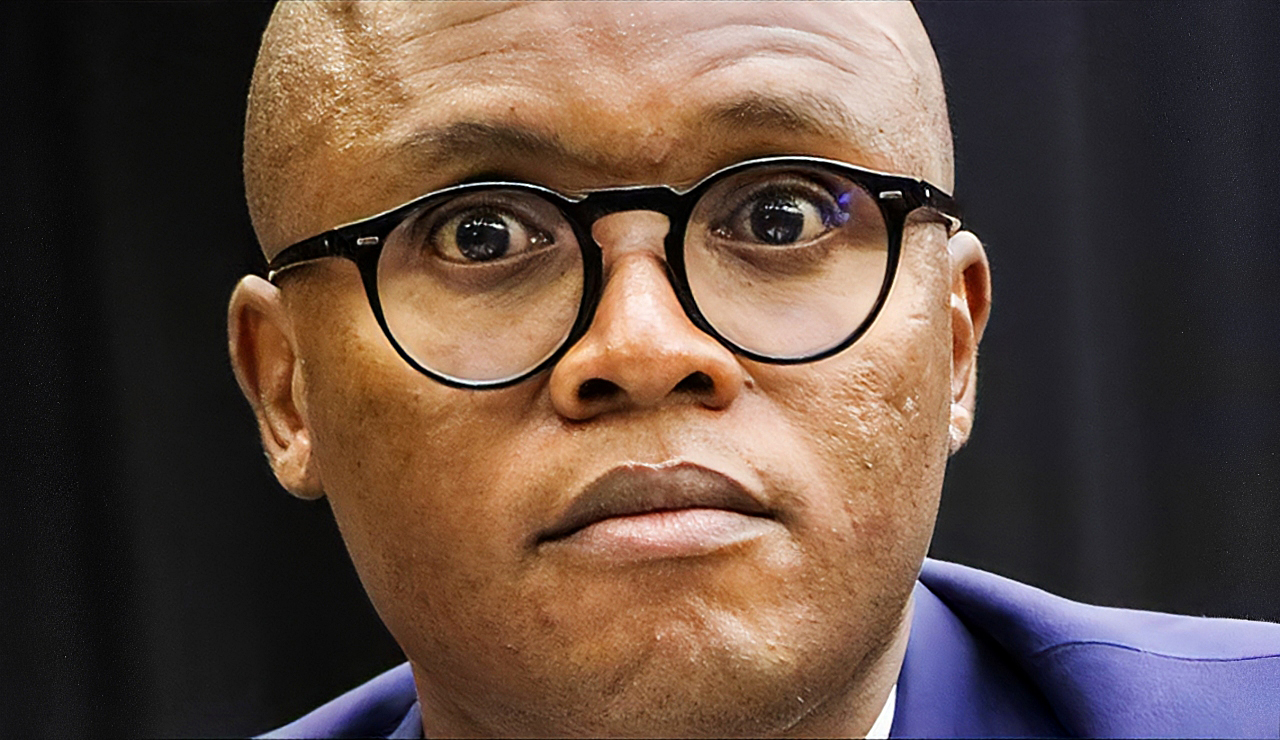
 Solly Malatsi (Minister of Communications and Digital Technologies of South Africa) at the launch for the Roadmap on the Digital Transformation of the South African Government at Gallagher Convention Centre on May 12, 2025 in Midrand. (Photo: Gallo Images / OJ Koloti)
 /file/dailymaverick/wp-content/uploads/2025/10/label-analysis-2.jpg)
There’s a statistic that you will read a lot as the fallout from Communications Minister Solly Malatsi’s latest directive to skirt Black Economic Empowerment (BEE) ownership policy for Starlink continues: 73% of ANC voters don’t support BEE policy, according to the Institute of Race Relations’ latest survey.
To call the study flawed would be an understatement, but it is another step on the path to undermining South Africa’s equity aspirations — and it happened just before this latest bending to Elon Musk’s will.
Read more: Malatsi issues directive to bypass Icasa BEE deadlock and clear Starlink for landing
The fact that the PR agency that invited me to SpaceX regional head Ryan Goodknight’s fireside at Africa Tech Festival sent me the policy directive an hour before the Department of Communication and Digital Technologies’ official WhatsApp speaks to the game that is afoot.
Not standing down
The Presidency has certainly noticed the pressure. Presidential spokesperson Vincent Magwenya didn’t hold back in a statement on the weekend, accusing Musk of “deliberate dishonesty” regarding the regulatory landscape. “He thinks he can bully us into submission... We will not be bullied!”
There’s an information war raging, and it’s time to set the record straight.
Let’s start with that 73% figure, because it is the foundational lie upon which this new policy house is being built. The Institute of Race Relations’ (IRR) head of strategic communications, Hermann Pretorius, told Daily Maverick that its sample of 807 people is “global best practice.” But dig into the methodology, and there are cracks.
Stellenbosch University political scientist and survey methodology expert Professor Collette Schulz-Herzenberg pointed out a critical failure after Daily Maverick explained the methodology of the poll: the survey only polled registered voters.
That immediately excludes the roughly 30% of the eligible voting-age population who aren’t on the voters roll, a demographic that is overwhelmingly young, black and economically marginalised. If the output statistics are being used to comment on national policy, it’s a poor reflection of the nation.
While 18-to-29-year-olds make up about 28% of the voting-age population, they constituted a mere 3.4% of the IRR’s sample. Schulz-Herzenberg explained that it’s difficult to claim full representation in light of that.
Barely passing the language test
Then there is the neutrality of the questions. Respondents were asked to choose between “value for money” procurement or buying from black-owned companies, “even if it means paying more and getting less value”.
“If you are asking respondents to take a position on these really important, critical policy decisions, but if you then prime them with heavily laden political questions, you cannot expect them to give you that,” said Schulz-Herzenberg, making a point about unsound polling. It frames redress as inherently corrupt and expensive, forcing a false dichotomy that no rational person would choose.
Pretorius himself leaned heavily into this framing recently, saying, “The ANC would rather have a few cadres and cronies be further enriched through sweetheart BEE deals than tens of thousands of rural kids be empowered.”
It is an ideological trap designed to manufacture the very consent Malatsi needs to justify his next move, although the link between the DA-aligned data source and the DA-member minister’s policymaking is pure correlation.
/file/dailymaverick/wp-content/uploads/2025/10/IMG1.jpg "The minister of digital communications and technologies, Solly Malatsi. (Photo: Supplied / RTC Studios)")
Clever words
Malatsi’s directive instructs SA’s communications authority, Icasa, to align its regulations with the BBBEE Act, specifically to allow for equity equivalent investment programmes.
In plain English? It allows multinationals like Starlink to bypass the requirement to sell 30% of their business to black South Africans. Instead, they can “pay” for their licence through skills development or infrastructure investment — things a tech giant would probably do anyway as part of customer acquisition.
Malatsi argues this is about “regulatory parity” and investment. He claims that forcing ownership scares away capital. But this view, championed by the IRR’s “Blueprint for Growth”, frames black ownership as a barrier to entry rather than a non-negotiable sovereign imperative.
This is where conflict with the Constitution becomes visible. By treating spectrum — a finite national resource — as just another commodity to be traded for internet penetration, the country is surrendering digital sovereignty. The ANC and the parliamentary committee chair, Khusela Sangoni Diko, have correctly identified this as an “affront to the centuries-old fight for equity”.
No saviour necessary
Diko also dismantled the saviour narrative regarding Starlink’s promise to connect rural schools. “Starlink has made public pronouncements ... that they would connect 5,000 schools,” she explained.
“This doesn’t move the needle an inch when compared to the more than 22,000 schools our mobile network operators, who already comply with our transformative laws, have committed to and are busy delivering on.”
Even voices outside the ruling party are sounding the alarm. Rise Mzansi leader Songezo Zibi warned of the broader security implications of handing critical infrastructure to a volatile foreign actor.
“Elon Musk is a huge security risk (even for the US) in the broadest sense of the word,” said Zibi, citing Musk’s history of threatening to cut Starlink access for the Ukrainian military. “We can't have that Starlink thing here.”
/file/dailymaverick/wp-content/uploads/2025/10/2024-05-14T145806Z_1918884265_RC2CQ7AAVVON_RTRMADP_3_SAFRICA-ELECTION-PARTY.jpg "Rise Mzansi leader Songezo Zibi. (Photo: James Oatway / Reuters)")
At the heart of the matter
Ownership ensures that economic value remains anchored in South Africa; “equity equivalents” are often little more than corporate social responsibility line items that can be switched off when the wind changes — or when a billionaire changes his mood.
The core of the debate is whether the country is being asked to trade sovereign equity principles for bandwidth.
Detractors argue that the narrative supported by Malatsi and the IRR uses disputed data to frame transformation as an obstacle to progress, implying that regulatory concessions are the only way to secure Starlink’s entry.
This establishes a potentially contentious precedent. If ownership requirements are waived for satellite internet, concerns remain that this could serve as a test case for dismantling the economic redress framework across the wider economy. DM